
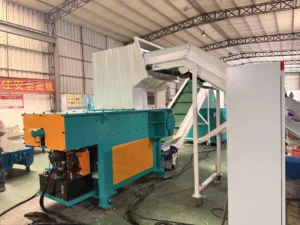
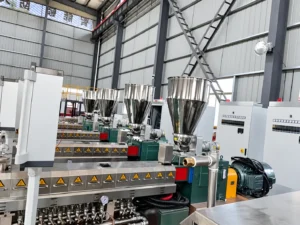
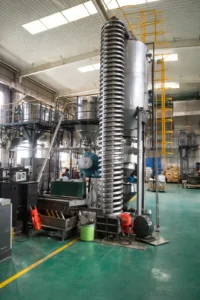

Equipment
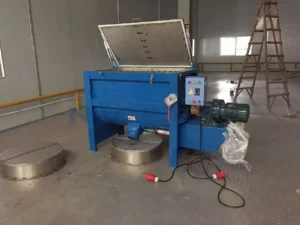
Ribbon Blender
Horizontal ribbon blender with counter-flow double helical ribbons for convective batch blending of polymer pellets, powders, regrind, and masterbatch without frictional heat build-up.
Materials & Processing
CPEA Approved Article (China Plastics Equipment Alliance)
A batch that passes at the mixer can still reach the extruder uneven. Particle differences, the silo's flow pattern and the route after blending are what I check before extending mixing time.
I know how frustrating it is to approve a blended batch and then meet uneven color or unstable extrusion. The place I start is rarely the mixer setting; it is what happens to the material after mixing.
The symptom I chase is segregation after blending: particles separating during transfer, silo filling or discharge. Differences in particle size, shape and density drive that separation. Before I decide that the mixer needs more time, I check the handling route, the silo’s flow pattern and outlet samples.
Nicety Machinery Co., Ltd. builds auxiliary machinery and integrated systems for plastic compounding, pelletizing and engineering plastics processing. Our view is a factory owner’s view: stable output, fewer rejected batches, and a clear reason for every equipment investment.
My starting question is simple: does the material stay uniform until the point where production needs it?
I keep two tasks apart. The mixer has to create a uniform batch; the equipment after the mixer has to preserve that uniformity. You can meet the first requirement and still fail the second.
I would hesitate to extend every mixing cycle when a good blend keeps separating downstream. Understand how the particles move first.
Segregation is the separation of different particle groups within a blend: fine particles passing between larger ones, coarse particles rolling across a pile, fine powder moving differently in air. Heavier particles do not automatically settle at the bottom.
Jenike & Johanson’s explanation of segregation mechanisms is a sound technical starting point. It names particle differences and handling conditions as the key factors.
For a plastics plant, those principles become specific material checks.
| Material combination | Difference to investigate | Question to ask |
|---|---|---|
| Pellets mixed with fines | Particle size | Can fines move through gaps between pellets? |
| Regular pellets mixed with regrind | Size and shape | Do flakes and pellets follow different paths? |
| Resin pellets mixed with masterbatch | Size, shape, and particle density | Does the masterbatch remain evenly distributed? |
| Pellets mixed with powder additives | Size and response to airflow | Does powder remain with the pellets during transfer? |
I pay particular attention to pile formation. During filling, small particles can pass through the spaces between larger ones, and larger particles can roll toward the outside of the pile. Jenike & Johanson describes these behaviours in its sifting segregation guidance.
Air-related separation I treat as a separate mechanism. Fine powder may stay suspended longer than coarse material, and very fine material can travel with air toward walls or collection points.
Particle density and bulk density are different measurements. Particle density concerns the material within a particle; bulk density also includes the empty spaces between particles.
So I do not predict discharge order from a bulk-density sheet alone. What matters is the actual blend, its particle-size range and the filling method.
I also avoid blaming storage time by itself. When a plant reports separation after an overnight hold, I check filling history, vibration, moisture change and restart conditions — not an assumption that a stationary pile keeps separating simply because time passes.
I have watched production time disappear while the mixer settings were blamed and the silo was releasing different parts of the batch in an uneven order.
Check whether the silo discharges through a central channel or moves material across the whole vessel. Funnel flow can expose differences that already exist between regions. Mass flow reduces some segregation effects, but it is not a guarantee that separate layers become fully mixed.
What I care about is how the silo empties, not how many tonnes it holds.
In funnel flow, material moves through a channel while some surrounding material remains still. In mass flow, all material moves whenever material is discharged. Jenike & Johanson’s flow-pattern explanation distinguishes the two.
The practical concern is the order in which different regions reach the outlet.
| Flow behavior to investigate | Production question to ask |
|---|---|
| Material near the walls remains behind | Could older or compositionally different material discharge later? |
| Quality changes near the end of emptying | Does the final discharge contain a different particle fraction? |
| Performance changes with silo level | Does the flow pattern change as the vessel empties? |
| New material enters during discharge | Can the production lot reaching the outlet still be traced? |
I would not diagnose the flow pattern from the outside shape alone. A steep cone may look suitable and still perform poorly with a particular material.
The principle I follow is that storage and feeding equipment should be designed as one system.
Material flow tests should guide wall slope, surface finish and outlet dimensions, and the feeder should withdraw material across the intended outlet area.
I would not prescribe one cone angle for PP pellets, irregular regrind and fine mineral powder alike.
I also keep preservation and mixing apart as duties. Loading one grade above another may preserve those layers in orderly discharge; combining them needs a dedicated blending arrangement. A reliable storage silo and a homogenizing silo serve different purposes.
Batch averages matter to me, but customer trust is earned through consistent production. A good average can hide material that changes during the shift.
Homogenization reduces variation in the material supplied to the next process. In recycling it may mean combining approved incoming lots; in compounding, consistent ingredient distribution or finished-pellet blending. Mixing does not repair contamination, degradation or an incorrect formulation.
I first ask where the mixer sits in the production line.
| Process position to assess | Mixing duty to define | Limit to keep in mind |
|---|---|---|
| Before recycling extrusion | Distribute approved feedstock lots more evenly | Mixing does not remove unwanted polymers or contamination |
| Before compounding extrusion | Distribute ingredients within an approved premix | Dry mixing does not replace melt dispersion |
| After pelletizing | Blend approved finished-pellet lots | Mixing does not change the composition inside each pellet |
| Before packing | Keep the supplied lot consistent across bags | A passing composite sample may hide bag-to-bag differences |
For recycled material, I want an agreed incoming-material window before blending begins. I would not use a large mixer to hide an uncontrolled feedstock problem.
For compounding, I separate ingredient distribution from ingredient dispersion. Masterbatch pellets can be distributed evenly in a dry blend, while the extrusion process still has to melt and disperse their contents properly.
When I assess finished compound, one distinction matters.
If filler or pigment has already been incorporated into intact pellets, ordinary silo handling does not sift that ingredient out of each pellet. The useful question is whether different pellet populations, loose fines or poorly incorporated material are present.
Nor do I expect blending recycled lots to produce an exact melt-flow result through simple arithmetic. The final blend is verified by testing.
From an owner’s perspective, the aim I work to is a controlled input to production: an operator working from a stable material supply instead of repeatedly adjusting the process to follow a changing feed.
I would not approve a replacement mixer on the evidence of one uneven bag. What I need is evidence of where the variation first appears.
Compare samples across mixer discharge, downstream transfer, silo discharge and the final use point. Keep individual samples and record their sequence. The first location where variation increases is the finding — provided the sampling method itself is not distorting the result.
Jenike & Johanson’s discussion of uniformity and sampling makes the point plainly: acceptable variation has to be defined before a process can be judged.
The measurement I choose depends on the material.
| Concern to investigate | Measurement to consider | Limitation to account for |
|---|---|---|
| Masterbatch distribution | Validated component separation or a suitable composition test | Pellet counts do not equal mass percentages when pellet weights differ |
| Fines distribution | Sieve analysis by mass | Size separation does not identify chemical composition |
| Mineral filler variation | A suitable, validated ash-content method | Other inorganic ingredients can affect the result |
| Finished-product color | Color measurement on consistently prepared specimens | Processing conditions can also change color |
| Recycled-resin consistency | Relevant material and processing tests | A change does not prove segregation by itself |
I prefer samples that represent the flowing material across its stream. A scoop from an accessible surface is not proof of the whole batch.
I also keep sample size and test method constant. When the test method varies more than the process, no sound equipment decision is possible.
For an initial investigation I would build the following plan with the plant’s quality team, adjusting the number and size of samples to the formulation and acceptance limits.
| Sampling point to select | What to compare |
|---|---|
| Mixer discharge | Separate samples across the discharge cycle |
| Transfer-system outlet | Samples across several conveying cycles |
| Silo discharge | Early, middle, late, and final discharge samples |
| Extruder feed or packing point | Samples matched to production time and upstream records |
I record material lot, batch mass, mixer settings, silo level, hold time, transfer conditions and any refill event.
Individual samples stay separate. A composite sample may be prepared as well, but I do not let it replace the sequence.
Take a hypothetical 1,000 kg batch containing 2% masterbatch. The batch holds 20 kg of masterbatch in total.
For the example I divide the discharge into five equal 200 kg portions.
| Discharge portion | Illustrative masterbatch content | Masterbatch mass |
|---|---|---|
| First | 1.6% | 3.2 kg |
| Second | 1.8% | 3.6 kg |
| Third | 2.0% | 4.0 kg |
| Fourth | 2.2% | 4.4 kg |
| Fifth | 2.4% | 4.8 kg |
| Whole batch | 2.0% | 20.0 kg |
These numbers explain the principle; they are not measured factory data.
The whole-batch average meets the recipe, yet the first and last portions differ from the target by 20% in relative terms.
I would investigate that trend even when the combined sample passes. I would also avoid assuming it occurs in every silo: the actual discharge pattern has to be measured.
I can buy more motor power and still miss the real problem. The mixing method follows the material and the required result.
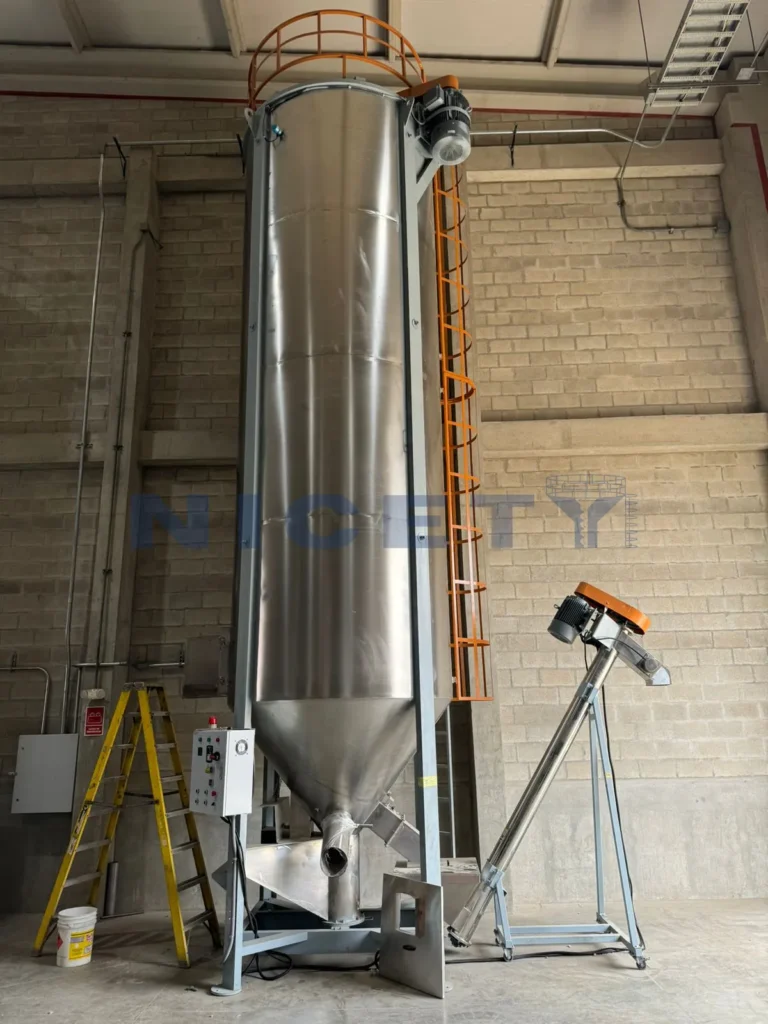
Vertical silo mixers suit suitable pellet blending duties; horizontal ribbon blenders suit suitable powder or powder-rich blends; purpose-built silo blending systems cover other bulk duties. Each choice is confirmed through material trials, working-volume limits, discharge tests and the handling steps that follow.
At Nicety, I frame equipment selection around the full application.
| Equipment to consider | Duty to evaluate | Evidence required |
|---|---|---|
| Vertical screw silo mixer | Homogenizing suitable free-flowing plastic pellets | Whole-batch circulation and consistent discharge |
| Horizontal ribbon blender | Blending suitable powders and powder-rich formulations | Distribution at the required addition level |
| Purpose-built silo blender | Homogenizing approved bulk material lots | Effective withdrawal or circulation from different regions |
| Gentle circulation system | Handling materials where damage is a concern | Uniformity without unacceptable fines or particle damage |
I do not apply these categories as universal rules. Some powders need a different mixer design, and some regrind blends flow poorly in equipment that handles regular pellets well.
I also keep storage capacity and working capacity separate. The required volume comes from the actual bulk density, then the permitted fill range is checked.
A machine sold with a tonne rating for one material may hold a different mass of another.
I would test several mixing durations and compare the resulting discharge samples, monitoring fines, temperature and visible material damage at the same time.
Where extra time brings no useful improvement, I look at loading order, circulation coverage and the downstream route.
I would not promise the same mixing time for every resin, batch size and recipe.
Silo homogenization does not always require a mechanical screw. Coperion’s silo-blender range illustrates different designs for pellets, regrind and powders.
My selection principle is straightforward: evidence for the proposed machine with the proposed material. Another supplier’s circulation count or performance statement is not a guarantee for a Nicety system.
I do not want to pay for mixing twice because the transfer route keeps undoing the work. So every step after blending gets reviewed.
Reduce unnecessary handling, investigate particle damage, and check filling and withdrawal conditions. For sensitive formulations, separate ingredient feeding near the extruder is worth considering. Each change is validated at the use point, because a uniform mixer sample alone does not prove a stable production feed.
My first review covers practical changes.
| Change to evaluate | Result to verify |
|---|---|
| Removing unnecessary intermediate transfers | Less opportunity for separation or material loss |
| Reviewing the inlet and drop arrangement | More controlled filling |
| Checking conveying settings and pipe condition | Less particle damage and fewer new fines |
| Reviewing silo withdrawal | More consistent outlet composition |
| Controlling refill and batch-change sequences | Better traceability and fewer unexplained transitions |
I do not assume an inlet distributor solves segregation by itself. Whether its spreading action helps the actual blend has to be tested.
Separation and loss are also different. When a filter captures part of an intended powder ingredient, the batch composition has changed — recirculating the remaining material cannot restore an ingredient that has left the system.
I take conveying damage seriously. Coperion describes fines and streamer formation during pneumatic conveying of polyolefin pellets. So I compare material before and after transfer whenever the conveying system is suspected of creating a new problem.
I also ask whether a sensitive ingredient should remain in a large premix throughout the handling route.
A loss-in-weight feeder controls material mass flow. My engineering conclusion: one feeder carrying a segregated premix can regulate total kilograms per hour without correcting the ingredient ratio inside that stream.
For some formulations, I would evaluate separate ingredient feeders close to the extruder, then validate feeder sizing, refill behaviour and the required addition rate.
I would not assume separate feeding is always the better investment. It is compared with a proven premixing and handling arrangement.
I want a production result I can verify. A large vessel and a running motor say nothing about whether the investment protects product quality.
Define acceptance around outlet uniformity, throughput, usable batch size, material damage and cleanout. Test the actual material through the intended route, including low-level discharge and normal refills. Agree the sampling method and limits before the equipment trial begins.
I would build the acceptance plan around the conditions that matter to production.
| Requirement to define | Evidence to request |
|---|---|
| Ingredient or lot uniformity | Individual results across the discharge sequence |
| Production capacity | Verified throughput with the actual material |
| Working range | Trials at the intended minimum and maximum batch sizes |
| Particle condition | Comparison of fines or damage before and after handling |
| Batch changes | Demonstrated cleanout and an agreed carryover limit |
| Operating cost | Measured energy for a clearly defined operating cycle |
I would not accept “uniformity above 99%” without a definition. Which component was measured, how samples were collected, and how the result was calculated all matter.
Where I use coefficient of variation, I define it as the standard deviation divided by the mean, multiplied by 100%. I also inspect the individual results and their order: a single statistical value can hide a steady change through discharge.
I do not set one universal acceptance limit for every blend. The limit connects to formulation needs, downstream performance and measurement capability.
From a factory owner’s perspective, I would calculate the cost of rejected material, reprocessing, retesting, lost production time and customer claims.
Those costs are then set against the proposed improvement, without double-counting recovered material as a complete loss.
At Nicety Machinery Co., Ltd. we prefer that discussion to start with the material and process: the formulation, particle forms, batch size, required throughput, silo arrangement and sampling results.
That information supports an assessment of the mixing, conveying, storage and feeding duties together, and I would rather base the final choice on agreed trial results than on an unsupported promise of zero segregation.
I judge blending at the point of use. Suitable mixing, controlled handling, reliable silo discharge and representative sampling together keep production consistent.
Sources
Only sources cleared to publish are listed; an article without a listed source is written from company practice.
Related
The equipment, solutions and projects the article relates to — chosen per article, not generated from keywords.
Equipment
Horizontal ribbon blender with counter-flow double helical ribbons for convective batch blending of polymer pellets, powders, regrind, and masterbatch without frictional heat build-up.
Equipment
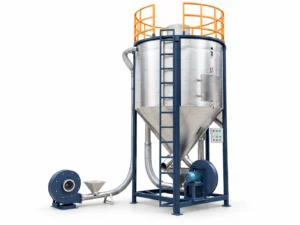
Vertical screw batch mixer for large-capacity blending, batch homogenization, and color mixing of plastic pellets, regrind flakes, and granular masterbatches.
Equipment
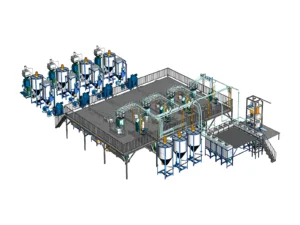
Plant-wide centralized pneumatic conveying and material distribution system for automated, closed-loop resin transfer to multi-station extrusion and molding lines.
Solution
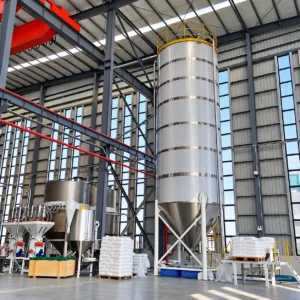
High-capacity batch homogenization and lot blending system for virgin resin, modified compounding pellets, and recycled plastics to eliminate MFI, color, and density batch-to-batch fluctuations.
Application
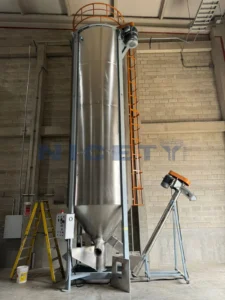
Compounding plant bulk homogenization profile covering pneumatic loading, multi-ton vertical silo blending, and automated FIBC bulk packaging.
Case study
Industrial case study: 15-ton vertical pellet homogenization silo retrofit for an automotive PP compounding plant, reducing batch MFI variation from ±12.7% to ±1.1% (Cpk…
Case study
Industrial case study: sanitary 4,000L horizontal ribbon blender retrofit for a color masterbatch maker — dry cleanout cut from 95 to 18 minutes and…
Tell us the material, the process and what you need to achieve. Technical details can be completed later together with our sales team.