Auxiliary equipment & integrated systems
e-mail [email protected] Language EN ES

Equipment

Underwater Pelletizer

Submerged die-face underwater pelletizing system for high-output, dust-free spherical pellet production of TPU, TPE, hot melts, and engineering plastics.

  • Pelletizing Equipment and Auxiliaries
  • Pelletizing
  • Modified Plastics
  • Multifunctional Masterbatch
  • Resin
  • Rubber
  • Thermoplastic Elastomer
  • TPE
  • TPU
  • Pellets
  • Off-spec pellet size and fines
  • Sticking and agglomeration
Placeholder image: equipment photo, 1200 × 900 px (4:3). It shows the space reserved for approved material and is not a photograph of our equipment.
Placeholder · 1200 × 900 px (4:3)(占位图) Replace with an approved equipment photo at this size.(按此尺寸替换为正式图片。)

Overview

What this machine does

Cuts extruded polymer melt strands directly at the die face submerged under circulating process water into uniform, spherical plastic pellets.

The Underwater Pelletizer (underwater hot-die face pelletizing system) delivers high-efficiency, spherical pellet production for difficult-to-cut thermoplastic polymers, including low-melting-point hot melts, highly elastic rubbers (TPE, TPU, TPV), high-melt-index polyolefins, masterbatches, and engineering plastics (PA, PET, PC). By cutting the extruded polymer melt strands directly at the die plate surface submerged beneath a circulating high-flow process water chamber, the system instantly quenches the cut molten droplets into perfectly uniform, dust-free spherical pellets without strand wrapping or airborne fumes.

Equipped with an electrically or liquid-heated precision die plate, hydraulic quick-clamping cutting chamber, servo/inverter-driven cutting shaft with micro-precision blade advancement, and an integrated tempered water loop (water tank, heat exchanger, and circulation pump), the underwater pelletizer operates continuously without operator intervention. Pellets are immediately swept into the slurry water pipeline and transferred directly to the centrifugal dewatering dryer, eliminating strand dropouts and labor-intensive line re-stringing.

Key features

The parts that do the work

Each picture names one part of the machine and what it does for the material and the batch.

Placeholder image: equipment feature photo, 960 × 720 px (4:3). It shows the space reserved for approved material and is not a photograph of our equipment.

Precision Heated Die Plate with Tungsten Carbide Wear Face

High-precision alloy die plate equipped with vacuum-brazed tungsten carbide cutting surface and thermal insulation layers. Optimized flow distribution channels ensure uniform melt exit velocity across every die hole, preventing hole freeze-off and uneven pellet size.

Placeholder image: equipment feature photo, 960 × 720 px (4:3). It shows the space reserved for approved material and is not a photograph of our equipment.

Hydraulically Clamped Submerged Cutting Chamber

Quick-clamping hydraulic cutting chamber mounted on linear guide rails. Closes tightly against the die plate with high clamping force, ensuring zero process water leakage under high circulation flow.

Placeholder image: equipment feature photo, 960 × 720 px (4:3). It shows the space reserved for approved material and is not a photograph of our equipment.

Dynamic Balanced Cutter Shaft with Axial Micrometer Adjustment

High-speed cutter rotor driven by a variable-speed servo or AC motor with dynamic balance. Features fine axial micrometer adjustment to maintain continuous, uniform contact with the die plate surface, eliminating tailing and fines.

Placeholder image: equipment feature photo, 960 × 720 px (4:3). It shows the space reserved for approved material and is not a photograph of our equipment.

Integrated Closed-Loop Tempered Water System (TWS)

Closed-loop tempered water system (TWS) comprising a stainless steel reservoir, high-flow centrifugal slurry pump, plate heat exchanger, and electric heating elements. Automatically maintains water temperature within ±1.0°C to prevent pellet agglomeration.

Placeholder image: equipment feature photo, 960 × 720 px (4:3). It shows the space reserved for approved material and is not a photograph of our equipment.

One-Touch Automated Start-Up PLC Architecture

Centralized PLC control with intuitive touchscreen HMI. Coordinates water temperature, water flow rate, cutter RPM, melt pressure interlocks, and start-up bypass sequences for one-touch automatic operation.

Material and process

Where it fits — and where it does not

Read the conditions together: a machine is selected for the material and the output, not from its name alone.

Suitable materials and conditions

Engineered for high-value compounding, recycling, and masterbatch lines producing top-tier spherical granules.

Particularly suited for materials that are sticky, soft, low-melt-strength, or prone to strand breakage in conventional water baths, including Thermoplastic Polyurethane (TPU), Thermoplastic Elastomers (TPE, TPV), Ethylene Vinyl Acetate (EVA), Hot Melt Adhesives (HMA), high-flow Polypropylene (PP), Polyamides (PA6, PA66), and masterbatches. Capable of producing standard pellets (2.0–3.2 mm) and micro-pellets (0.8–1.5 mm).

Limitations and when it does not apply

The underwater pelletizing system operates under submerged high-flow water quenching; key operating boundaries include:

  • Extreme temperature differences and freeze-off: High-melting-point engineering resins (e.g. PPS, PEEK) require strict thermal isolation; improper water temperature or inadequate die heating will instantly freeze die holes.
  • Severe foaming and volatile gas release: Entrained gases or excessive moisture in the melt will cause violent cavitation at the die exit underwater, creating hollow, irregular pellets.
  • Die hole clogging from unplasticized contaminants: Unmelted polymer or solid dirt particles will plug individual die holes; fine filtration (< 80 mesh) upstream via continuous screen changers is essential.
  • High initial investment and utility footprint: Higher capital cost, water chiller requirements, and electrical load compared to simple strand pelletizing lines; best suited for products demanding premium spherical appearance or sticky elastomers.

Feed condition and requirements

Accepts continuous, pressurized, thoroughly plasticized and filtered polymer melt delivered directly from the upstream extruder or melt gear pump via a hydraulic screen changer.

Melt entering the pelletizer die plate must exhibit stable pressure (typically 40 to 180 bar) and uniform temperature distribution without unmelted polymer chunks or foreign particulate contaminants that could block die orifices.

Output condition and boundaries

Produces highly uniform, dust-free spherical or lenticular plastic pellets with consistent diameter (typically 2.0–3.2 mm) and smooth, sealed surfaces.

Pellets are instantly swept by process water through the slurry pipe into the centrifugal dewatering dryer and vibrating classifier, yielding dry, ready-to-pack pellets with surface moisture < 0.05%.

Throughput

Capacity range

Read a figure together with the basis below it: the same machine reaches different numbers on different materials.

Basis for the capacity figures

Throughput ratings range from 100 kg/h up to 3,000+ kg/h depending on extruder melt delivery capacity, polymer melt flow index (MFI), die plate hole pattern count (ranging from 12 to 300+ holes), and cutter rotor blade quantity (2 to 16 blades).

Low-viscosity hot melts and high-MFI resins require high cutting speeds and smaller die hole diameters to prevent pellet agglomeration, whereas high-viscosity elastomeric resins (TPE/TPU) require precise water temperature control to prevent die hole freeze-off.

Scope of supply

What is included, and what is not

The quotation states the scope for the confirmed configuration; the groups below describe how a supply is normally split.

Included as standard

  • Precision heated die plate with tungsten carbide cutting surface Optimized flow cavity, electric/oil heating zones, thermocouple ports, and wear-resistant cutting surface.
  • Hydraulically actuated submerged cutting chamber on guide rails Stainless steel water chamber, hydraulic clamping cylinders, viewing window, and quick-disconnect slurry couplings.
  • Variable-speed cutter rotor assembly with micrometer advance Precision balanced cutter shaft, cutter hub, carbide blades, and axial position adjustment mechanism.
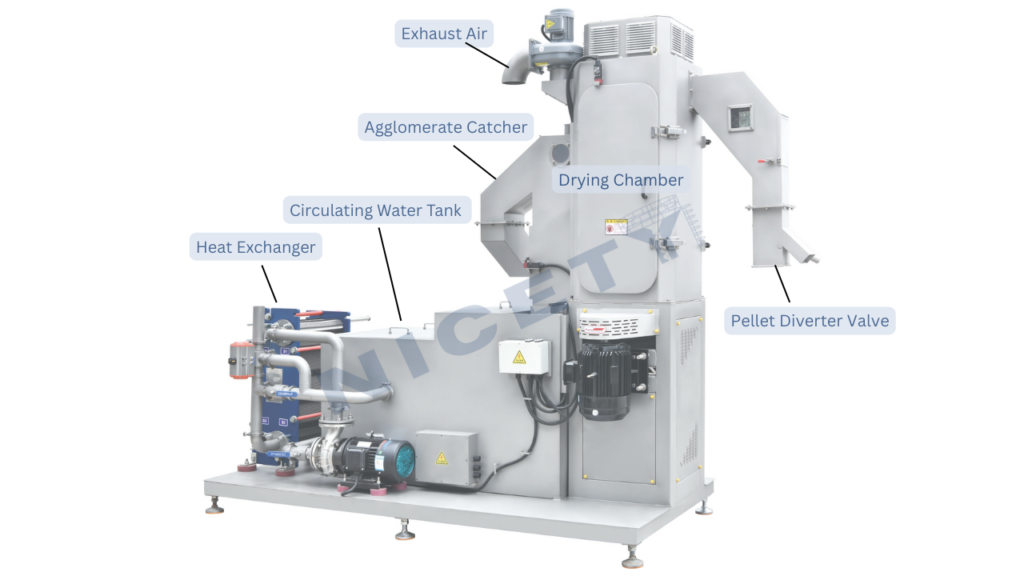
  • Closed-loop tempered water system (TWS) skid Stainless steel water tank, high-flow circulation pump, plate heat exchanger, bypass diverter valve, and electric trim heater.
  • Integrated electrical control cabinet with touchscreen PLC Controls water temperature, water flow, cutter motor speed, hydraulic clamping, and automatic interlocks with the extruder.

Optional items

  • Die plate heating method Choice of high-wattage electric cartridge heaters, liquid thermal oil heating, or high-pressure steam heating tailored to polymer processing temperatures and heat sensitivity.
  • Die plate metallurgy and wear protection Hardened tool steel base with vacuum-brazed tungsten carbide (WC) or titanium carbide (TiC) wear-resistant cutting face tiles to resist extreme abrasive filler wear.
  • Micro-pellet configuration Specialized die plates with micro-hole diameters (0.5 mm to 1.5 mm) paired with high-blade-count cutter rotors for rotational molding and masterbatch micro-pellets.
  • Automated hydraulic blade advancement system Pneumatic or electro-hydraulic blade pressure regulation with automatic knife wear compensation to maintain zero blade-to-die clearance without premature dulling.
  • Integrated bypass water loop with diverter valve Multi-port water diverter valve ensuring full water flow across the cutting face before polymer melt is introduced, preventing initial strand freeze-off.

Not included

  • Civil foundations and shop drainage gutters Concrete floor slabs, anchoring, and wastewater drainage trenches.
  • Primary cooling water chiller and cooling towers Central chillers, external cooling towers, and main distribution piping to the machine skid interface.
  • Main electrical supply cables from substation Cabling from the plant main electrical distribution board to the pelletizer control cabinet.
  • Upstream extruder, melt pump, and screen changer Upstream polymer plasticizing machinery unless quoted together as a full extrusion line.

Installation planning

Utilities, interfaces and site readiness

These are the connections the machine and the line around it have to agree on before the layout is fixed.

Utility requirements

Power supply
380 V / 415 V / 460 V / 220 V (customizable), 50/60 Hz, 3-phase AC.
Water
Chilled or tower cooling water (temperature ≤ 20°C for elastomers, ≤ 30°C for rigid plastics, pressure 0.25–0.40 MPa) connected to plate heat exchanger. Flow rate: 5–25 m³/h depending on output.
Compressed air
0.6–0.7 MPa (6–7 bar), clean, dry, oil-free compressed air for pneumatic diverter valves and chamber clamping. Consumption: approx. 0.1–0.2 m³/min.
Exhaust and ventilation
Not required for submerged cutting; slight steam venting from the tempered water tank overflow vent.
Other notes
Cooling water demand is determined by polymer heat dissipation rate. Die plate heating power scales with die diameter (6 kW to 36+ kW).

Interface requirements

Mechanical: Standard circular flanged connection (DN80 to DN200) bolted to the upstream screen changer or diverter valve; flexible slurry transfer pipe connecting cutting chamber outlet to the centrifugal dewatering dryer inlet.

Electrical & Automation: Three-phase industrial power supply to the electrical control cabinet; dry I/O contacts and industrial fieldbus (Profinet/Ethernet-IP) for interlock coordination with upstream extruder melt pump and downstream dewatering dryer.

What the customer prepares on site

The buyer provides a reinforced level floor foundation, chilled/process cooling water supply up to the tempered water system heat exchanger inlet, dry instrument air lines, and main electrical power drops terminated at the local control cabinet disconnect switch. Buyer also provides drainage trenches for process water dumping during cleaning and recipe changeovers.

Spare parts

Wear parts and recommended spares

The parts that wear in normal service, and the spares worth keeping on site. How often a part is replaced depends on the material and the duty the machine runs, so the basis is confirmed for each machine.

Wear parts

Placeholder image: spare part photo, 960 × 720 px (4:3). It shows the space reserved for approved material and is not a photograph of our equipment.

Tungsten Carbide Faced Underwater Cutting Blades

Inspect blade edge sharpness weekly; hone or replace when cutting edges show chipping, micro-grooving, or uneven wear causing pellet tailing.

Precision ground cutter knives mounted on the rotating cutter hub. Direct wear contact with the die face under high-speed water flow. Keep 3 to 5 full replacement sets in stock; specify blade angle and thickness when ordering.

Placeholder image: spare part photo, 960 × 720 px (4:3). It shows the space reserved for approved material and is not a photograph of our equipment.

Die Plate Heating Elements / Cartridge Heaters

Inspect resistance draw during monthly preventive maintenance; replace defective heaters immediately to prevent localized hole freeze-off.

High-density electric cartridge heaters embedded inside the die plate body to maintain uniform die orifice temperature.

Placeholder image: spare part photo, 960 × 720 px (4:3). It shows the space reserved for approved material and is not a photograph of our equipment.

Cutting Chamber Inflatable / Silicone Perimeter Gaskets

Inspect for cuts, chemical aging, or water weeping; replace during scheduled quarterly maintenance.

High-temperature silicone sealing gaskets sealing the cutting chamber to the die plate body under water pressure.

Placeholder image: spare part photo, 960 × 720 px (4:3). It shows the space reserved for approved material and is not a photograph of our equipment.

Process Slurry Water Circulation Pump Mechanical Seal

Inspect for water weeping at the pump shaft seal; replace seal faces during scheduled maintenance or every 8,000 operating hours.

Heavy-duty mechanical seal for the high-flow slurry water pump circulating water and cut pellets to the dewatering dryer.

Recommended spares

Placeholder image: spare part photo, 960 × 720 px (4:3). It shows the space reserved for approved material and is not a photograph of our equipment.

Cutter Shaft Bearing & Dynamic Mechanical Water Seal

Replace seal assembly and check bearing play during bi-annual maintenance overhaul.

Dynamic sealing assembly isolating the cutter motor drive shaft from high-pressure process water in the cutting chamber.

Blades, screens and other normal consumables are outside the standard warranty. How a spare part is identified and ordered is set out under Warranty & Spare Parts.

Selection

How to choose a model

Work through what you already know. The rest is settled in the conversation, not before the first message.

Select the optimal underwater pelletizing system configuration based on polymer rheology, pellet size, and throughput requirements:

  • Die Plate Configuration & Hole Diameter: Select hole diameter (1.8 mm to 3.2 mm for standard pellets; 0.8 mm to 1.5 mm for micro-pellets) and hole count based on melt density and target kg/h per hole (typically 8–25 kg/h per hole).
  • Water Temperature Control: For sticky elastomers (TPE, TPU, soft EVA), configure high-capacity plate heat exchangers to run cold process water (15–30°C) with anti-stick surfactant dosing; for crystalline polymers (PET, PA), run warm tempered water (50–70°C) to prevent die hole freeze-off.
  • Cutter Speed Regulation: Ensure the cutter drive features wide-range variable speed control (500 to 3,500+ rpm) to modulate pellet length and aspect ratio across changing extruder throughput rates.
  • Metallurgy Specification: Specify solid tungsten carbide wear-faced die plates and TiC coated blades when running abrasive compounds (CaCO3 masterbatch, glass fiber reinforced resins).

Information we need from you

  1. 01 Polymer type and rheological properties Exact resin grades (TPE, TPU, EVA, hot melt adhesive, PP, PET), melt flow index (MFI/MVR), melting point, crystallization temperature, and tackiness at cooling temperatures.
  2. 02 Target production output and pellet size Required hourly throughput (kg/h) and desired finished pellet diameter/geometry (typically 2.0 mm to 3.5 mm spherical beads or micro-pellets < 1.5 mm).
  3. 03 Upstream extruder connection details Extruder make, screw diameter, screen changer flange connection dimensions, and maximum melt pressure and temperature at the die entry.
  4. 04 Factory utilities and cooling headroom Available plant primary chilled water supply (temperature, pressure, flow rate), compressed air pressure, and electrical voltage/frequency.

Request a Quote A model name, a material or a drawing is enough to start.

Next step

Request a Quote

Tell us the material, the process and what you need to achieve. Technical details can be completed later together with our sales team.

Request a Quote
Request a Quote