Auxiliary equipment & integrated systems
e-mail [email protected] Language EN ES

Equipment

Strand Pelletizer System

Turnkey continuous strand pelletizer system integrating cooling water bath, air-knife dewatering, heavy-duty rotary pelletizing, and inline classification screening.

  • Pelletizing Equipment and Auxiliaries
  • Size Reduction Equipment
  • Pelletizing
  • ABS
  • HDPE
  • Modified Plastics
  • Multifunctional Masterbatch
  • PE(Polyethylene)
  • PET
  • PP(Polypropylene)
  • PS
  • Recycled plastics
  • Resin
  • Pellets
  • High surface moisture on the material
  • Line output limited by auxiliaries
  • Off-spec pellet size and fines
Placeholder image: equipment photo, 1200 × 900 px (4:3). It shows the space reserved for approved material and is not a photograph of our equipment.
Placeholder · 1200 × 900 px (4:3)(占位图) Replace with an approved equipment photo at this size.(按此尺寸替换为正式图片。)

Overview

What this machine does

Integrates strand water cooling, high-velocity air-knife dewatering, heavy-duty rotary scissor cutting (including Gantry Pelletizer configurations), and inline classification screening into a continuous turnkey pelletizing line.

The Strand Pelletizer System is an integrated, continuous production line engineered for industrial polymer strand cooling, dewatering, precision cutting, and size-classification across engineering plastics compounding, glass-fiber reinforced polymers, color masterbatch manufacturing, and polymer recycling facilities. Rather than operating as an isolated cutting tool, the complete system harmonizes four synchronized process sections: a stainless steel cooling water bath with submerged strand guides, a high-velocity air knife strand drying unit, a heavy-duty rotary strand pelletizer (supporting heavy-duty Gantry Pelletizer configurations for wide working widths and high strand counts), and a downstream linear vibrating screen classifier.

In high-capacity compounding operations, post-die strand handling is the primary bottleneck dictating final pellet quality and overall line uptime. Inadequate cooling creates soft polymer cores that deform under feed nip pressure, causing angled cuts and continuous stringers; excessive cooling induces strand embrittlement and blade-chipping fines; residual surface moisture causes pellet agglomeration and mold vent jamming downstream; and unclassified oversize clumps or dust fines trigger customer rejections. The Strand Pelletizer System resolves these challenges through closed-loop process integration: hot continuous strands extruded from the die head are uniformly cooled in temperature-controlled water troughs, stripped of surface moisture by counter-current air wipe blowers, positively drawn and sheared into clean cylindrical granules by precision helical cutting rotors, and immediately classified by multi-deck vibrating screens to scalp out doublets and separate fines, delivering 100% qualified, calibrated pellets ready for immediate automated packing.

Key features

The parts that do the work

Each picture names one part of the machine and what it does for the material and the batch.

Placeholder image: equipment feature photo, 960 × 720 px (4:3). It shows the space reserved for approved material and is not a photograph of our equipment.

Stainless Steel Cooling Water Bath with Submerged Guides

Heavy-gauge SUS304 stainless steel cooling trough with height-adjustable submerged guide rollers and water overflow weirs, ensuring uniform strand quenching without thermal deformation.

Placeholder image: equipment feature photo, 960 × 720 px (4:3). It shows the space reserved for approved material and is not a photograph of our equipment.

High-Velocity Dual Air-Knife Strand Dewatering Unit

High-velocity dual top and bottom air knives powered by a dedicated high-pressure blower, stripping surface moisture droplets completely to prevent roller slippage and wet pellets.

Placeholder image: equipment feature photo, 960 × 720 px (4:3). It shows the space reserved for approved material and is not a photograph of our equipment.

Precision Helical Strand Pelletizer (Conventional / Gantry)

High-precision helical cutter cylinder dynamically balanced to ISO G1.0, paired with reversible solid tungsten carbide bed knife for clean, perpendicular scissor cutting. Supports heavy-duty Gantry Pelletizer units for wide working widths.

Placeholder image: equipment feature photo, 960 × 720 px (4:3). It shows the space reserved for approved material and is not a photograph of our equipment.

Pneumatic Dual-Tension Traction Infeed Assembly

Pneumatic cylinder loaded upper polyurethane/rubber traction roller coupled with a precision-ground lower alloy steel roller, delivering constant, non-slip pulling tension across varying strand counts.

Placeholder image: equipment feature photo, 960 × 720 px (4:3). It shows the space reserved for approved material and is not a photograph of our equipment.

Inline Multi-Deck Vibrating Classifier Screen

High-efficiency double-deck linear vibrating screen scalps out long stringers and doublets while dedusting fine chips and cutting dust, ensuring 100% on-spec finished granules.

Placeholder image: equipment feature photo, 960 × 720 px (4:3). It shows the space reserved for approved material and is not a photograph of our equipment.

Integrated Line Synchronization & Safety Control

Unified central control station coordinating line traction speed synchronization, water bath circulation, cutter RPM, and screener operation with integrated safety emergency stop interlocks.

Material and process

Where it fits — and where it does not

Read the conditions together: a machine is selected for the material and the output, not from its name alone.

Suitable materials and conditions

The universal industrial standard for continuous strand pelletizing in engineering plastics compounding, glass fiber reinforcement, color & additive masterbatch manufacturing, and polymer recycling lines.

Universally suitable for Polyamides (PA6, PA66), Polycarbonate (PC), Polybutylene Terephthalate (PBT), Polyethylene Terephthalate (PET), ABS, SAN, Polystyrene (PS), POM, Polypropylene (PP), and high-density Polyethylene (HDPE). Exceptional performance on high-rigidity formulations, glass fiber compounds (up to 50% GF), carbon fiber composites, and mineral-filled engineering alloys.

Limitations and when it does not apply

The Strand Pelletizer System relies on continuous water quenching, strand pulling tension, and rotary scissor cutting; key operating boundaries include:

  • Low-melt-strength and ultra-soft polymers: Not suitable for very soft elastomers (soft TPU, TPE, EVA < 65 Shore A) that lack tensile strand stiffness and tend to stretch or wrap around infeed rolls; underwater pelletizers (UWP) are mandatory for these formulations.
  • Manual line startup: Extrusion startup requires experienced operators to manually pull strands across the water bath and thread them through the air knife into the infeed nip.
  • Strand break sensitivity: Upstream strand breakage requires manual re-stringing into the feed guide comb; not fully self-threading like die-face water ring or underwater systems.
  • Floor footprint requirement: Requires an inline straight-line workshop length of 8 to 18 meters from extruder die face to classifier discharge.

Feed condition and requirements

Accepts continuous parallel polymer melt strands extruded directly from the upstream twin-screw or single-screw extruder die head.

Compatible with standard strand diameters between 2.0 mm and 4.0 mm across engineering polymers, masterbatch, and recycling compounds. Strands enter the water bath at melt temperatures typically between 180°C and 290°C.

Output condition and boundaries

Delivers high-precision, dust-free cylindrical polymer pellets with flat, perpendicular cut faces, uniform length-to-diameter aspect ratio, and residual surface moisture ≤ 0.05% (500 ppm).

Finished on-spec pellets discharge continuously from the vibrating classifier middle chute directly into pneumatic conveying lines, storage silos, or automated packaging bagging stations. Oversize doublets and fines are isolated into separate collection containers.

Throughput

Capacity range

Read a figure together with the basis below it: the same machine reaches different numbers on different materials.

Basis for the capacity figures

System throughput ranges from 200 kg/h for pilot compounding up to 3,500+ kg/h for continuous petrochemical and high-volume engineering compounding lines, determined by water bath cooling length (3 m to 12 m), air-knife blower CFM, rotary cutter width (100 mm to 800 mm, including heavy-duty Gantry Pelletizer models), and classifier screen deck surface area.

Throughput is governed by polymer crystallization kinetics and strand thermal conductivity in the water bath. Engineering plastics (e.g., PA66, PBT, PET) achieve high linear line speeds (60–120 m/min) due to rapid skin solidification, whereas ductile or flexible polymers require longer bath residence time to achieve sufficient cutting rigidity.

Models

Models in this range

The figures are the reference values entered for each model. The model for your line is confirmed against your material and output before it is quoted.
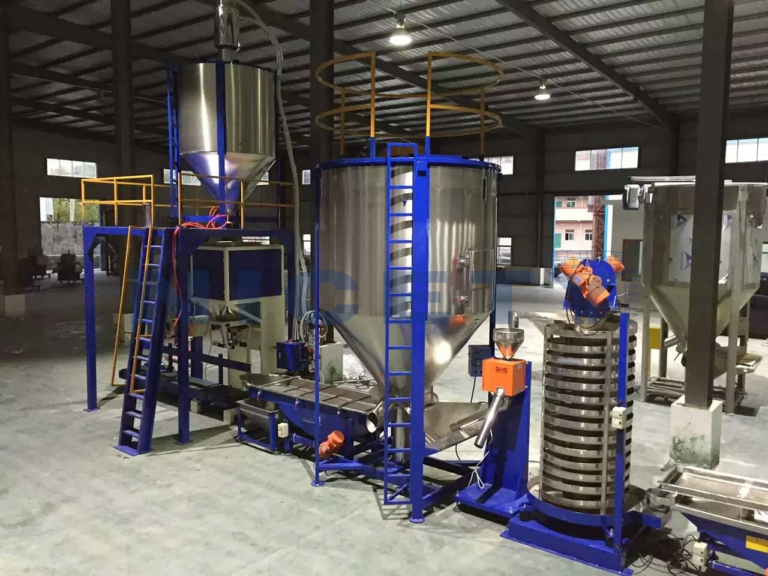
Turnkey downstream compounding auxiliary line delivered for ABS compounding in Thailand, featuring vertical batch mixer, vibrating spiral elevator, vibrating classifier, and bagging station.

Strand Pelletizing Section for an ABS Compounding Line · Thailand

The strand line's cooling, drying and cutting stages — the cooling water bath, the air-knife strand dryer and the rotary strand pelletizer — delivered with the same back-end package as the vibrating screen, the spiral elevator, the vertical mixer and the automatic weighing and packing station.

Scope of supply

What is included, and what is not

The quotation states the scope for the confirmed configuration; the groups below describe how a supply is normally split.

Included as standard

  • Stainless steel strand cooling water bath with adjustable guides Heavy-gauge SUS304 trough, height-adjustable submerged strand guide rollers, water overflow weirs, and drain valve.
  • High-velocity air-knife strand dewatering blower system Adjustable top and bottom air knives, high-pressure centrifugal air blower, and stainless water catchment tray with drain.
  • Precision rotary strand pelletizer (Conventional / Gantry framework) Helical multi-tooth cutter rotor, reversible tungsten carbide bed knife, pneumatic upper feed roller pressure, and variable frequency drive.
  • Linear vibrating classifier screen with dual decks Stainless steel screener with top scalping deck and bottom fines dedusting deck, powered by dual synchronous vibration motors.
  • Centralized electrical control cabinet with variable speed drives Integrated control panel coordinating line speed synchronization, digital RPM display, and emergency stop interlocks.

Optional items

  • Gantry Pelletizer heavy-duty cutter upgrade Dual-column portal gantry cutter unit accommodating working widths up to 800 mm and up to 120 parallel strands for high-capacity compounding lines.
  • Closed-loop water bath temperature control skid Automated thermostatic water circulation skid featuring stainless steel circulating pump, plate heat exchanger, and digital PID temperature regulation (20°C–60°C).
  • Tungsten carbide / Stellite wear-resistant blade metallurgy Solid tungsten carbide (WC) helical cutter rotors and reversible bed knives engineered specifically for abrasive 30%–50%+ glass fiber or ceramic-filled compounds.
  • Independent dual-servo traction drive Direct servo drive for infeed traction rollers allowing stepless digital pellet length adjustment (1.0 mm to 6.0 mm) via touchscreen HMI without changing mechanical gears.
  • Double-deck vibrating classifier Multi-fraction linear screen providing simultaneous oversize agglomerate scalping and fine particle dedusting.
  • Integrated sound-attenuated cutter enclosure Stainless steel acoustic enclosure reducing operating cutting noise levels below 78 dB(A).

Not included

  • Upstream extruder and melt gear pump Single/twin-screw extruder machinery, screen changer, and strand die head belong to the extruder contract.
  • Primary plant chilled water generation system External central water chillers, cooling towers, and primary supply pumps to the water bath skid.
  • Civil engineering, foundation bolts, and drainage gutters Floor leveling, anchor bolt drilling, and plant wastewater drainage trenches.
  • Primary electrical power feeder cables Cabling from the plant distribution substation to the main system control cabinet isolator switch.

Installation planning

Utilities, interfaces and site readiness

These are the connections the machine and the line around it have to agree on before the layout is fixed.

Utility requirements

Power supply
380 V / 415 V / 460 V / 220 V (customizable), 50/60 Hz, 3-phase AC.
Water
Continuous recirculating cooling water for strand water bath (supply temp 15°C–25°C, flow rate 5–20 m³/h depending on output); makeup water consumption < 0.2 m³/h.
Compressed air
0.5–0.7 MPa (5–7 bar), clean, dry compressed air for pneumatic upper feed roll tensioning cylinders and optional classifier cover clamps.
Exhaust and ventilation
Passive dust exhaust duct connection on classifier screen cover; optional dust extraction hood at pelletizer discharge.
Other notes
Total connected system electrical power typically ranges from 15 kW to 75 kW depending on line output, cutter width (100 mm to 800 mm), and blower rating.

Interface requirements

Mechanical: Height-adjustable water bath inlet chute positions directly beneath the extruder strand die head; bottom discharge chute of the vibrating screen connects directly to pneumatic conveying adapters, cooling spirals, or bulk bagger hoppers.

Electrical & Automation: Centralized multi-drive control cabinet powered by 3-phase industrial power; dry I/O interlock signals for extruder emergency stop synchronization and automated hauling speed tracking.

What the customer prepares on site

The buyer provides a reinforced level concrete floor foundation with adjacent wastewater drainage trenches, primary electrical power cabling terminated at the central system control cabinet, secondary industrial chilled/cooling water piping to the water bath heat exchanger, dry instrument compressed air piping, and operator access walkways alongside the cooling trough.

Spare parts

Wear parts and recommended spares

The parts that wear in normal service, and the spares worth keeping on site. How often a part is replaced depends on the material and the duty the machine runs, so the basis is confirmed for each machine.

Wear parts

Placeholder image: spare part photo, 960 × 720 px (4:3). It shows the space reserved for approved material and is not a photograph of our equipment.

Tungsten Carbide / Alloy Helical Cutting Rotor

Inspect knife edge sharpness monthly; resharpen or replace when cutting edges show chipping, dulling, or uneven strand cutting.

The primary multi-blade cutting cylinder. Keep one precision-sharpened spare rotor assembly in reserve to eliminate downtime during resharpening cycles.

Placeholder image: spare part photo, 960 × 720 px (4:3). It shows the space reserved for approved material and is not a photograph of our equipment.

Solid Tungsten Carbide Stationary Bed Knife

Rotate to fresh cutting edge when worn; resharpen or replace when all edges have been utilized.

Stationary counter-blade with multiple precision-ground cutting edges mounted on fine micrometer gap adjustment bolts.

Placeholder image: spare part photo, 960 × 720 px (4:3). It shows the space reserved for approved material and is not a photograph of our equipment.

Polyurethane / Synthetic Rubber Upper Traction Roller Sleeve

Inspect for grooving, abrasion, or cracking every 6 months; recover or replace sleeve when pulling grip degrades.

Resilient elastomer sleeve on the upper feed roller providing non-slip pulling tension on plastic strands without crushing.

Placeholder image: spare part photo, 960 × 720 px (4:3). It shows the space reserved for approved material and is not a photograph of our equipment.

Vibrating Screen Mesh & Punch Plate Decks

Lubricate regularly; replace every 10,000–15,000 operating hours or upon bearing temperature rise / vibration.

Top-deck perforated scalping plate and bottom-deck SUS304 woven wire dedusting mesh for the linear classifier.

Recommended spares

Placeholder image: spare part photo, 960 × 720 px (4:3). It shows the space reserved for approved material and is not a photograph of our equipment.

High-Precision Heavy-Duty Rotor Spindle Bearings

Precision spherical or cylindrical roller bearings supporting the dynamic cutter shaft and vibration motor bearings.

Blades, screens and other normal consumables are outside the standard warranty. How a spare part is identified and ordered is set out under Warranty & Spare Parts.

Selection

How to choose a model

Work through what you already know. The rest is settled in the conversation, not before the first message.

Select the optimal Strand Pelletizer System configuration based on polymer characteristics, line throughput, and plant automation level:

  • Capacity & Pelletizer Model Matching: For production rates up to 800 kg/h (up to 25 strands), specify standard cantilever strand cutters with 100–200 mm width; for high-output lines (800 to 3,500+ kg/h and 30–120 strands), configure with heavy-duty Gantry Pelletizer portal cutters (300 mm to 800 mm width) to eliminate spindle deflection and ensure blade clearance consistency.
  • Water Bath Length & Thermal Control: Select 3–4 m water troughs for fast-freezing polymers (e.g. PP, PS, masterbatch); select 6–10+ m troughs with plate heat exchanger temperature control for slow-crystallizing or high-temperature engineering plastics (e.g. PBT, PET, PA66) to ensure complete strand core solidification.
  • Tooling Metallurgy: Specify standard tool steel (D2) for unfilled polyolefins and standard compounds; always specify solid tungsten carbide (WC) rotors and bed knives when running glass-fiber reinforced polymers (PA66+GF, PBT+GF) to prevent rapid abrasive dulling.
  • Classifier Screening: Choose single-deck screener for simple lump scalping; choose double-deck screener for formulations with stringent dust limits or high fines generation.

Information we need from you

  1. 01 Polymer formulation, filler type, and loading ratio Base resin (PA, PC, PBT, PET, PP, POM), glass fiber percentage (e.g. 15%–50% GF), mineral filler loading, or flame retardant additives.
  2. 02 Target production capacity and strand count Required hourly finished pellet rate (kg/h), number of die head strand holes, and nominal strand diameter (typically 2.8 mm to 3.5 mm).
  3. 03 Pellet specification and classification limits Target pellet cut length (typically 2.5 mm to 3.2 mm), acceptable oversize doublet ratio, and maximum permissible fines threshold.
  4. 04 Shop floor layout and drain trench availability Available straight-line floor distance between extruder die face and packaging station, floor drain locations for water bath overflow, and ceiling clearance.
  5. 05 Plant electrical, water, and compressed air utilities Available 3-phase electrical supply voltage/frequency, process cooling water supply (temperature, pressure, flow rate), and dry compressed air.

Request a Quote A model name, a material or a drawing is enough to start.

Next step

Request a Quote

Tell us the material, the process and what you need to achieve. Technical details can be completed later together with our sales team.

Request a Quote
Request a Quote