_画板-1的副本-300x300.png)
Application
Large-Batch Pellet Homogenization, Lot Blending, and Bulk Packaging System
Compounding plant bulk homogenization profile covering pneumatic loading, multi-ton vertical silo blending, and automated FIBC bulk packaging.

This industrial application profile outlines the multi-ton bulk pneumatic conveying, cyclic vertical screw blending, and automated load-cell packaging architecture engineered specifically for commercial plastic compounding plants, resin toll compounders, and high-volume masterbatch producers.
Large-scale compounding and toll processing facilities face serious lot consistency audits from automotive, appliance, and electronic converters: during long multi-shift extrusion runs (producing 5 to 50 metric tons per order), minor raw material batch drifts, temperature fluctuations, and screw feeder variances cause noticeable Melt Flow Index (MFI drift of 5%–15%), slight color delta E shifts, and density fluctuations between pallets. Packing pellets directly from the extruder chute leads to customer rejection when injection molders experience sudden part weight shifts, flash, or sink marks. Furthermore, toll compounders handling recycled PCR/PIR lots must homogenize disparate incoming source batches to establish uniform melt properties. This application integrates ground-level bulk charging, automated vacuum/screw conveying, heavy-duty stainless steel vertical silo mixers (5 m³ to 30 m³ working volume), top pulse-jet dust venting, and precision load-cell bulk bag (FIBC) packaging, guaranteeing lot-wide MFI coefficient of variation (CV) ≤ 1.5% and flawless delivery consistency.
The scenario
Who runs it, what it makes, and what it must hold
Who it is for
High-volume commercial compounding plants, resin toll processors, polymer recycling centers, and masterbatch manufacturers producing large uniform production lots.
Typical output
Perfectly homogenized, dust-free compounded plastic pellets packaged in 1,000 kg bulk bags (FIBC) or palletized 25 kg bags, fully certified for automotive injection molding, pipe extrusion, and precision blown-film operations.
Production goal
Equalize melt flow index (MFI), density, and color variations across multi-shift production lots, delivering 100% homogeneous batches with automated, labor-free bulk packaging.
Material
What the line is fed
The properties named here are the ones the equipment questions turn on — they are confirmed per project, from samples where it matters.
Solid thermoplastic polymer pellets, masterbatches, and clean regrind: PP, PE, HDPE, ABS, PS, PC, PA66, and filled compounds. Bulk density 0.45–0.75 kg/L; particle size Ø2.5–4.5 mm; dry and free-flowing.

Process
The typical flow, step by step
The flow is the usual shape of the scenario; the machines for each step are chosen per project — see the solutions below.

-
Bulk Infeed & Automated Pneumatic Loading
Feeding and Material Transfer
Transfers pellets from multiple extruder discharge buffers or bag-dump hoppers into the vertical silo mixer via vacuum or screw conveying.
-
Cyclic Vertical Screw Recirculation & Homogenization
Mixing
Central vertical screw draws pellets from bottom cone, elevating and spraying them 360° across top surface for continuous cyclic turnover.
-
Top-Vent Pulse-Jet Filtration & De-aeration
Feeding and Material Transfer
Integrated top cartridge filter vents displaced air and pulses trapped fines back into the mix, ensuring clean workshop environment.
-
Conical Bottom Discharge & Gravimetric Bulk Packaging
Storage and Packing
Contoured bottom slide gate discharges homogenized pellets directly into an automated load-cell bulk bag packaging station.
Requirements
What the process demands, and what quality is judged on
Critical process requirements
1. Rapid Vertical Recirculation: Central heavy-gauge flighted screw lifts bottom material at high linear velocity, discharging onto a top rotating 360° scattering cone that showers pellets uniformly across the vessel perimeter, achieving 4 to 6 full volume turnovers per cycle.
2. Gentle Anti-Attrition Handling: Screw rotational speed optimized (typically 180–300 RPM) to prevent frictional heating (< 3°C rise) and eliminate pellet skinning, "angel hair", or dust generation.
3. Top Breathing & Pulse-Jet Dust Venting: Flanged top dust extraction port with automatic reverse pulse-jet filter cartridges balances internal pressure during rapid charging and prevents fugitive plant dust emissions.
4. Clean Flush Discharge: Steep bottom cone angle (60°–70°) and pneumatic slide gate ensure rapid, complete discharge with negligible residual dead-stock (< 0.05%).
Quality requirements
Lot MFI Uniformity: Stratified core, top, and bottom sampling across 10-ton batch achieves MFI coefficient of variation (CV) ≤ 1.5%.
Color Delta E*: Spectrophotometric color difference Delta E* < 0.40 between any two bags sampled across the batch.
Weighing Precision: Bulk bag automated filling accuracy within ±0.1% of target weight (±1.0 kg per 1,000 kg bag).
Selection
What decides the equipment in this scenario
These are the questions a quotation is built from — answering them up front shortens the first round.
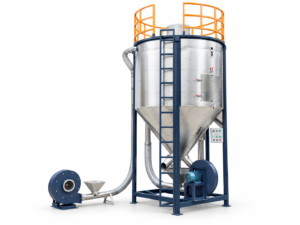
- Heavy-gauge SUS304 vertical silo mixer
- Stainless steel vessel, center lifting pipe, internal heavy flighted screw, and top cone dispersal umbrella.
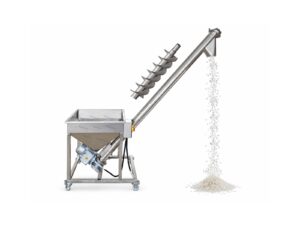
- Low-level dump hopper & screw conveyor loader
- Ergonomic floor-level charging hopper with safety protective grid and inclined stainless screw conveyor.
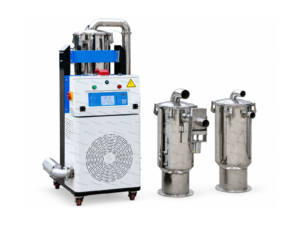
- Pneumatic transfer receiver / vacuum loader
- High-capacity vacuum receiver with rotary valve for automated charging from multiple extruder lines.
- Automated load-cell bulk bag (FIBC) packaging frame
- Four-point load cell weighing frame with pneumatic bag clamping spout and automated cutoff gate.
Fit
Where this scenario fits — and where it does not
The boundaries are part of the scenario: they keep equipment from being quoted into a case it cannot serve.
Best fit when
Best fit for commercial plastic compounding facilities, toll compounders, and high-volume masterbatch producers delivering 5 to 50 metric tons per production campaign, where tier-1 automotive, medical, or appliance customers require strict batch-to-batch MFI, colorimetric, and mechanical property consistency.
Needs assessment when
Requires assessment when homogenizing ultra-fine powders (< 100 mesh) with high cohesiveness or fluidization characteristics, where fluidizing air pads or specialized ribbon/paddle agitators are required in place of vertical lifting screws.
Not suitable when
Not suitable for ultra-low viscosity liquid resins, damp wet slurries, or sticky paste-like materials requiring specialized dynamic shear dispersers.
Variants
How the scenario splits
A variant is written down only where the process and the decision actually differ.
Multi-Shift Virgin Compound Lot Homogenization
- How it differs
Compounded virgin resin pellets (PP, PE, ABS, PC, PA) produced across multiple 8-hour extrusion shifts for tier-1 automotive molders.
- Process difference
Direct pneumatic dilute-phase transfer from multiple extruder surge bins into a single 15–25 m³ central vertical silo mixer for 15-minute cyclic circulation.
- Output difference
Lot-wide MFI coefficient of variation CV ≤ 1.5% and color delta E* < 0.30 across entire 10-to-20-ton shipment.
Post-Consumer Recycled (PCR) Multi-Lot Blending
- How it differs
Recycled post-consumer / post-industrial plastic flakes or regrind pellets (PCR/PIR HDPE, PP, ABS) with divergent source lot densities and melt indices.
- Process difference
Utilizes floor-level dump hopper and heavy-duty inclined screw conveyor for high-speed charging of 1-ton bulk bags.
- Output difference
Standardized composite recycled resin lots with stabilized viscosity, preventing downstream molding injection pressure fluctuations.
Photos
The scenario in practice
Photos go here once real views of this scenario are cleared to publish.
-

Placeholder · 1200 × 900 px (4:3)(占位图) Replace with an approved application photo, real workshop or installation views at this size.(按此尺寸替换为正式图片。) -

Placeholder · 1200 × 900 px (4:3)(占位图) Replace with an approved application photo, real workshop or installation views at this size.(按此尺寸替换为正式图片。)
Before an inquiry
What we need to know to quote this scenario
- 01 Polymer pellet characteristics and bulk density Resin types (PP, PE, ABS, PC, PA, regrind), pellet dimensions, and bulk density (0.45 to 0.75 kg/L).
- 02 Target batch volume and daily lot size Required silo working volume (5 m³, 10 m³, 20 m³, or 30 m³) and daily blending tonnage.
- 03 Factory headroom and floor loading limits Clear vertical height (typically 5.5 m to 9.5 m) and reinforced concrete floor slab load-bearing capacity (min 20–35 kN/m²).
- 04 Packaging requirements and utility connections Weighing format (1,000 kg big bags / 25 kg bags), 380V/415V power, and compressed air supply (0.6 MPa).
Request a Quote Send these points with your inquiry; the scenario can then be quoted against your line, not against an assumption.
Where to go next
The solutions and the equipment this scenario names
Solutions for this scenario
Solution
Continuous Strand Pelletizing, Inline Classification, and Automated Packaging Line
Integrated continuous st…
Equipment for this scenario