
Equipment
Vertical Mixer Machine
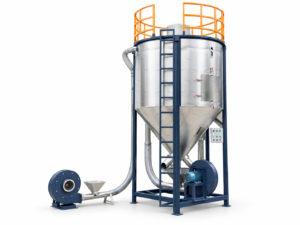
Vertical screw batch mixer for large-capacity blending, batch homogenization, and color mixing of plastic pellets, regrind flakes, and granular masterbatches.
Equipment Selection
CPEA Approved Article (China Plastics Equipment Alliance)
How controlled mixing reduces batch variation in plastic recycling and compounding: vertical silo mixers for bulk PP and HDPE pellets, ribbon blenders for powders and sensitive granules.
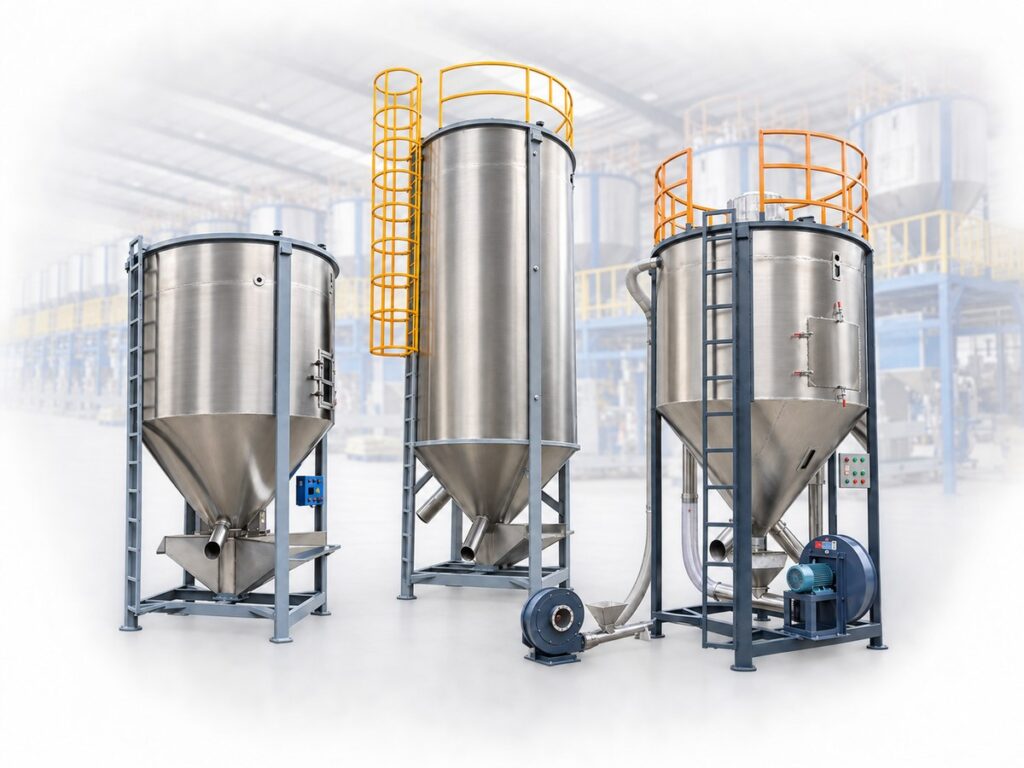
I know how costly unstable material can become. When every batch behaves differently, my production team spends more time adjusting the line and investigating defects.
I use mixers to reduce differences within and between plastic material batches and to distribute measured ingredients before processing. For recycling and compounding pelletizing, controlled blending helps create more consistent feedstock. I select vertical silo mixers for suitable pellets and rigid flakes, and horizontal ribbon blenders for suitable powders and more demanding formulations.
I approach mixer selection from a factory owner’s position: I want predictable production, manageable operating costs, and material that meets the agreed specification.
At Nicety Machinery Co., Ltd., I focus on auxiliary equipment and integrated systems for plastic modification, pelletizing, and engineering plastics processing. I treat material mixing as part of that complete production process.
Before choosing a machine, I ask three questions. What variation am I trying to control? What form does the material take? How will the material reach the next process without losing its uniformity?
Those questions matter more than choosing the largest tank or the lowest purchase price.
I cannot expect steady production when the material entering my extruder changes throughout the shift. Repeated machine adjustments can hide the underlying material problem.
I use homogenization to distribute approved material lots throughout a defined batch. This can reduce local differences in composition and feeding behavior. I still need incoming inspection, controlled blend ratios, and final testing because mixing cannot remove contamination, reverse polymer damage, or make incompatible materials compatible.
When I investigate unstable extrusion, I check the feedstock alongside the machine settings.
I may receive recycled PP or HDPE from different collection streams, suppliers, or production periods. Even when the bags carry the same polymer description, I cannot assume that their composition, melt behavior, color, and contamination levels are identical.
I find useful evidence in research on batch fluctuations in post-consumer HDPE. The researchers examined six consecutive batches and linked material differences with changes in processing and product properties.
I take a practical lesson from this: I need to understand the incoming variation before I decide how to blend it.
| Variation I investigate | What I expect controlled blending to do | What I still need to control separately |
|---|---|---|
| Differences among approved resin lots | Distribute the selected lots more evenly | Incoming specifications and blend proportions |
| Uneven masterbatch distribution | Spread measured masterbatch throughout the batch | Dosing accuracy and melt-stage dispersion |
| Uneven filler or additive distribution | Improve the consistency of the premix | Powder handling, feeding, and compounding conditions |
| Moisture differences | Redistribute material without necessarily removing water | Drying and moisture testing |
| Foreign polymers, metal, or dirt | Potentially spread contamination through a larger batch | Sorting, inspection, separation, and filtration |
| Degraded or unsuitable resin | Blend it with other material without repairing it | Material acceptance and application testing |
I do not treat a large mixed batch as automatically better.
If I blend an unsuitable lot into several acceptable lots, I may create a larger quantity of unsuitable material. I therefore approve the input lots and establish the recipe before loading the mixer.
I also avoid predicting a blended melt flow rate through simple arithmetic. Polymer melt behavior can depend on composition and interactions between materials. I confirm the final blend with the agreed test method.
My goal is repeatability. I want a controlled material supply that my production team can process using a stable operating window.
I can weigh the right ingredients and still feed an uneven mixture. That gap can create changing material composition during an otherwise steady production run.
I use premixing to distribute measured ingredients before extrusion and post-pelletizing blending to homogenize suitable finished pellet lots. I keep these functions separate from melt compounding, where the extruder performs the melting, mixing, and dispersion needed for the final formulation.
I may place a mixer before the pelletizing line when I need to combine approved recycled feedstocks or prepare a formulation.
I may place it after pelletizing when I need to homogenize cooled, suitable finished pellets before packaging. In some plants, I may need both stages.
| Mixing position I consider | My purpose | My main checks |
|---|---|---|
| Before recycling extrusion | Blend approved recycled feedstocks | Polymer identity, contamination, moisture, and flow |
| Before compounding extrusion | Prepare a consistent recipe premix | Ingredient weights, distribution, and segregation |
| After pelletizing and cooling | Homogenize approved finished pellet lots | Pellet temperature, lot compatibility, and final quality |
| Before packing | Deliver a defined blended shipment | Sampling results, bag identification, and traceability |
I may need to blend resin with color masterbatch, UV stabilizers, antioxidants, flame retardants, or other additives.
I first check the physical form of each ingredient. A pelletized additive masterbatch presents a different mixing problem from a fine powder.
I use a suitable dry mixer to distribute those ingredients through the batch. I do not claim that this step fully disperses pigments or breaks down every powder agglomerate.
For many compounds, I still rely on the extruder’s screw design, temperature profile, residence time, and feeding arrangement to develop the required melt quality.
I also consider whether an ingredient should enter through a separate feeder rather than through a common premix. I would not assume that reinforcing fibers, fine powders, and low-dose additives all belong in the same loading sequence.
I find Coperion’s description of premix manufacturing useful because it treats weighing, mixing, conveying, and extruder feeding as connected steps.
My own selection follows that same process logic: I choose a mixer together with the equipment that loads and unloads it.
I do not want to pay for unnecessary mixing complexity when my main task is homogenizing large quantities of suitable PP or HDPE pellets.
I generally recommend Nicety’s vertical screw silo mixers for large batches of free-flowing plastic pellets and suitable clean, dry rigid flakes. I exclude powders and loose film from this standard design, and I do not recommend it for tacky elastomer or rubber materials.
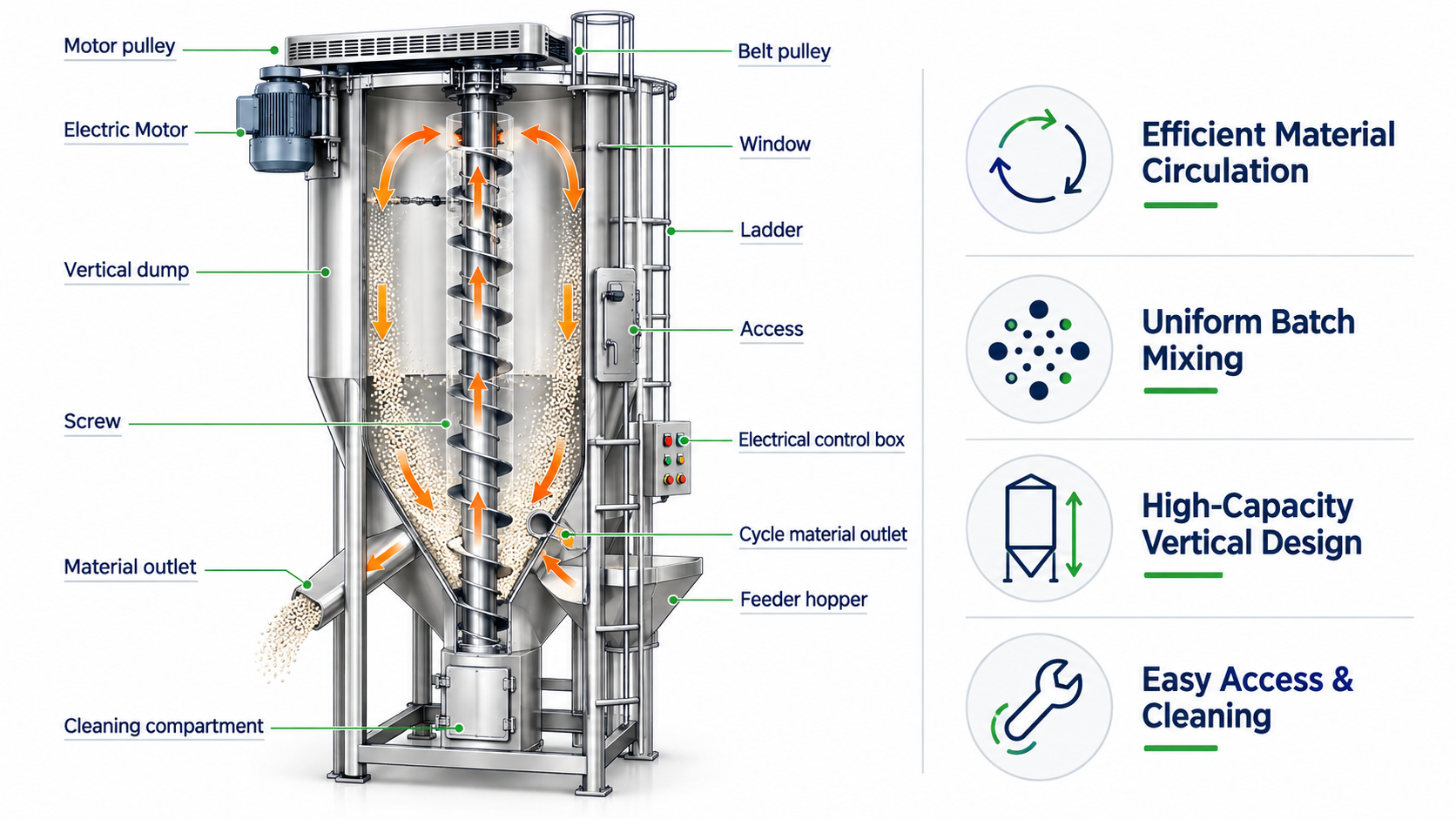
In this article, I use “vertical silo mixer” to describe Nicety’s vertical screw circulation design. I do not use the term to describe every vertical mixing technology.
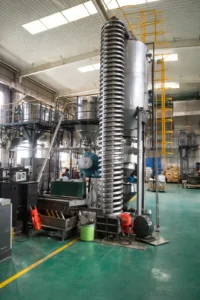
I use the screw to lift material through the central conveying section. I then allow the material to return through the surrounding bulk, creating repeated circulation.
For this process, I need material that can move through the screw and return through the vessel reliably.
| Material or application I review | My usual position on Nicety’s standard vertical screw design |
|---|---|
| Free-flowing recycled PP pellets | A strong candidate for bulk homogenization |
| Free-flowing recycled HDPE pellets | A strong candidate for bulk homogenization |
| Suitable rigid PP or HDPE flakes | A candidate after checking size, dryness, and circulation |
| Other engineering plastic pellets | A candidate after reviewing heat sensitivity, abrasion, and moisture requirements |
| Fine powders or powder-rich formulations | I select another mixing approach |
| Loose plastic film | I do not recommend this design |
| Tacky elastomer or rubber particles | I do not recommend this design |
I do not recommend loose film because it can wrap around moving components, bridge, or circulate poorly.
I also exclude powder handling from our standard vertical pellet-and-flake mixer. Powder applications need their own assessment of mixing action, sealing, dust control, and discharge.
For elastomers and rubber, I pay close attention to friction and heat. The screw movement in our standard design can create local heating. Sensitive or tacky material may soften and adhere to the screw and nearby surfaces.
I regard that buildup as both a production problem and a cleaning problem. A lower purchase price offers little value if operators repeatedly stop the machine to remove sticky residue.
For suitable materials and approved shipping arrangements, Nicety’s larger export vertical silo mixer configurations can reach approximately 15–20 metric tons per batch.
I treat that figure as a configuration range. I confirm the actual working mass against bulk density, usable volume, drive requirements, and transport dimensions.
For large batches of ordinary free-flowing recycled HDPE or PP pellets, I usually find a vertical silo mixer more economical than a horizontal ribbon blender.
I still review building height, loading access, maintenance clearance, and the strength of the installation area before recommending one.
I need a different mixing approach when powders, difficult additives, or sensitive particles make a standard vertical screw mixer unsuitable.
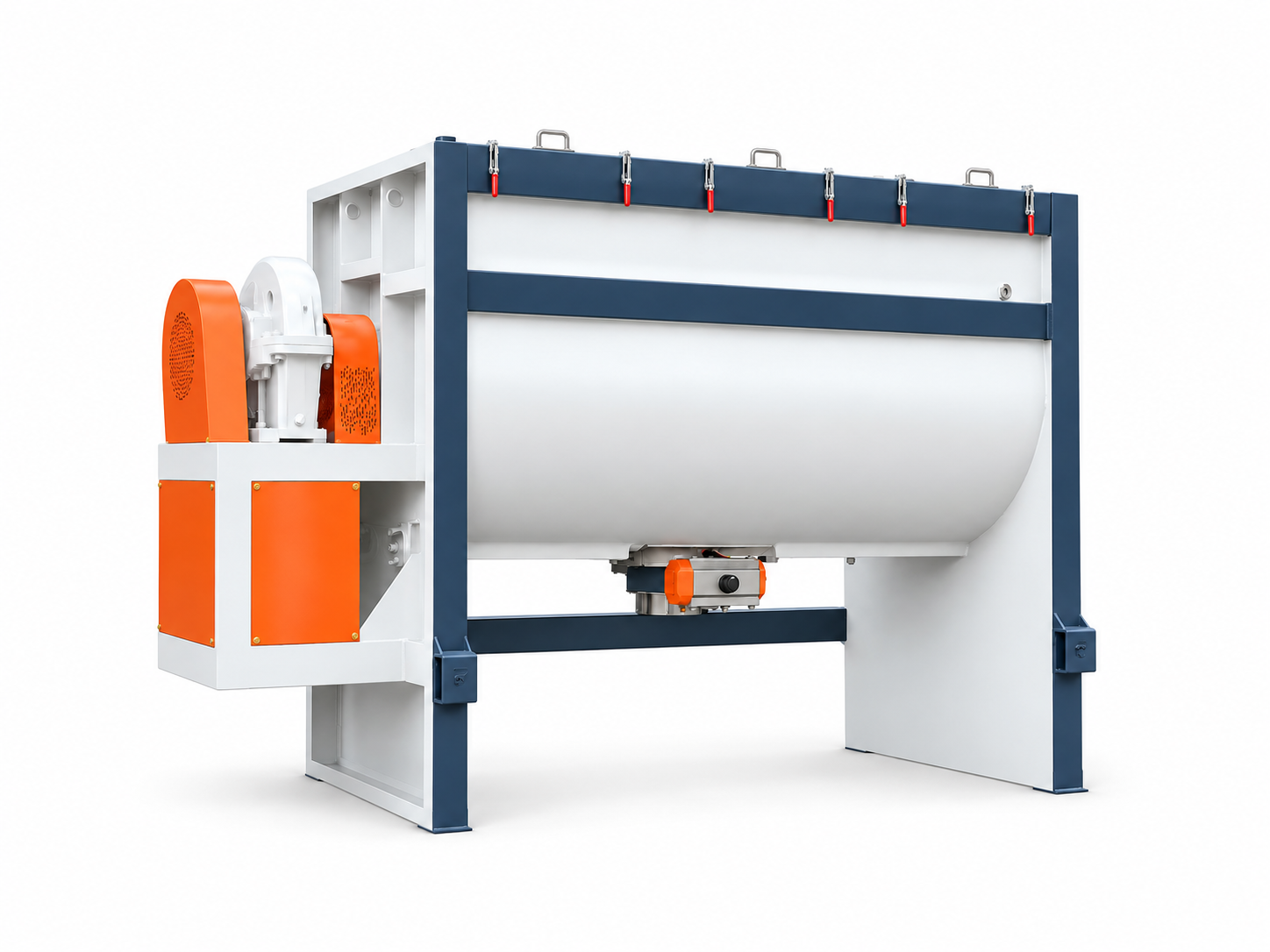
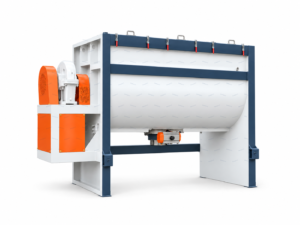
I use horizontal ribbon blenders for suitable powder blends, pellet-and-powder premixes, and some free-flowing elastomer or rubber granules. I confirm material behavior through testing. I do not treat a ribbon blender as a universal solution for sticky rubber masses, highly viscous compounds, or every PVC formulation.
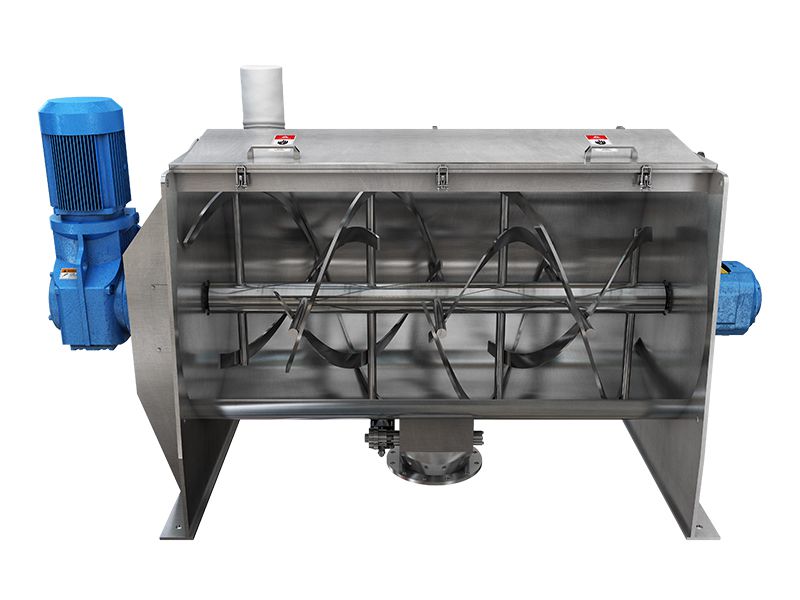
I use “horizontal mixer” as a broad equipment description. A ribbon blender is one type of horizontal mixer.
In a typical ribbon blender, I use inner and outer helical ribbons to move material in opposing directions along a horizontal trough. That movement helps exchange material across the batch.
I consider this arrangement when I need to blend suitable resin powders, fillers, pigments, and additives before compounding.
I also review horizontal mixing for suitable elastomer and rubber granules. I check particle form, tackiness, temperature response, and the torque needed to move the batch.
| Application I consider | What I assess before recommending a ribbon blender |
|---|---|
| Resin powder with powdered additives | Flow, agglomerates, dust containment, and ingredient distribution |
| Pellets with powder additives | Density differences, powder adhesion, and later segregation |
| Free-flowing TPE or TPR granules | Heat generation, sticking, and discharge |
| Free-flowing rubber granules | Particle behavior, abrasion, and cleaning |
| Frequent color changes | Access to ribbons, seals, trough surfaces, and outlet |
| Sticky rubber masses | Whether a kneader or internal mixer is required |
| PVC formulations | Whether the process requires hot/cold high-speed mixing instead |
I can configure a horizontal mixer with an appropriate speed and drive, but I still expect mechanical work to generate some heat.
I may need temperature monitoring or a cooling jacket for sensitive materials. I also assess whether a different agitator would better suit a fragile or difficult product.
For rubber, I distinguish between blending solid particles and working an uncured rubber mass. I would not offer an ordinary ribbon blender as a replacement for a dedicated rubber compounding machine.
For PVC, I check the complete recipe and process. I do not replace a required high-speed hot/cold mixing stage with a ribbon blender simply because both machines can handle powders.
For Nicety’s usual container-shipped export configurations, I generally work with an upper horizontal mixer capacity of approximately 5–6 metric tons per batch, subject to material density and final dimensions.
I present this as our practical export range, not a universal manufacturing limit for ribbon blenders.
I also explain why our horizontal machines generally cost more than comparable vertical silo mixing solutions. The trough, agitator, drive, sealing, and access requirements can add cost.
I accept that higher cost when the material or cleaning requirement makes the horizontal design the better production tool.
I can buy the cheaper mixer and still lose money through cleaning delays, poor discharge, or material that never reaches the required consistency.
I choose the mixer by material form, flow behavior, heat sensitivity, recipe, batch volume, and cleaning needs. I usually favor vertical silo mixing for bulk PP or HDPE pellet homogenization. I consider horizontal ribbon blending when suitable powders, additives, or sensitive granules require a different mixing action.
I use the following comparison for Nicety’s standard equipment configurations.
| Selection factor | My vertical silo mixer assessment | My horizontal ribbon blender assessment |
|---|---|---|
| Main application | Bulk homogenization of suitable pellets and rigid flakes | Suitable powder blends and more varied premixes |
| Common PP and HDPE pellet batches | Often my first choice | Possible, but I check whether the added cost is justified |
| Powder-rich recipes | Outside our standard design scope | A main application, subject to testing |
| Loose film | I do not recommend it | I assess separately; I do not assume suitability |
| Tacky elastomer or rubber | I do not recommend our standard screw design | I require trials and may select another mixer type |
| Larger export batch range | Approximately 15–20 metric tons | Approximately 5–6 metric tons |
| Installation | I need sufficient height and service access | I need sufficient floor area and service access |
| Cleaning | I review screw, vessel, and outlet access | I review trough, ribbons, seals, and outlet access |
| Purchase cost | Generally lower for our bulk pellet applications | Generally higher in our comparable proposals |
I ask for bulk density rather than relying on polymer name alone.
I calculate the required working volume as:
Required working volume = batch mass ÷ measured bulk density
For an illustrative 5,000 kg batch at a bulk density of 500 kg/m³, I need 10 m³ of material working volume. At 250 kg/m³, I need 20 m³.
I use those numbers only to explain the calculation. I do not present them as measured densities for a customer’s material.
I then account for the manufacturer’s permitted fill range and the space needed for effective material movement. I distinguish working volume from total vessel volume.
I use ROSS’s ribbon blender specification guidance as a supporting reference for the relationship between batch volume, bulk density, and equipment selection.
I include loading, mixing, discharge, inspection, and cleaning when I estimate output.
For a line consuming 1,000 kg/h, a usable 5,000 kg batch represents five hours of feedstock. I still need enough time and buffer storage to prepare the next batch.
I do not describe a five-ton batch mixer as a five-ton-per-hour machine without establishing its full operating cycle.
I cannot prove uniformity by watching pellets move through an inspection window. Visible circulation does not show whether the full batch meets specification.
I confirm mixing through a written trial using representative material, defined operating conditions, and samples from different discharge stages. I choose tests that reflect the actual quality concern, then check whether conveying and storage preserve the result before the material reaches production.
I first identify the property I need to control.
For a colored formulation, I may compare color measurements on consistently prepared plaques. For a filler-containing formulation, I may use ash testing where the method suits the ingredients. For recycled pellets, I may assess melt behavior and other agreed properties.
I do not use one test as proof of every aspect of uniformity.
| Trial detail I record | Why I record it |
|---|---|
| Input lot numbers and ingredient weights | I need to reproduce the batch |
| Material form and bulk density | I need to understand loading and circulation |
| Batch size and fill level | I need to confirm the intended operating range |
| Loading sequence, speed, and mixing time | I need a repeatable operating procedure |
| Initial and final material temperature | I need to detect unwanted heating |
| Samples from early, middle, and late discharge | I need to check the material leaving the machine |
| Residue and cleaning time | I need to assess changeover and contamination risk |
I may create a satisfactory blend and then lose some of that uniformity during handling.
I pay particular attention to differences in particle size, shape, and density. I review long drops, vibration, transfer lines, and intermediate storage because these can encourage ingredients to separate.
For a critical premix, I compare samples at the mixer discharge and near the extruder feed point. I want to know whether the downstream system preserves the blend.
I also avoid assuming that longer mixing is always better. Extra time can add heat, wear, or particle damage without improving the measured result.
At Nicety, I base my recommendation on the material, the intended process, and the results that a trial can demonstrate. I do not promise a universal mixing time or a fixed quality improvement without supporting data.
I choose mixers to make material supply more consistent. I match the design to the feedstock, validate the blend, and control handling through to production.
I identify the capacity ranges, material restrictions, and relative pricing described for Nicety equipment as company-specific guidance. I confirm final specifications against the customer’s material and project requirements.
Sources
Only sources cleared to publish are listed; an article without a listed source is written from company practice.
Related
The equipment, solutions and projects the article relates to — chosen per article, not generated from keywords.
Equipment
Vertical screw batch mixer for large-capacity blending, batch homogenization, and color mixing of plastic pellets, regrind flakes, and granular masterbatches.
Equipment
Horizontal ribbon blender with counter-flow double helical ribbons for convective batch blending of polymer pellets, powders, regrind, and masterbatch without frictional heat build-up.
Application
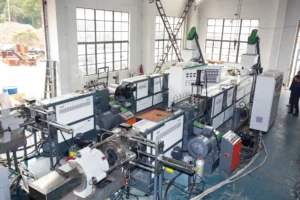
Rigid HDPE and PP scrap recycling line profile detailing shredding, vacuum extrusion, water-ring pelletizing, active VOC deodorization, and large-capacity vertical batch homogenization.
Case study
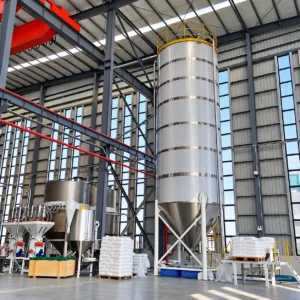
Industrial case study: 15-ton vertical pellet homogenization silo retrofit for an automotive PP compounding plant, reducing batch MFI variation from ±12.7% to ±1.1% (Cpk…
Case study
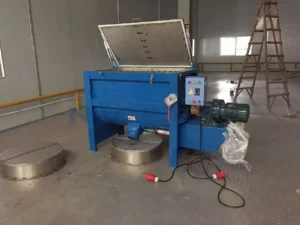
Industrial case study: sanitary 4,000L horizontal ribbon blender retrofit for a color masterbatch maker — dry cleanout cut from 95 to 18 minutes and…
Tell us the material, the process and what you need to achieve. Technical details can be completed later together with our sales team.