Equipo auxiliar y sistemas integrados
e-mail [email protected] Idioma EN ES

Equipment

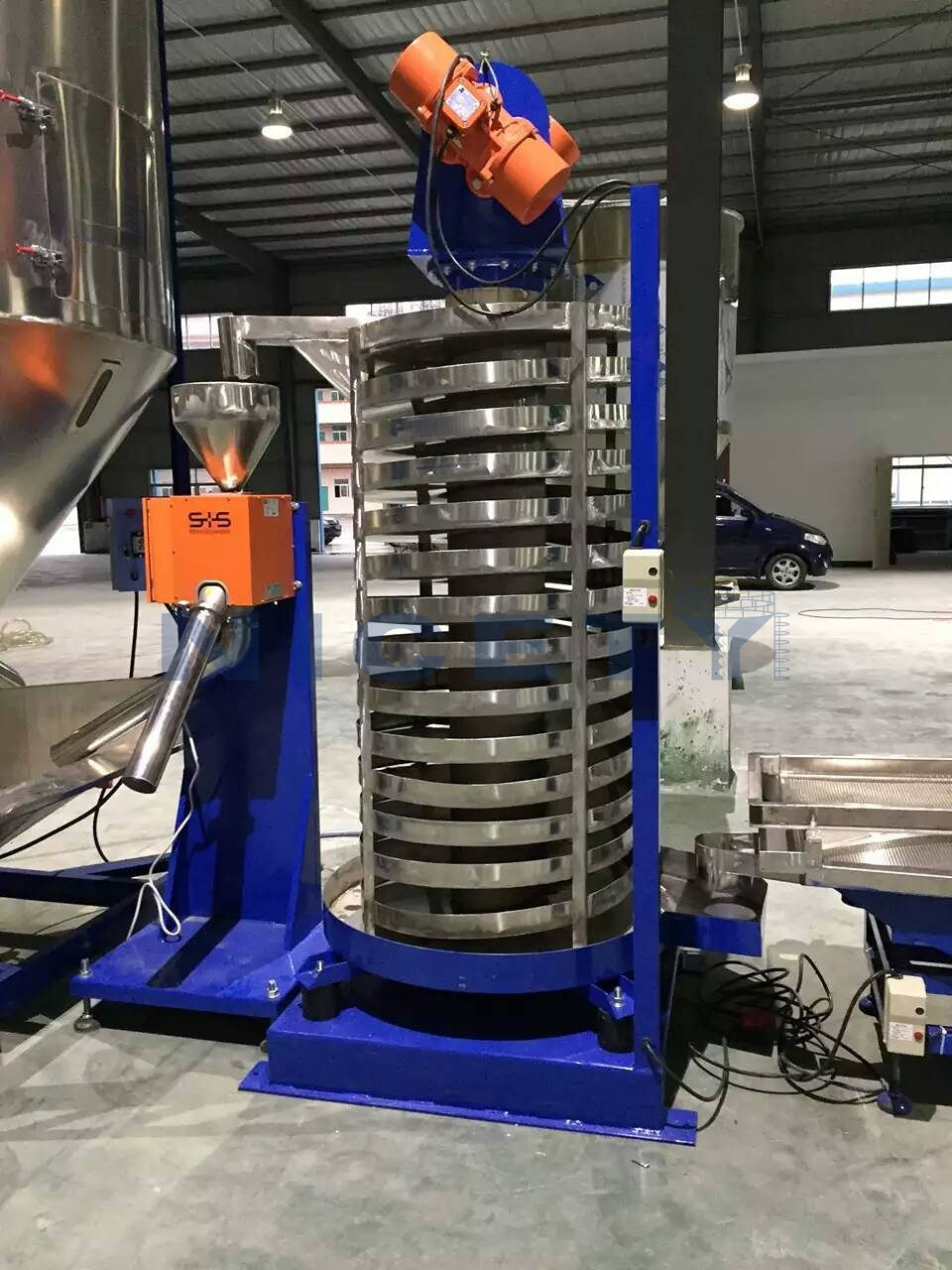
Vibrating Spiral Elevator

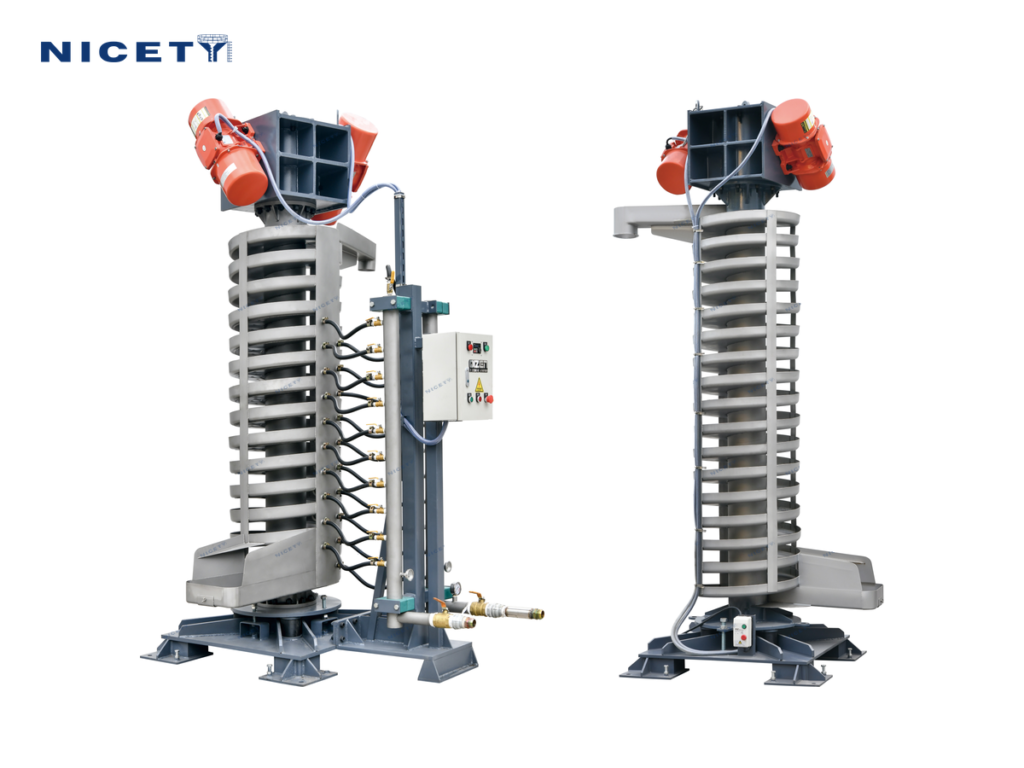
Vertical vibrating spiral elevator for gentle upward conveying and intensive cooling of hot plastic pellets, available in Air-Cooled and Water-Cooled jacketed models.

  • Drying, Cooling and Dewatering Equipment
  • Feeding and Conveying Equipment
  • Cooling
  • Dewatering and Drying
  • Feeding and Material Transfer
  • Post-Pellet Treatment
  • ABS
  • Color Masterbatch
  • EVA
  • HDPE
  • LDPE
  • Modified Plastics
  • Multifunctional Masterbatch
  • PE(Polyethylene)
  • PP(Polypropylene)
  • Recycled plastics
  • Resin
  • Rubber
  • SBS
  • Thermoplastic Elastomer
  • TPE
  • TPU
  • TPV
  • Pellets
  • Insufficient cooling
  • Limited floor space and headroom
Rango de capacidad
500–4000 kg/h
Models
NC-Z1250 · NC-Z2000 · NC-Z3500 · NC-Z4500 · NC-Z6000
Potencia nominal
0.2–4.4 kW
Base de las cifras de capacidad
Pellets

Reference values for the model or models named above. The confirmed configuration, the capacity basis and the scope of supply are stated in the quotation and the drawings.

Overview

What this machine does

Lifts plastic pellets vertically while simultaneously cooling them via high-velocity forced air or double-jacketed water cooling along an extended spiral flight path.

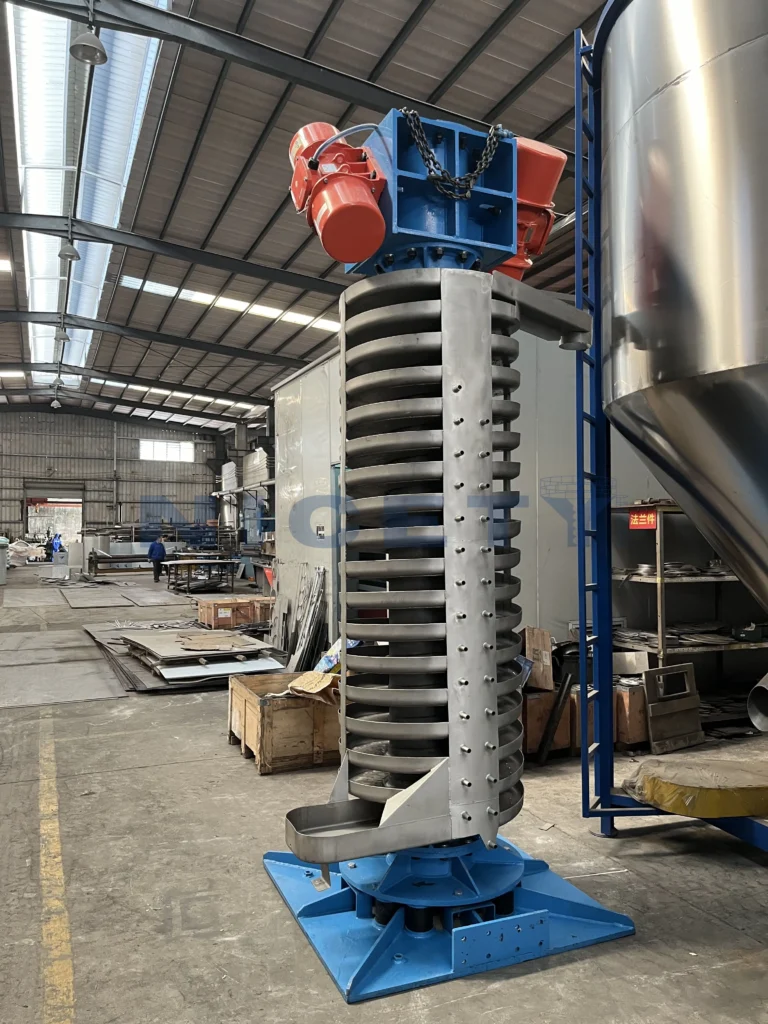
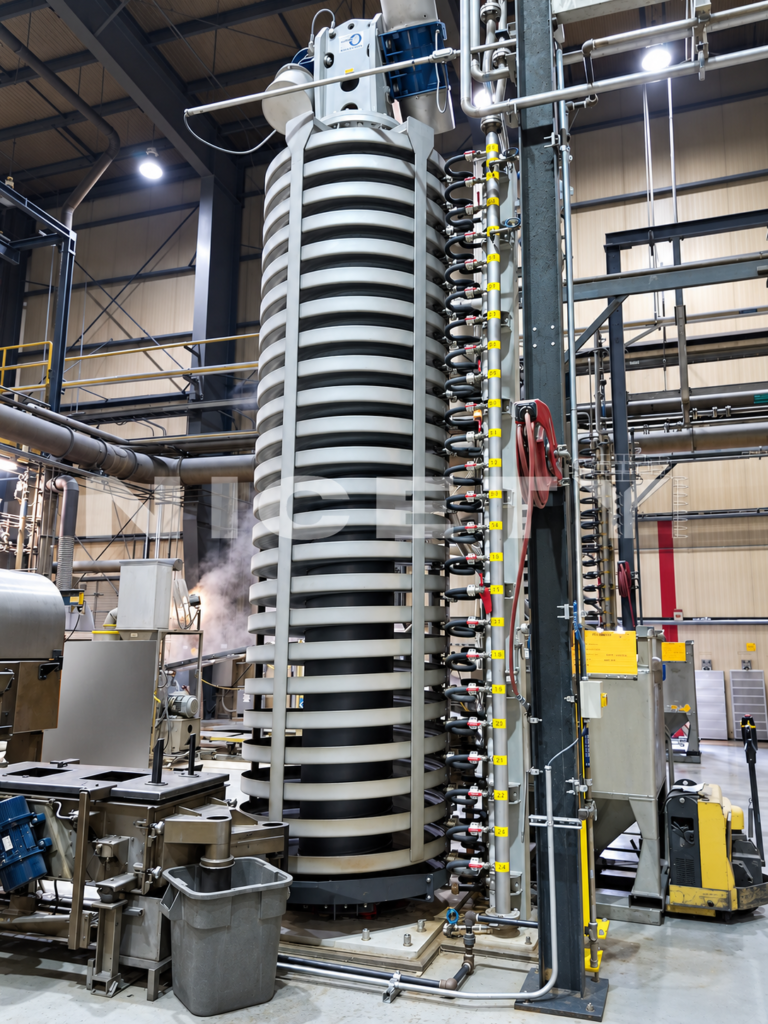
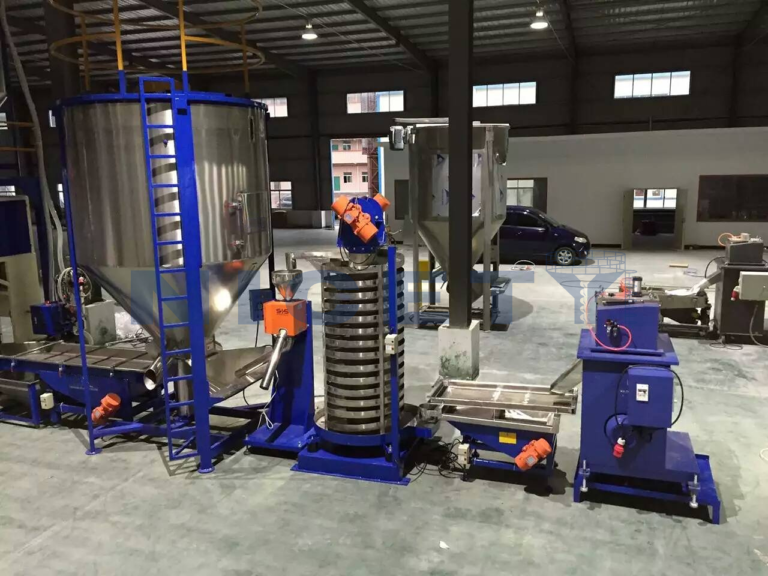
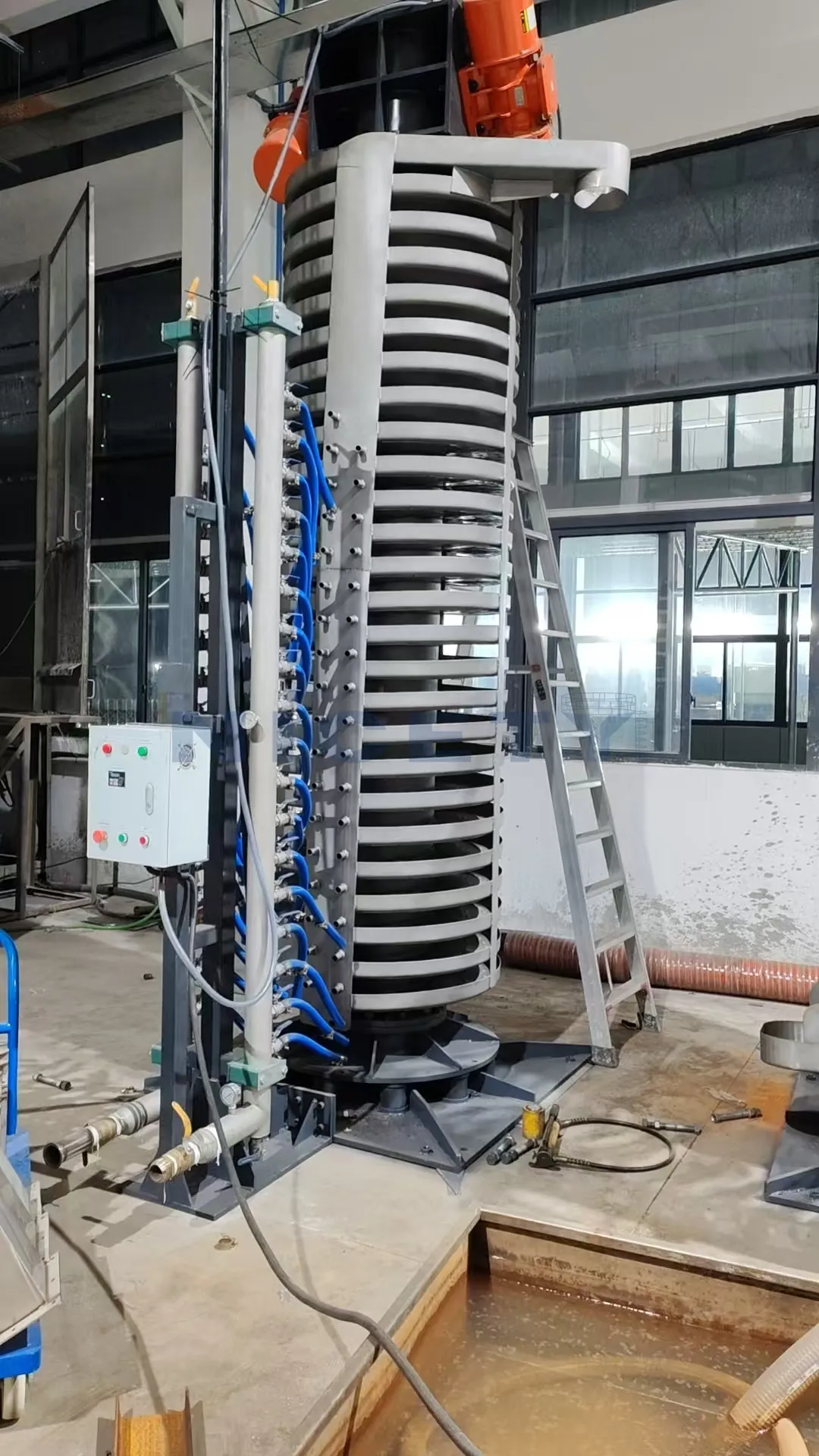
The Vibrating Spiral Elevator (also known as a Spiral Cooling Tower, Vertical Vibratory Spiral Conveyor, or Spiral Pellet Cooler) is a high-efficiency multi-functional system designed for modern plastics compounding, masterbatch manufacturing, and polymer recycling lines. Combining vertical material elevation with continuous thermal quenching, the machine elevates freshly cut plastic pellets while simultaneously cooling them along an extended helical travel path—requiring only a fraction of the floor space demanded by traditional horizontal fluid bed coolers or bulky inclined belt conveyors.

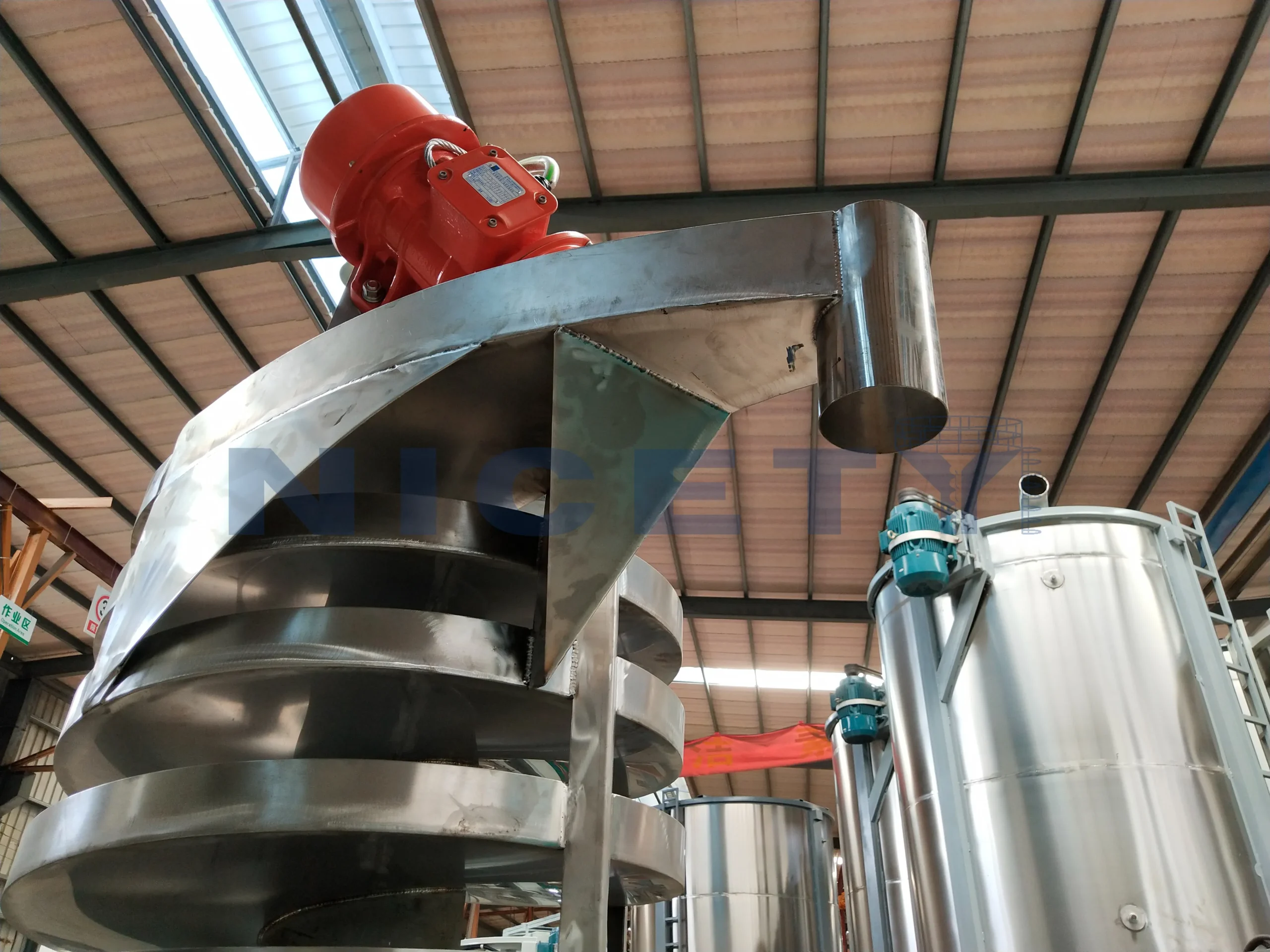
Driven by twin synchronized unbalance vibratory motors mounted at precision counter-opposed angles, the elevator induces a harmonic micro-hopping motion. Pellets tumble gently upward along a continuous multi-tier spiral flight fabricated from polished SUS304 stainless steel. This gentle, friction-free transport ensures zero pellet deformation, prevents abrasive fines generation, and provides continuous 360-degree surface exposure for rapid heat dissipation.

Two Engineered Cooling Modes: Air Cooling vs. Water Cooling

Depending on polymer crystallization characteristics, thermal sensitivity, surface tackiness, and workshop ambient conditions, the Vibrating Spiral Elevator is engineered in two distinct cooling configurations:

1. Air-Cooled Vibrating Spiral Elevator (Convective Airflow Cooling)

The air-cooled model integrates high-velocity centrifugal blowers and directional air distribution manifolds arranged vertically along the spiral column. Filtered ambient or chilled air is injected continuously across each ascending flight tier through targeted air knives. As pellets hop upward, the high-velocity cross-flow airflow penetrates the fluidized pellet layer, rapidly stripping sensible heat and residual surface moisture. Air-cooled models are highly energy-efficient, require zero water piping, and represent the industry standard for rigid polyolefins (PP, HDPE, LDPE), engineering thermoplastics (ABS, PS, PA, PC), and standard masterbatches.

2. Water-Cooled Vibrating Spiral Elevator (Jacketed Conductive Contact Cooling)

For temperature-sensitive, low-hardness, or tacky polymers, the water-cooled model features proprietary double-walled hollow spiral flights with internal liquid guide baffles. Closed-loop chilled water (typically 7°C to 12°C from an industrial chiller) circulates continuously through the sealed hollow flights. As hot pellets contact the chilled stainless steel flight surfaces during their micro-hopping ascent, intensive conductive heat transfer occurs, cooling pellets 2.0× to 3.0× faster than air alone. Water-cooled models eliminate the risk of pellet deformation and sticking, making them indispensable for Thermoplastic Elastomers (TPE, TPU, TPV), Ethylene Vinyl Acetate (EVA with high vinyl acetate content), hot-melt adhesives, and low-melting point polyolefin elastomers (POE).

Solving Space Constraints & Downstream Agglomeration

In high-tonnage compounding lines, pellets discharging from centrifugal dewaterers often retain elevated internal core temperatures (75°C to 90°C). If packaged immediately into 25 kg bags or transferred directly into bulk storage silos, residual core heat dissipates slowly, leading to catastrophic pellet caking, blocking, and resin sweating. By providing 60 to 180 seconds of ascending residence time within a compact vertical footprint of just 1.2 to 1.5 meters diameter, the Vibrating Spiral Elevator quenches pellet temperatures to safe packaging levels (≤ 40°C–45°C), ensuring perfect free-flowing pellet quality.

Key features

The parts that do the work

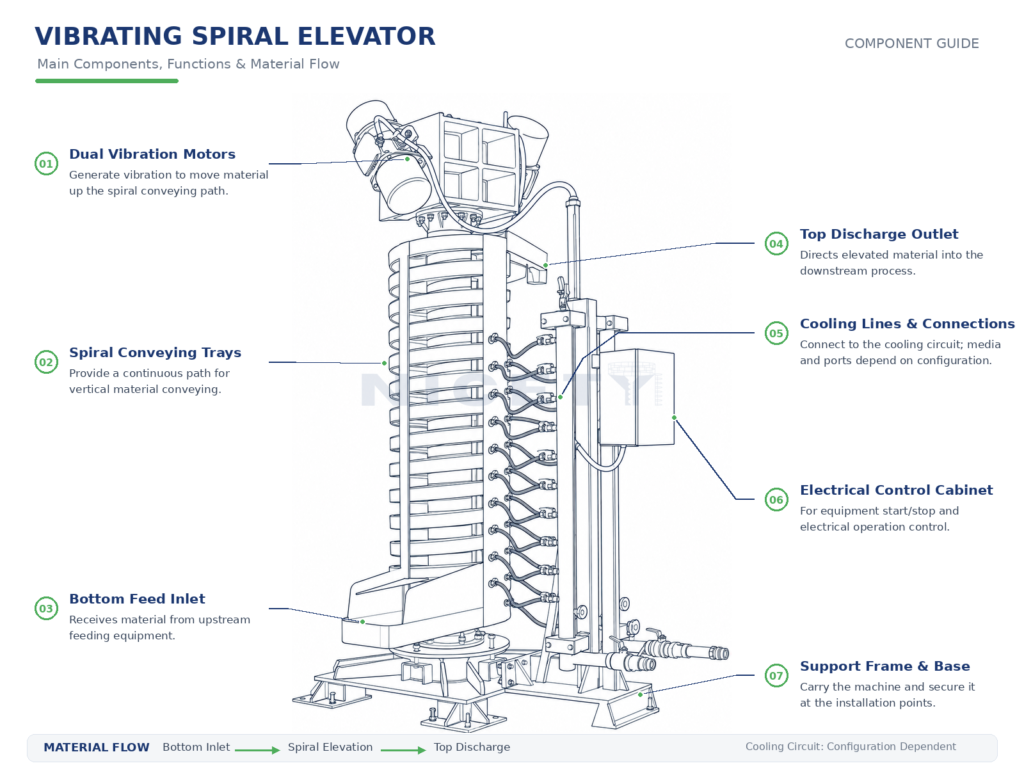
Each picture names one part of the machine and what it does for the material and the batch.

Dual Cooling Architectures: Air-Cooled & Water-Jacketed Cooling

Available in high-velocity forced Air-Cooling configuration (high-volume filtered ambient or refrigerated air blowing through directional nozzles) or advanced Water-Cooling configuration (continuous double-walled hollow spiral flights circulating chilled water for high-intensity conductive contact cooling).

Ultra-Compact Vertical Footprint with Long Residence Path

Combines vertical elevation (2 m to 6 m) and extended spiral conveying distance (up to 30–60 linear meters of travel) inside an ultra-compact footprint (typically 1.0 m to 1.5 m diameter), replacing 15-meter horizontal fluid beds and bulky inclined belt conveyors.

Gentle Micro-Hop Conveying via Synchronized Vibratory Motors

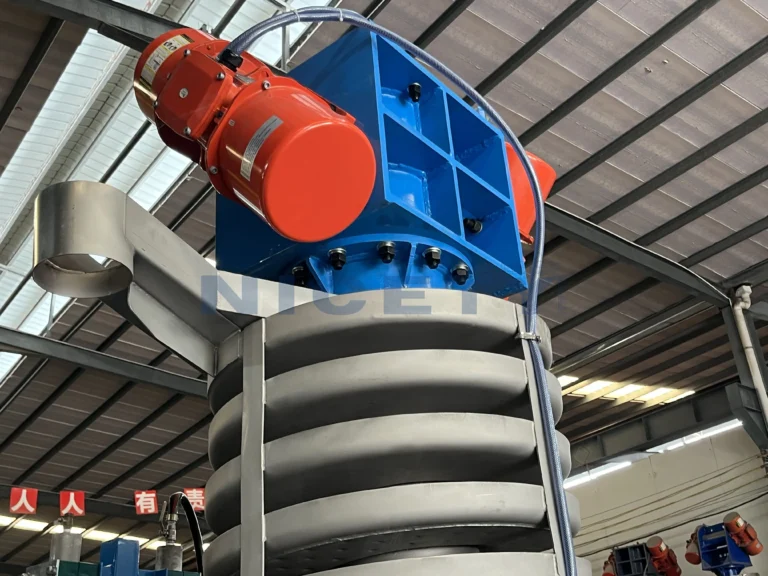
Twin synchronized unbalance vibratory motors mounted at precision counter-opposed angles. Generates gentle, harmonic micro-hopping motion that ascends pellets without shearing, abrasive pellet degradation, dust generation, or pellet deformation.

One-Piece Formed Spiral Trough & Hygienic Flights

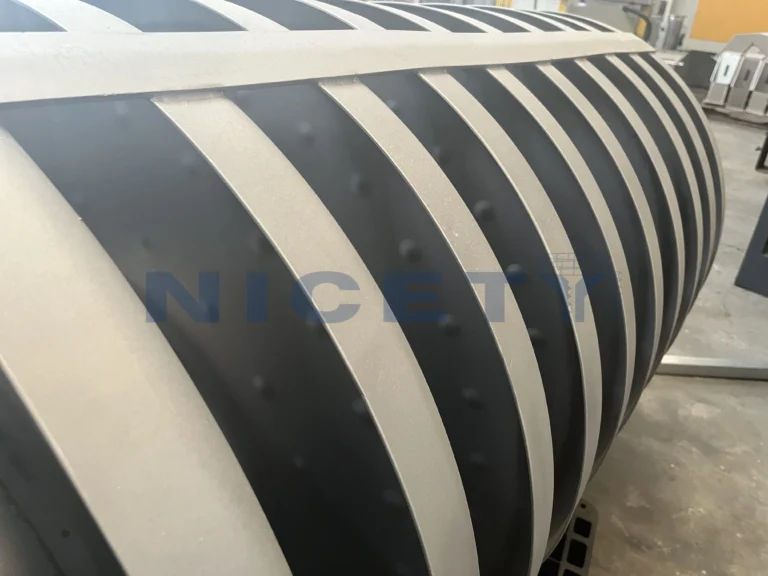
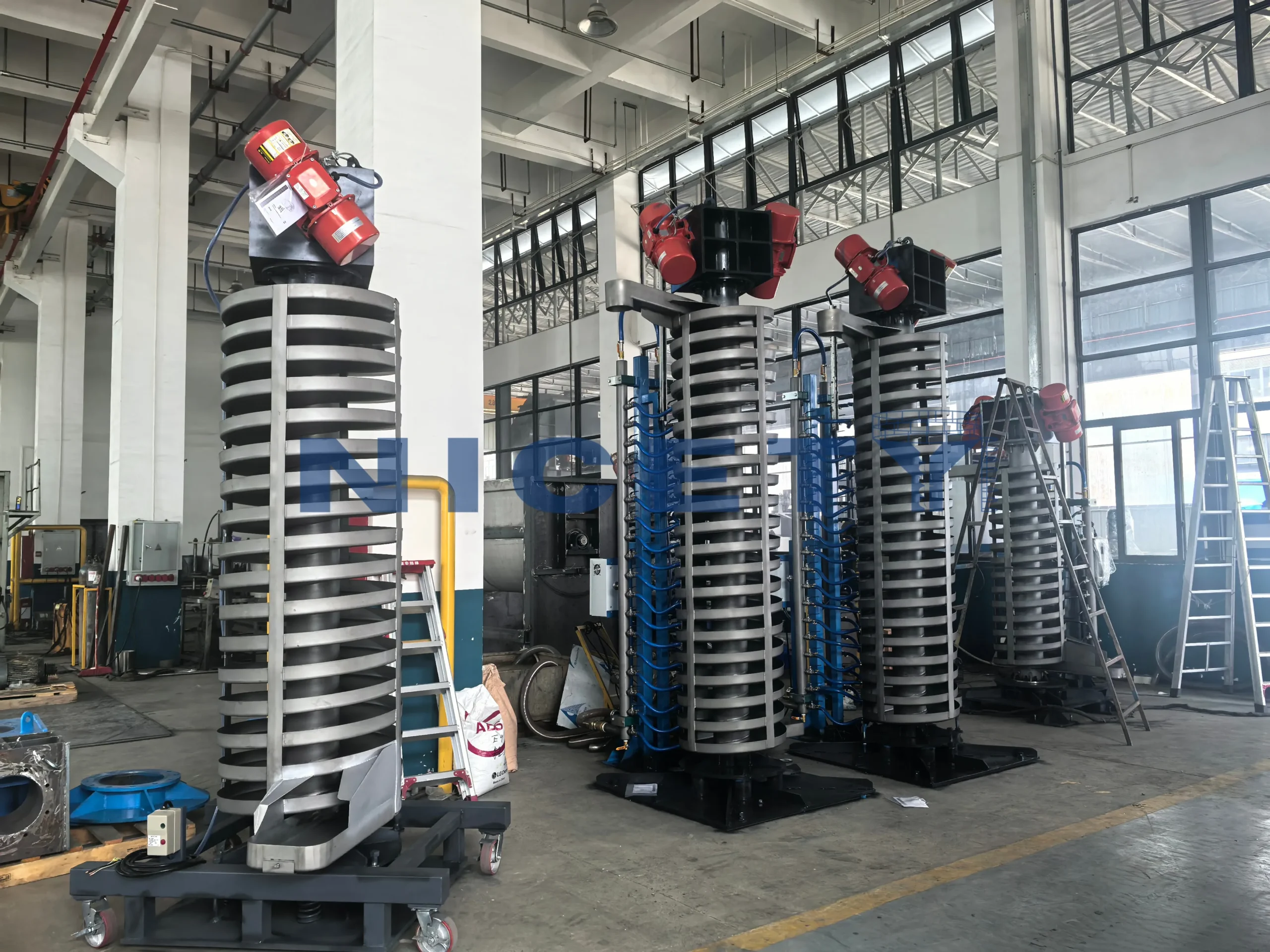
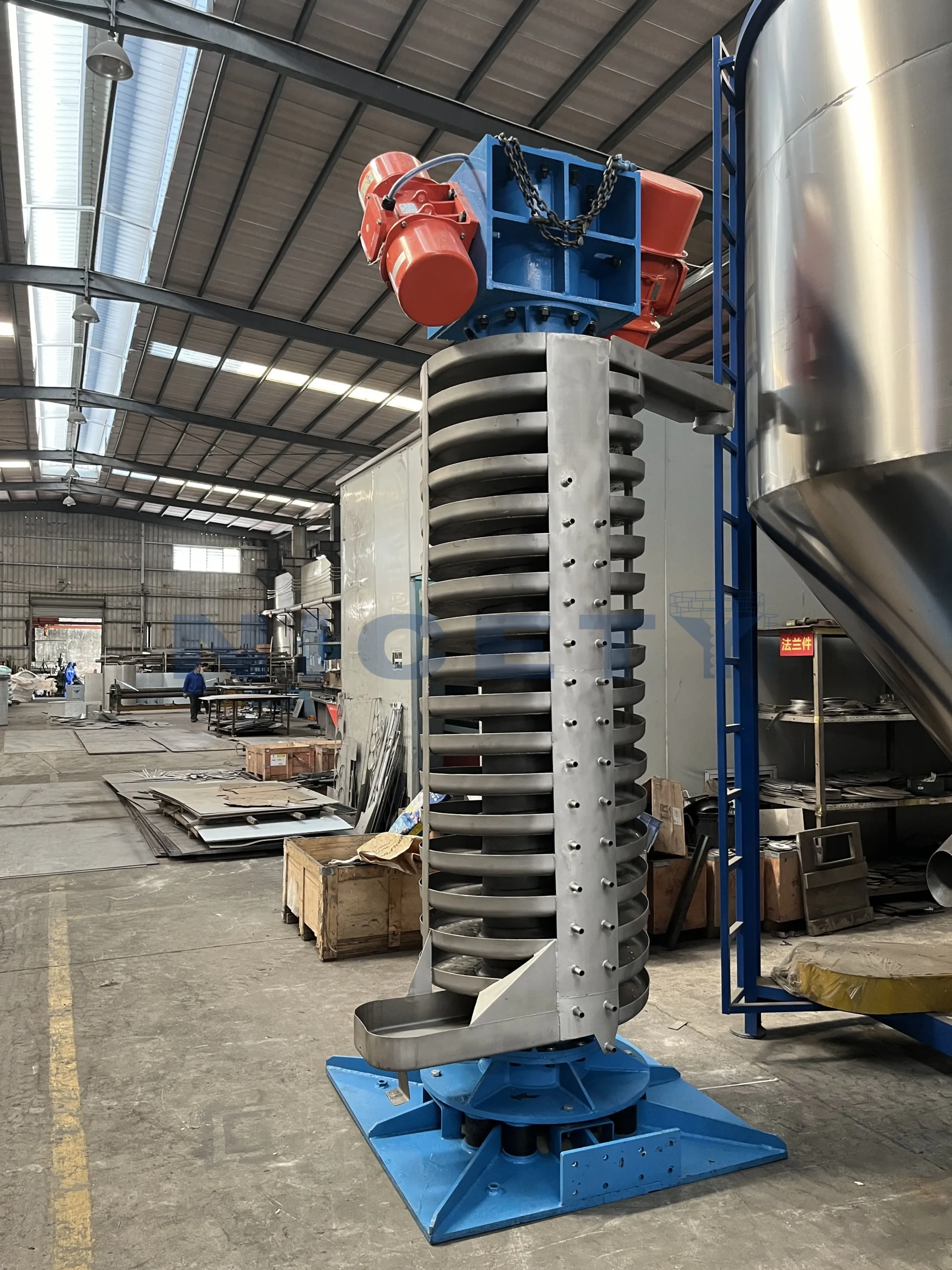
The spiral trough is formed as one continuous piece, not assembled from segment trays, and helically welded to the heavy-gauge central column as one unit. Polished SUS304 or SUS316L throughout, with a crevice-free surface that eliminates the ledges where pellets and colorant lodge, so color changes stay clean.

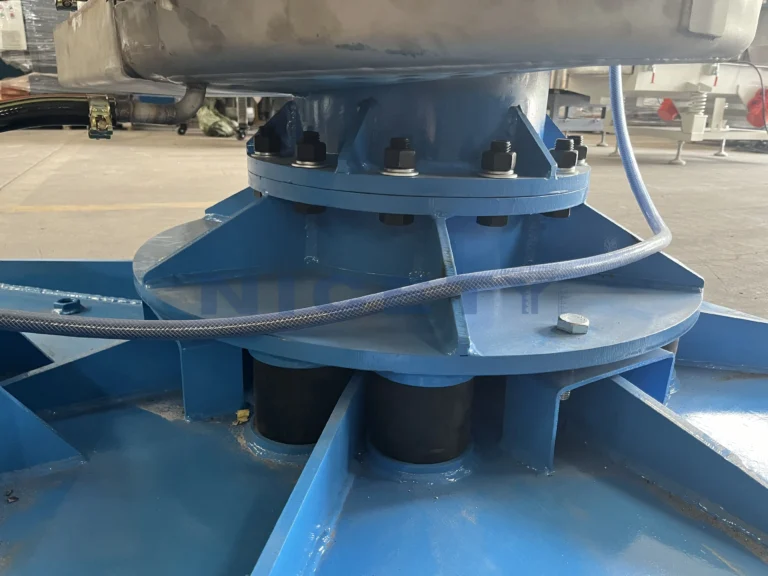
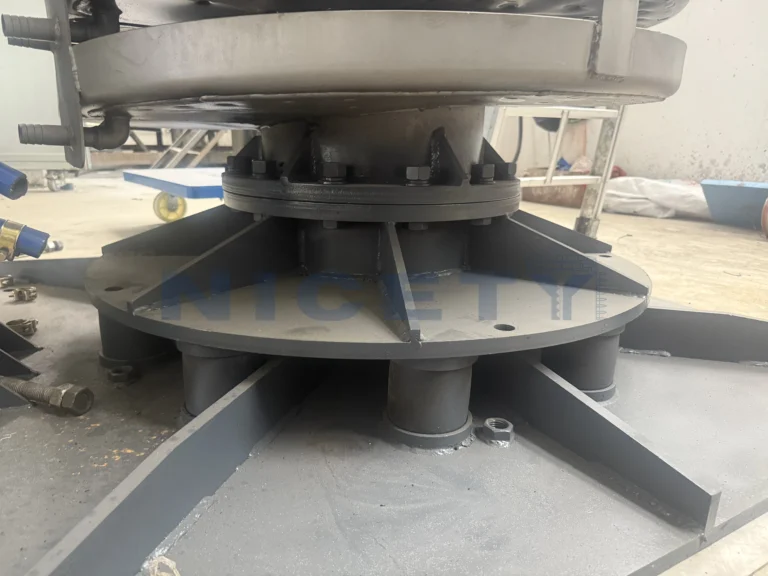
Heavy-Duty Rubber Damping Columns

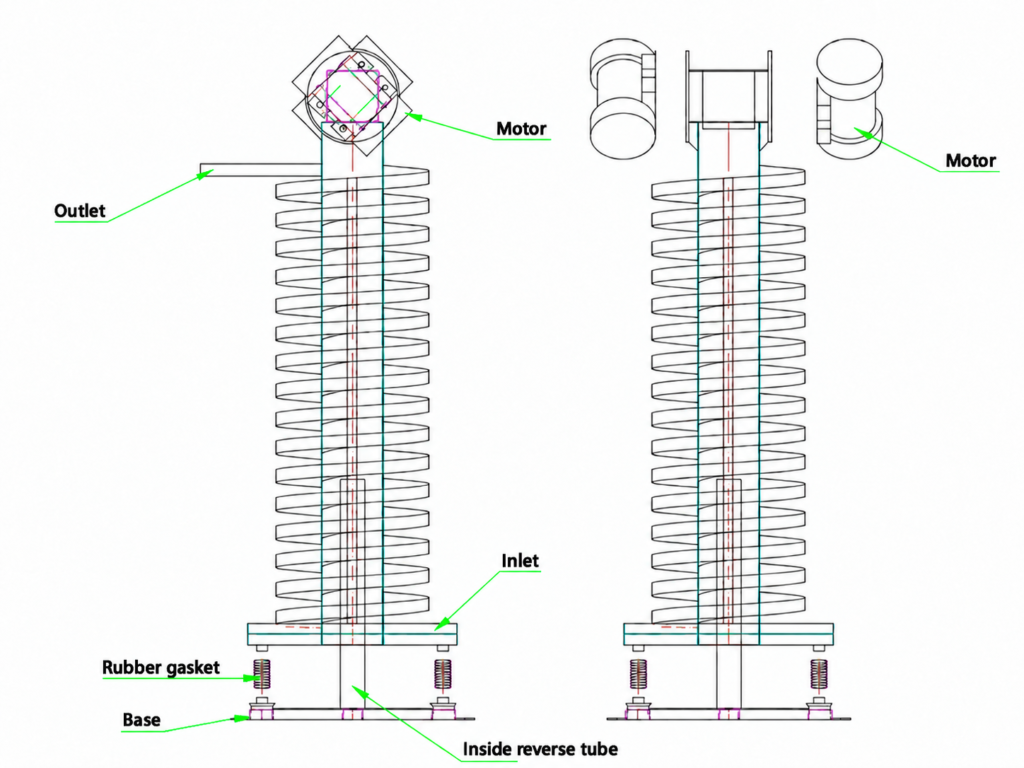
Depending on base structural configuration and column diameter, 8 to 10 heavy-duty rubber damping columns are fitted to isolate dynamic oscillatory forces and maintain operational stability. The rubber columns act as wear-absorbing components and should be periodically inspected and replaced when worn or aged.

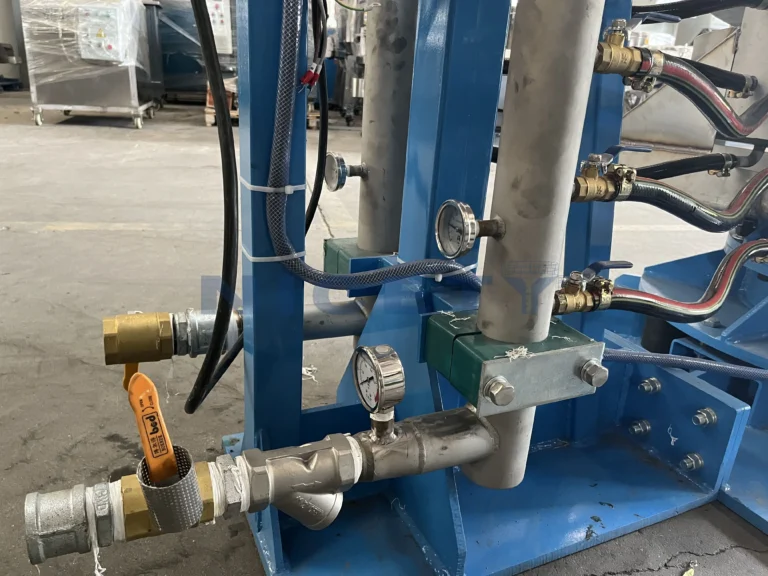
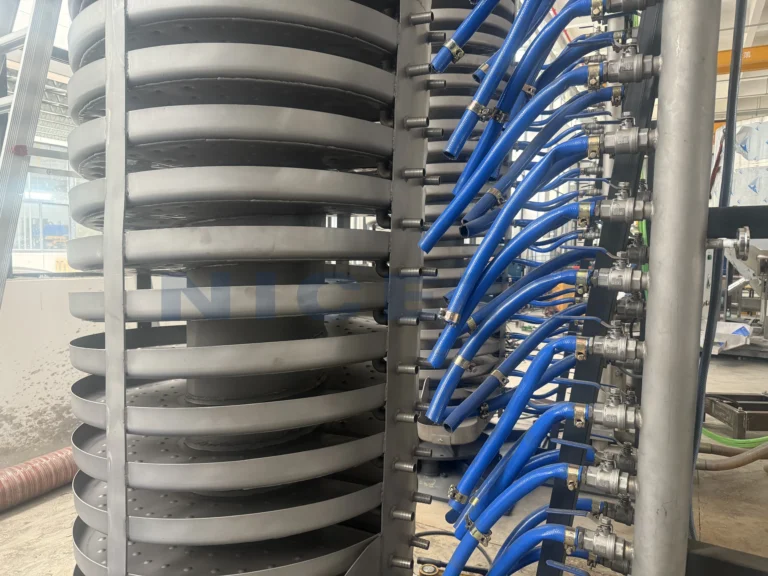
Cooling Utility Ports with Pressure Gauges & Protective Safety Devices

Equipped with stainless-steel braided flexible jumper connections, inline analog pressure gauges, overpressure relief valves, and drain ports at the cooling medium supply/return interfaces. Enables real-time pressure and flow monitoring to safeguard jacketed cooling flights against overpressure and hydraulic shock during continuous operation.

Material and process

Where it fits — and where it does not

Read the conditions together: a machine is selected for the material and the output, not from its name alone.

Materiales y condiciones adecuados

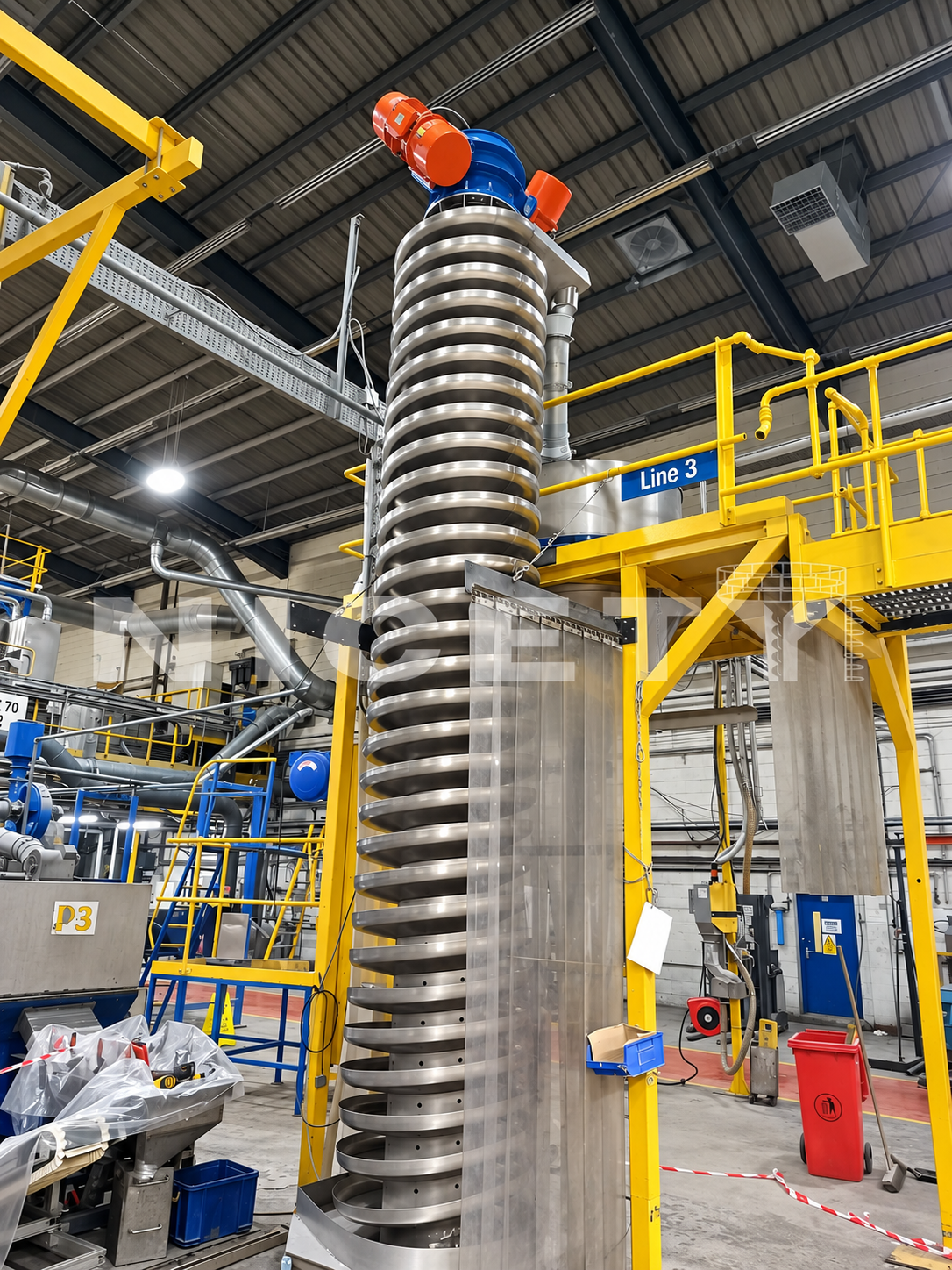
The Vibrating Spiral Elevator is specifically engineered for plastics compounding, masterbatch manufacturing, and polymer recycling facilities requiring vertical pellet lifting and intensive thermal quenching within an ultra-compact footprint. It replaces space-consuming inclined conveyors, long water troughs, and bulky horizontal fluid bed coolers, combining the functions of a vertical elevator and a cooling tower into one vertical footprint.

Optimized for a comprehensive range of polymer types across both Air-Cooling and Water-Cooling configurations:

  • Standard Polyolefins & Engineering Thermoplastics (Air-Cooled Configuration): PP, HDPE, LDPE, LLDPE, PET, PA6, PA66, ABS, PS, PC, and POM pellets directly following centrifugal dewatering or water-ring cutting. Provides convective air cooling to lower pellet core temperatures below 45°C.
  • Thermoplastic Elastomers & Sticky Soft Resins (Water-Cooled Configuration): TPE, TPU, TPV, EVA (high VA%), Hot Melt Adhesives (HMA), and polyolefin elastomers (POE). Double-jacketed water-cooled flights provide rapid conductive cooling, freezing tacky pellet surfaces immediately to eliminate sticking, agglomeration, and clumping.
  • High-Loading Masterbatch & Mineral Filled Compounds: Color masterbatch, carbon black concentrates, and CaCO3 / talc-filled compounds carrying high thermal mass, ensuring uniform cooling throughout the pellet core prior to screening and packaging.
  • Post-Consumer & Post-Industrial Recycling Lines: Flakes and dense recycling pellets requiring vertical lifting into storage silos while removing residual moisture and surface heat.

Limitaciones y cuándo no aplica

Operates on directional inertial micro-hopping vibration; technical boundaries include:

  • Not for water slurries: Cannot convey liquid-slurry mixtures directly from die-cutting heads; upstream centrifugal dewatering or sieves are required to remove free water.
  • Semi-molten sticky pellets: Pellets entering above their Vicat softening point risk bottom-pan agglomeration; water-quenching must freeze the pellet outer skin first.
  • Lift height limits (≤6.0 m): Single-column lift height is structurally limited to ~6 m; higher elevations require dual spirals in series or pneumatic conveying.
  • Fine powders (<200 μm): Fine powders lose vibratory conveying momentum on spiral flights; engineered strictly for solid granules and pellets.
  • Upper-floor installations: Balanced for ground-floor concrete slabs by default; elevated steel platform mounting requires engineering notice for resonance damping isolation.

Condición y requisitos de alimentación

Accepts continuous gravity or chute feed of polymer pellets, masterbatches, and elastomer granules directly following post-pelletizing centrifugal dewatering, underwater pelletizer drying, or water-ring cutting:

  • Material Forms: Spherical hot-cut pellets, cylindrical strand-cut granules, micropellets, filled masterbatch, and thermoplastic elastomer beads (1.0 mm to 6.0 mm).
  • Thermal Inlet State: Accepts elevated pellet core temperatures up to 85°C–95°C directly from centrifugal dewaterers. Material surface must be solidified (not molten paste) to ensure forward micro-hopping.
  • Moisture & Cleanliness: Surface moisture < 0.2% (dry-to-touch after centrifugal dewatering). Feed stream must be free of pooled water and heavy unyielding metal purge lumps.

Condición y límites de salida

Discharges continuously cooled, aerated, and completely solidified polymer pellets at safe downstream processing and packaging temperatures:

  • Discharge Pellet Temperature: Pellets exit at ≤ 40°C–45°C (ambient air cooling) or ≤ 35°C–38°C (water-jacketed conductive cooling), completely eliminating post-packaging blocking, agglomeration, and sweating inside 25 kg bags, gaylords, or bulk storage silos.
  • Pellet Integrity: Gentle micro-hop transport produces zero mechanical shear, preserving precise pellet geometry, sharp cut facets, and pellet bulk density with zero fines generation.
  • Elevation Delivery: Discharges smoothly via gravity into linear vibrating screens, cooling storage bins, or pneumatic transfer pickup hoppers.

Throughput

Rango de capacidad

Read a figure together with the basis below it: the same machine reaches different numbers on different materials.

500–4000 kg/h

Base de las cifras de capacidad

Lifting and cooling throughput capacity is rated from 300 kg/h up to 3,500+ kg/h based on continuous vertical conveying of standard polymer pellets (bulk density 0.50–0.65 kg/L) through spiral column diameters ranging from 500 mm to 1,200 mm and lifting heights from 2.0 m to 6.0 m:

  • Air-Cooled Models (Convective Cooling): Provide 60 to 180 seconds of ascending retention time. Using high-volume filtered ambient or chilled air (blowing velocity 10–18 m/s), core temperature of rigid polyolefin pellets (PP, HDPE) typically drops from 75°C–85°C down to ≤ 45°C.
  • Water-Cooled Models (Conductive Contact Cooling): Utilizes hollow double-walled flight channels circulating 7°C–12°C chilled water. Conductive contact heat transfer accelerates cooling rates by 2.0× to 3.0× compared to air alone, dropping sticky elastomer pellets (TPE, TPU, EVA, hot melt adhesives) from 85°C–95°C down to ≤ 38°C within a single vertical column.
  • Derating Factors: Highly elastic or tacky materials (Shore hardness < 75A) require fine-tuning of vibratory motor eccentric angle (typically 30° to 40°) and vibration amplitude to maintain steady forward micro-hopping, with throughput derated by 15%–25%.

Models

Models in this range

The figures are the reference values entered for each model. The model for your line is confirmed against your material and output before it is quoted.

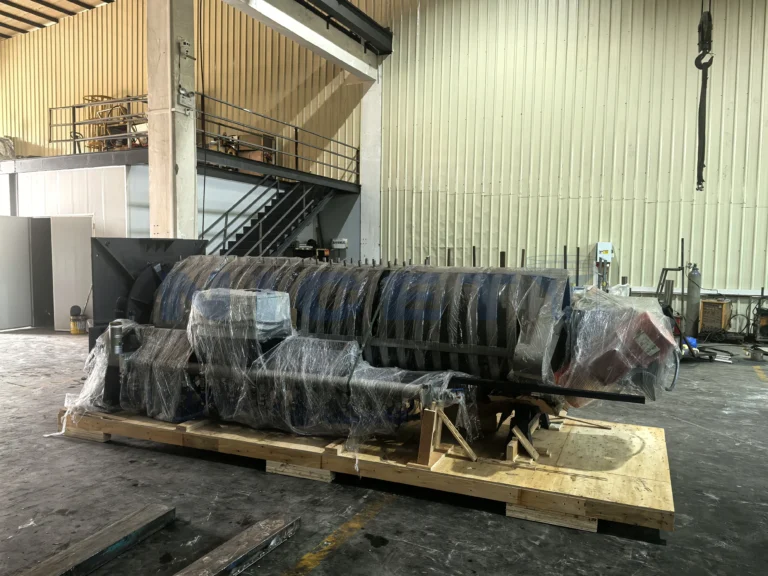
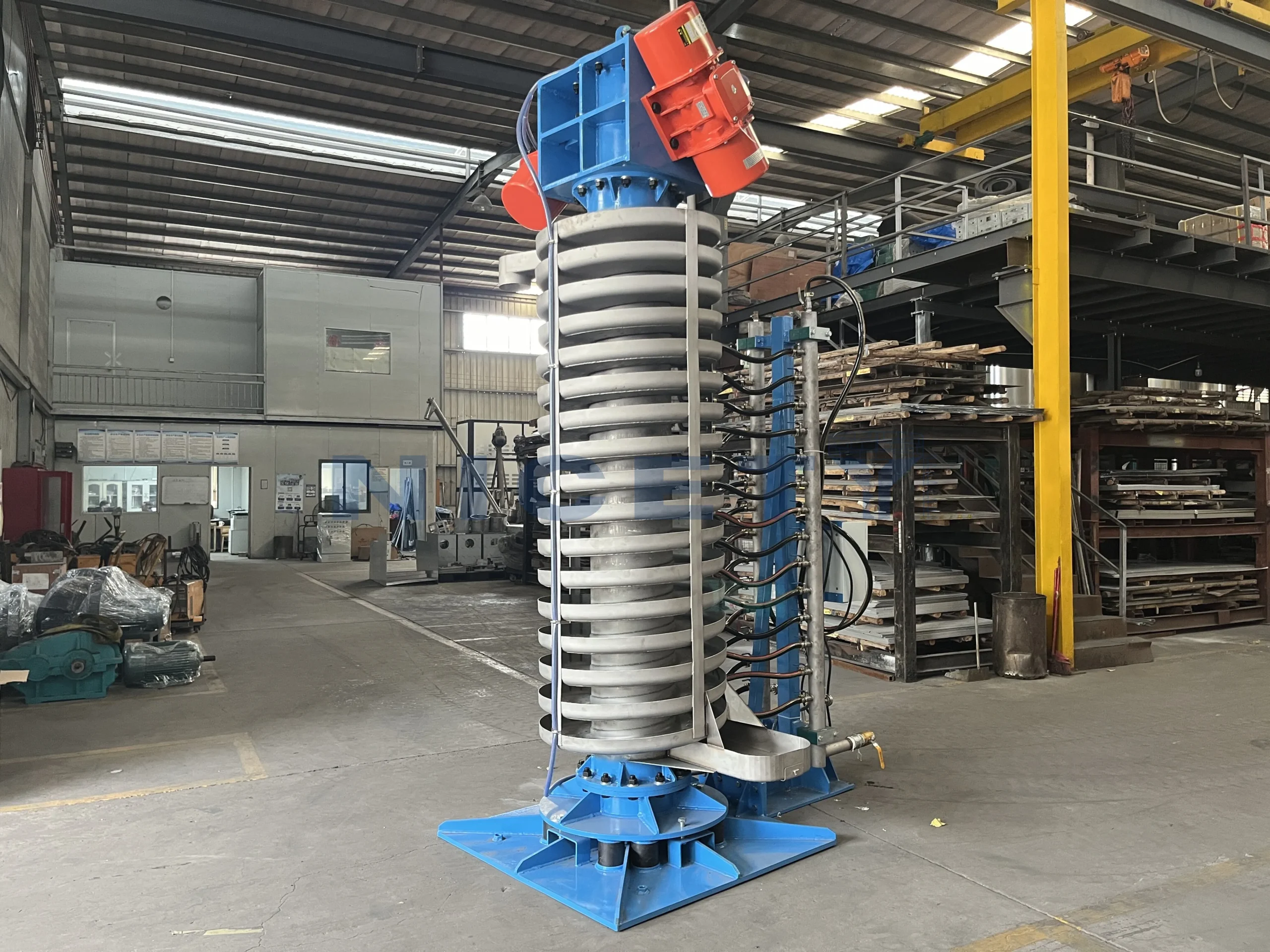
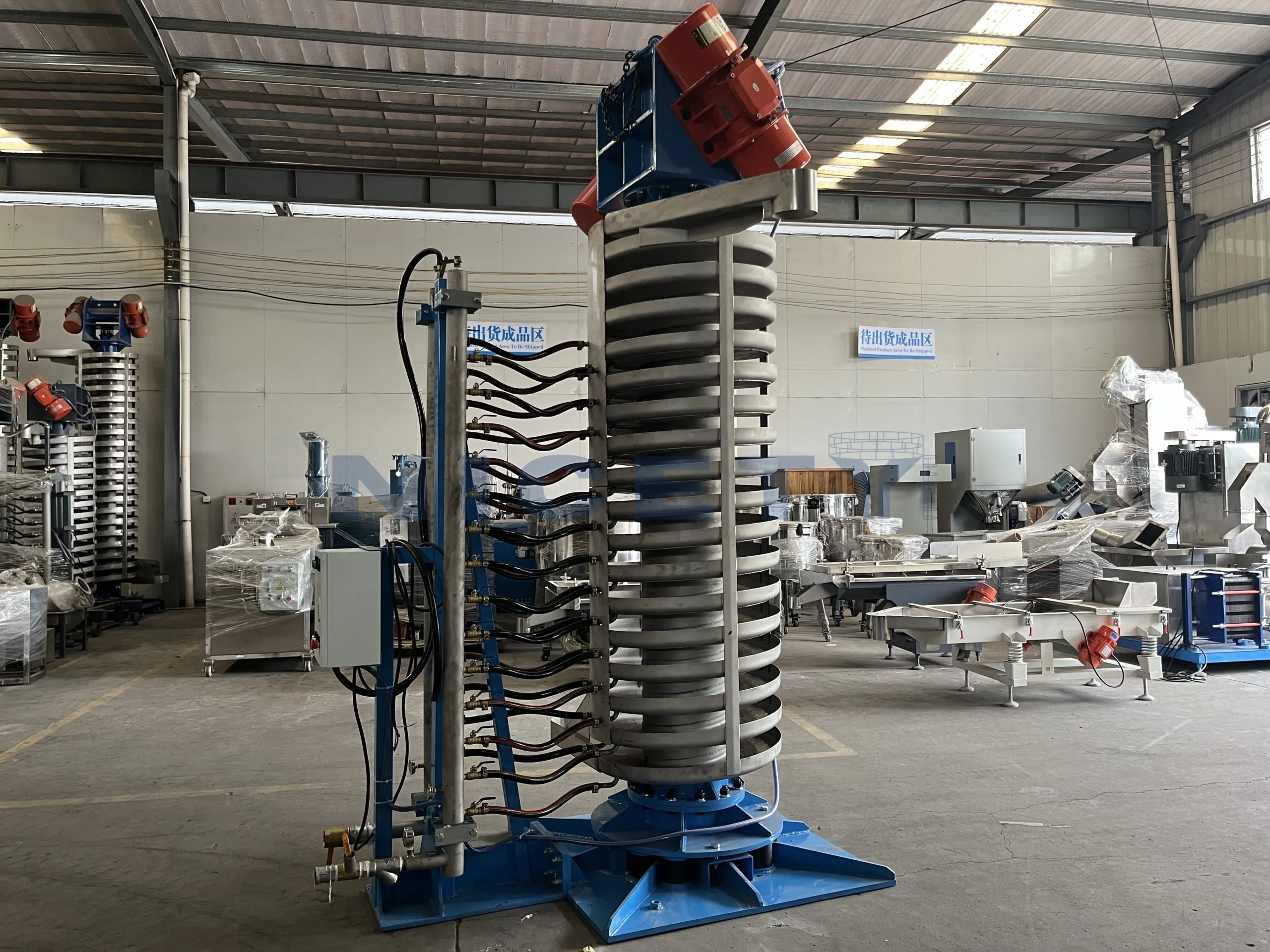
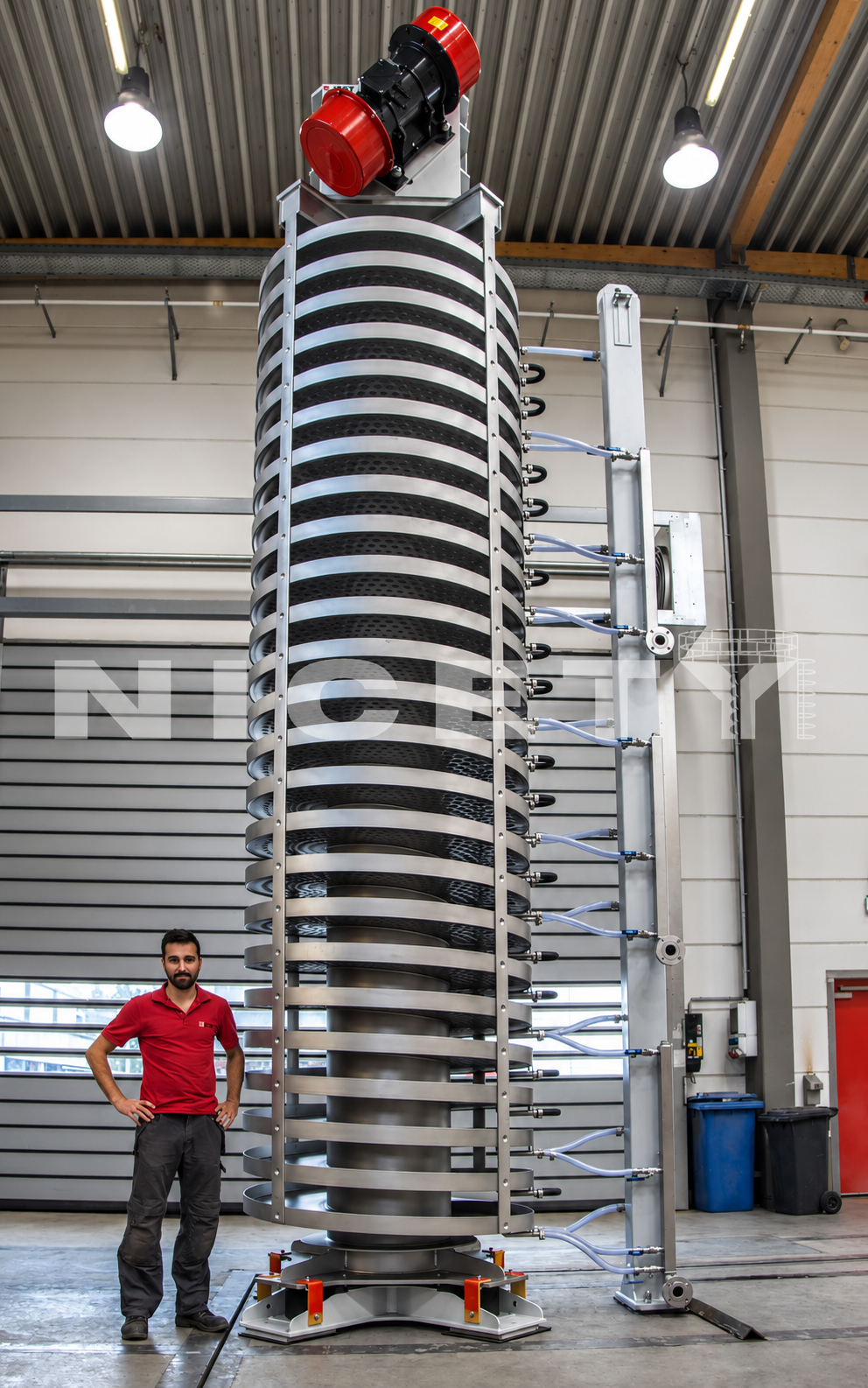
A water-cooled elevator we delivered to a plastics modification plant in Turkiye.

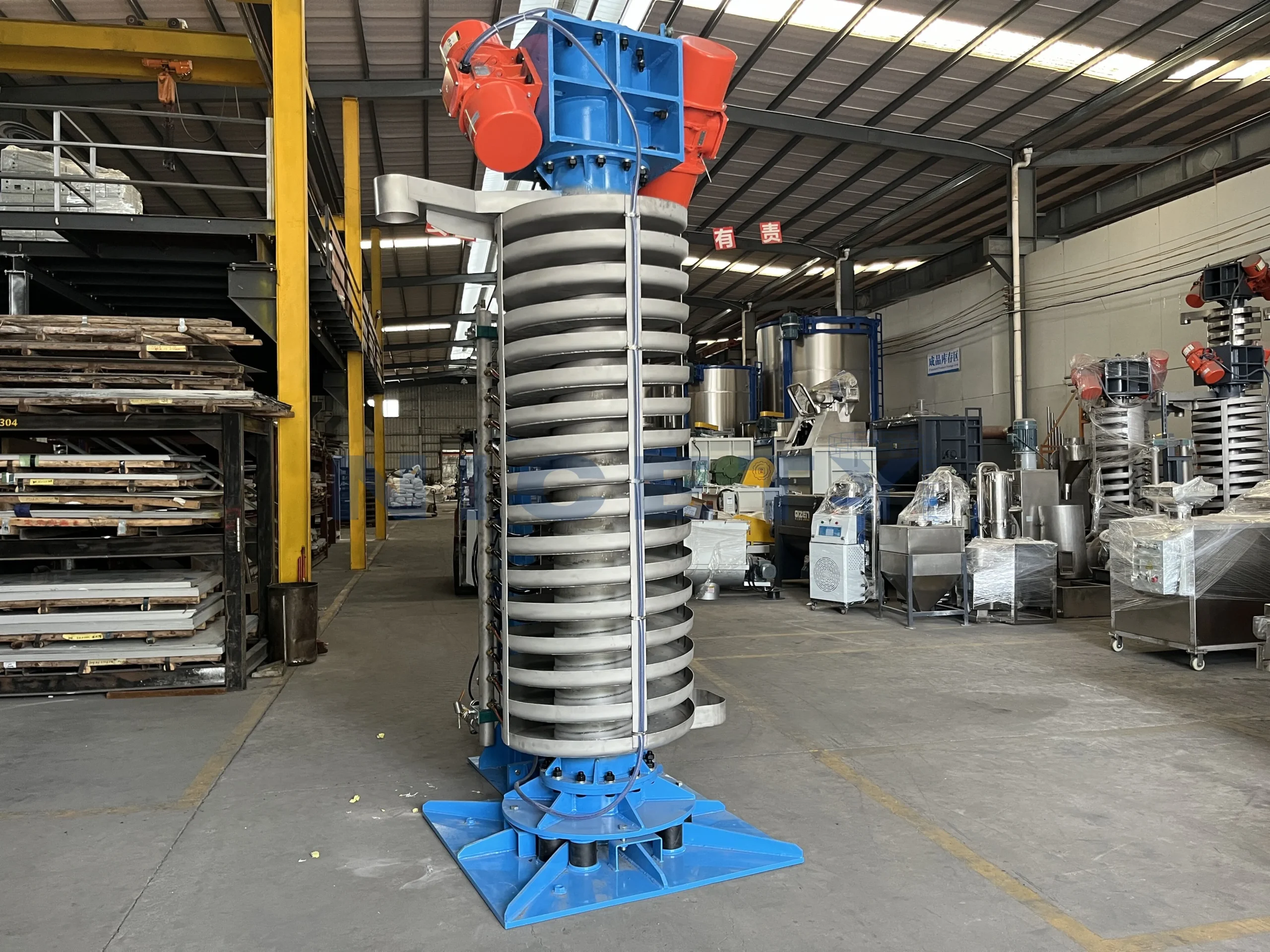
We have reinforced every part, wrapped the equipment in PE film, and packed it in a wooden crate to meet LCL shipping requirements and ensure maximum protection against impact damage.

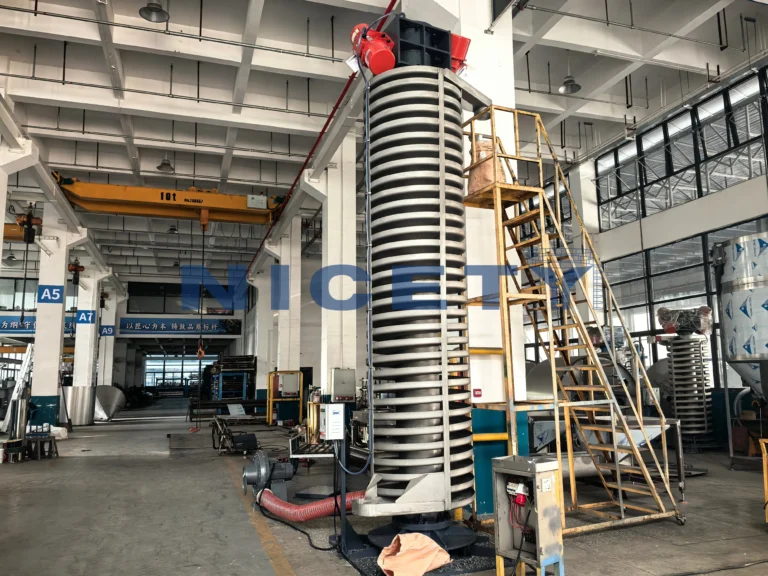
A Ø1,000 mm water-cooled elevator with a lift height of up to 6 m, delivered to a customer in Saudi Arabia.

Built for elastomer pellets, which need conductive cooling rather than air alone, so this is the water-cooled type: a Ø1,000 mm spiral column with a lift height of up to 6 m, taking the heat out through the trough wall on the way up. Every part was reinforced, the equipment wrapped in PE film and packed in a wooden crate to meet shipping requirements and protect against impact damage.

ABS Modification Pellet Cooling, Drying and Classification Line for an Automotive-Grade Compounding Plant in Thailand

A pellet cooling, drying and classification line for a plastics modification plant in Thailand that compounds ABS for automotive parts and interior components — cut, cooled, dried and graded in one closed line instead of being moved by hand between separate machines.

Scroll the table sideways to read every column →

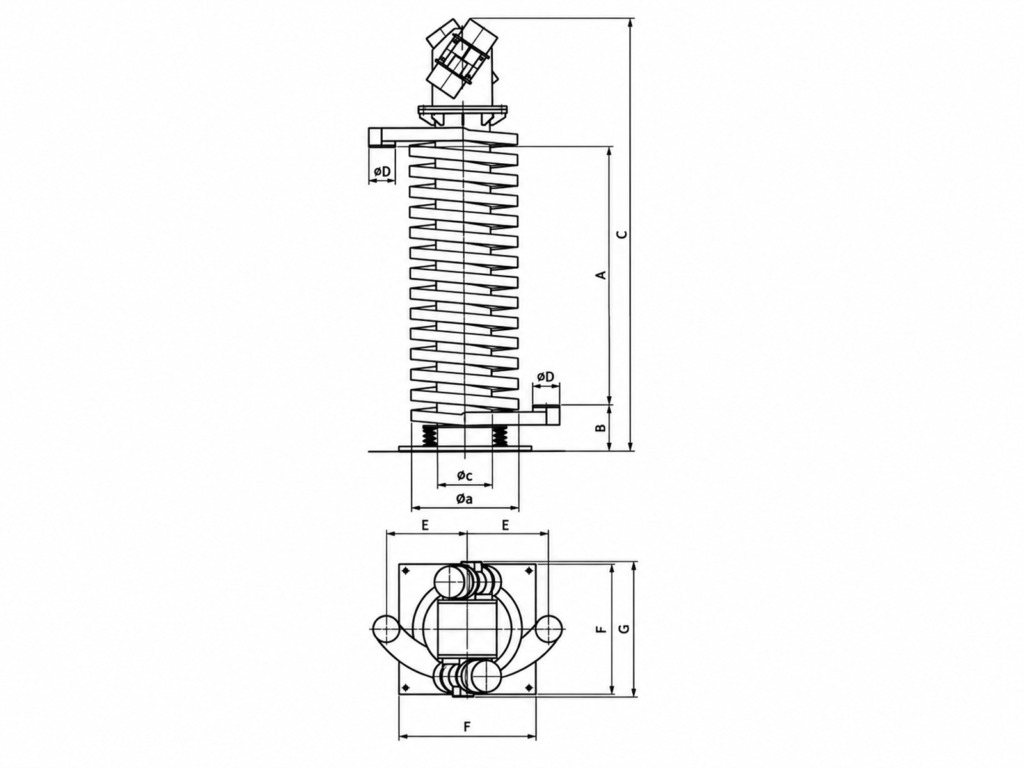
Model Rango de capacidad Potencia nominal Spiral Groove Diameter Height (Customizable) Working Frequency
NC-Z1250 0.3-0.5 Ton/Hour 0.2 kW ø300mm 1250mm 1500Hz/min
NC-Z2000 0.6-0.8 Ton/Hour 0.4 kW ø350mm 2000mm 1500Hz/min
NC-Z3500 3-3.2 Ton/Hour 1.5 kW ø500mm 3500mm 1000Hz/min
NC-Z4500 4-4.2 Ton/Hour 3 kW ø610mm 4500mm 1000Hz/min
NC-Z6000 2-2.2 Ton/Hour 4.4 kW ø800mm 6000mm 1000Hz/min

Scope of supply

What is included, and what is not

The quotation states the scope for the confirmed configuration; the groups below describe how a supply is normally split.

Incluido de serie

  • Heavy-gauge SUS304 spiral flight and central column assembly Continuous welded spiral flights with smooth polished product contact surfaces.
  • Dual adjustable eccentric vibration motors Synchronized unbalance motors with IP65 protection and adjustable counterweight plates for amplitude tuning.
  • Heavy-duty vibration isolation base with rubber damping columns Fitted with 8 to 10 rubber damping columns (configured according to base structure and column diameter) to absorb operational dynamic vibration and maintain equipment stability.
  • Customized cooling interfaces & internal fluid channel structure Tailored interfaces and internal flow channel structures engineered for water-cooling or air-cooling configurations, maximizing internal circulation efficiency and heat-dissipation performance.
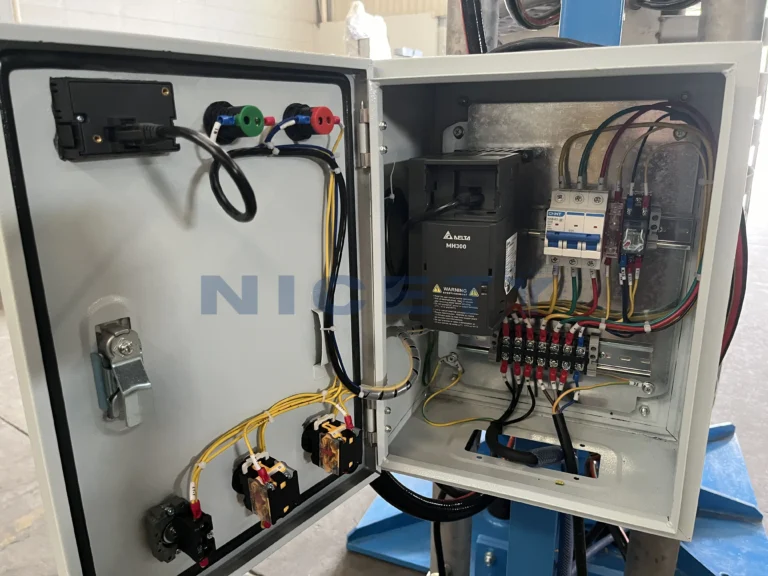
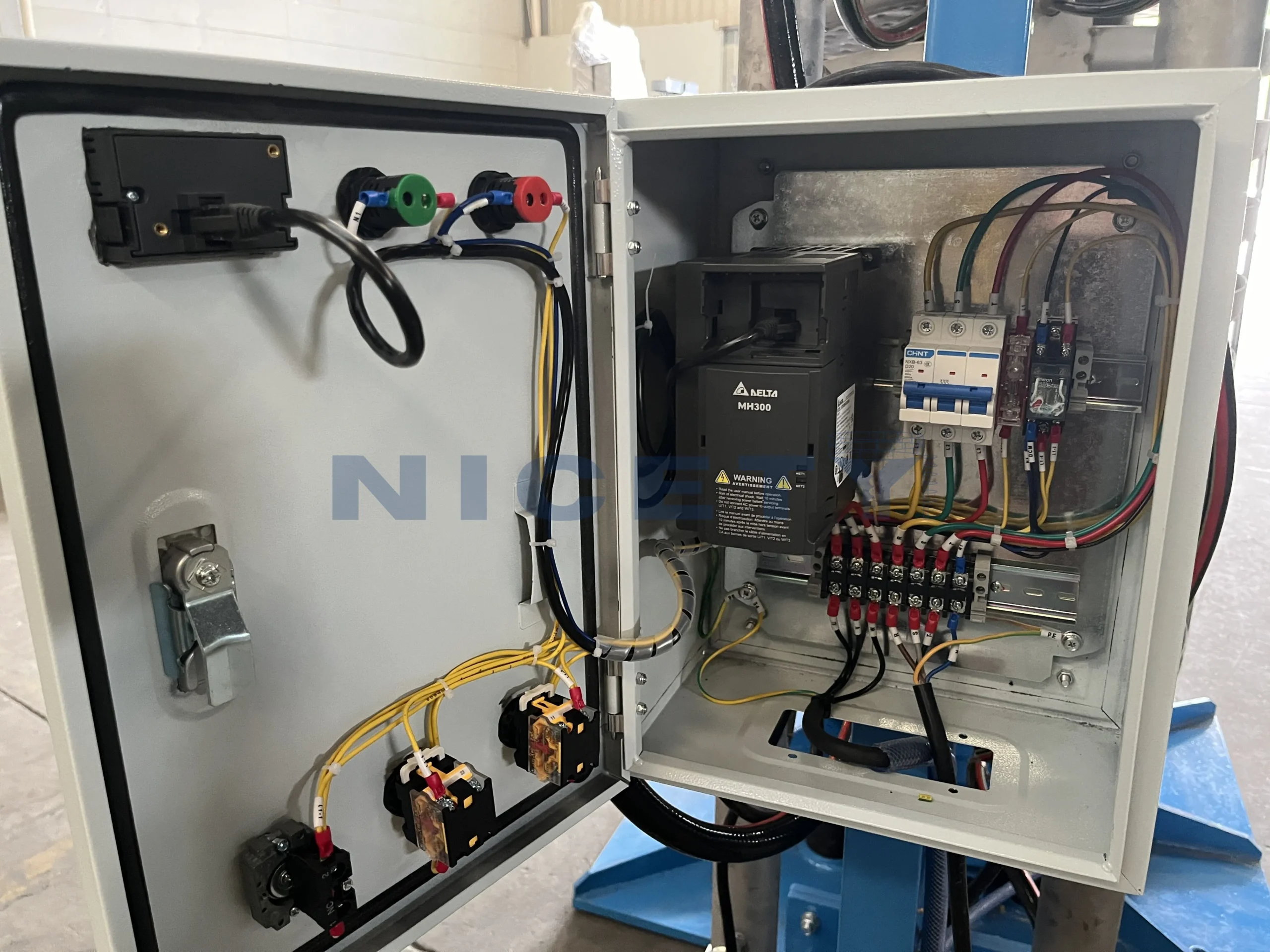
  • Electrical control cabinet with integrated VFD inverter Houses dedicated variable-frequency drive (VFD), circuit breakers, overload protection, run/stop pushbuttons, and emergency stop switch. Specified electrical component brands available upon request.
  • Variable-frequency drive (VFD) speed & amplitude control system Standard integrated inverter for stepless vibration frequency regulation and flight conveying speed adjustment, matching different polymer bulk densities, cooling residence times, and throughput requirements.

Elementos opcionales

  • Cooling Mode: Forced Air Cooling vs. Water-Jacketed Conductive Cooling Choose between air-knife convective air cooling, double-jacketed hollow flight chilled water cooling.
  • Spiral Flight & Column Metallurgy and Surface Treatments Full SUS304 stainless steel product contact surfaces standard; SUS316L for abrasive/corrosive additives; mirror polishing (Ra ≤ 0.4 µm) or non-stick PTFE/fluoropolymer coating for tacky hot-melt resins and low-hardness elastomers.
  • Removable Dust Containment Shrouds & Thermal Enclosures Segmented stainless steel or clear polycarbonate transparent dust covers with quick-release over-center toggle clamps, enabling 100% dust containment and rapid toolless washdown.
  • Chilled Air Air-Conditioning & Dehumidification Skid Dedicated closed-loop air handling unit supplying dry, refrigerated air (+10°C to +15°C, low dew point) to prevent condensation and maximize cooling efficiency in humid tropical climates.
  • Upper-Floor & Elevated Platform Anti-Resonance Vibration Isolation Package Engineered specifically when installing the vibrating spiral elevator on 2nd floors, intermediate mezzanines, or elevated steel platforms. Includes calibrated multi-stage rubber damping assemblies, tuned dynamic inertia counterweights, and structural resonance mitigation framing to prevent vibratory energy from transmitting into the building structure.

No incluido

  • Civil foundations, vibration isolation trenches, and anchor grouting Concrete floor slab pouring and specialized anti-vibration civil trenching.
  • External chilled water generation systems and primary piping headers Central chillers, cooling towers, and external piping beyond the elevator supply/return water manifolds.
  • External dehumidified air generation units Central plant air conditioning / desiccant dehumidifiers unless explicitly included in an integrated turnkey proposal.
  • Upstream dewatering dryers and downstream packaging machinery Centrifugal dewaterers, vibrating classifiers, storage silos, and automated bagging systems beyond the flexible connector spigots.

Installation planning

Utilities, interfaces and site readiness

These are the connections the machine and the line around it have to agree on before the layout is fixed.

Requisitos de servicios auxiliares

Suministro eléctrico
220 V / 380 V / 415 V / 460 V (customizable), 50/60 Hz, 3-phase AC.
Agua
Air-Cooled Models: Zero water consumption. Water-Cooled Models: Requires continuous closed-loop chilled water supply (temperature 7°C–12°C, flow rate 2.0–6.0 m³/h, pressure 2.5–4.0 bar) connected to external industrial chiller or cooling circuit.
Aire comprimido
Not required for basic elevator operation. Optional pneumatic dust cover clamping or air-knife de-dusting manifolds require 0.5–0.6 MPa clean dry compressed air (< 0.1 m³/min).
Extracción y ventilación
Passive breathable top exhaust sock standard. Optional connection to central plant dust extraction (DN100–DN150 flange, airflow 300–600 m³/h) recommended when processing dusty regrind or air-cooled masterbatches.
Otras notas
Vibration motor installed power typically ranges from 2 × 1.1 kW up to 2 × 3.7 kW depending on column diameter and height; forced cooling air blowers range from 1.5 kW to 7.5 kW. Ensure electrical control includes independent thermal overload protection and phase-sequence monitoring for both vibration motors.

Requisitos de interfaz

Mechanical: Bottom tangential or radial infeed hopper positioned beneath the upstream dehydrator discharge chute; top tangential discharge chute connecting to linear vibrating screens, pneumatic conveying adapters, or storage silos; heavy-duty flexible silicone/PU vibration-isolating connection boots (DN150–DN250) on all ports.

Electrical & Control: Three-phase industrial power supply to local control cabinet; interlock terminals providing dry contacts for Run/Fault status, remote line interlocks with upstream pelletizers, and emergency stop coordination.

Cooling Utilities: For Water-Cooled models, flexible high-pressure water supply/return braided hoses (1″ to 1.5″ BSP/NPT) connected to external chilled water loop with flow monitoring and pressure relief.

Lo que el cliente prepara en obra

The buyer provides a reinforced level concrete floor slab (minimum 150 mm thickness, grade C25/C30) capable of absorbing dynamic vibratory oscillation without resonance transmission. Standard elevator configurations are designed and calibrated for ground-floor (1st floor) foundation installation. If installation on upper floors (e.g., 2nd floor mezzanine or elevated steel platform) is required, please notify our engineering team in advance: we will perform customized structural resonance evaluations and upgrade the vibration isolation engineering (including damping column stiffness tuning, dynamic counter-balancing, and platform isolation framing) to eliminate harmonic resonance and prevent structural fatigue or vibration damage to the building; three-phase industrial main power cabling routed to the local control cabinet; flexible silicone/PU boots connecting upstream centrifuge chutes and downstream screening/silo piping; and for water-cooled models, external chilled water supply/return piping (7°C–12°C, 2.5–4.0 bar) equipped with shut-off valves and water filtration.

Spare parts

Wear parts and recommended spares

The parts that wear in normal service, and the spares worth keeping on site. How often a part is replaced depends on the material and the duty the machine runs, so the basis is confirmed for each machine.

Recommended spares

Rubber Damping Columns

Inspect for rubber aging, micro-cracking, deformation, or elasticity loss during regular maintenance; replace when worn or damaged.

Depending on the base configuration and spiral diameter, 8 to 10 rubber damping columns are installed per unit. They bear the primary dynamic oscillation load and serve as wear parts.

Control Cabinet Electrical Components (Start/Stop Pushbuttons, E-Stop Switch & VFD Speed Potentiometer)

Inspect contact block conductivity, mechanical detent feel, and potentiometer response semi-annually; replace immediately if contact resistance increases, emergency reset sticks, or frequency knob jitters.

Standard electrical cabinet replacement pack including industrial start/stop pushbuttons (with indicator lights), twist-to-release emergency stop push button switch, and precision frequency adjustment potentiometer / digital keypad for the variable-frequency drive (VFD).

Water-Cooling Swivel Rotary Joints & Flexible Braided Hoses (Water-Cooled Models)

Inspect monthly for vibration fatigue, weeping, or hose chafing; replace braided hoses every 12 months.

High-pressure stainless steel flexible braided hoses and rotary distribution fittings supplying chilled water to the vibrating column.

Blades, screens and other normal consumables are outside the standard warranty. How a spare part is identified and ordered is set out under Warranty & Spare Parts.

Selection

How to choose a model

Work through what you already know. The rest is settled in the conversation, not before the first message.

Selecting the optimal vibrating spiral elevator configuration depends on polymer thermal properties, required temperature drop, factory headroom, and environmental conditions:

  • 1. Choosing the Optimal Cooling Architecture:
    • Air-Cooled Vibrating Spiral Elevator (Standard Choice): Utilizes multi-point centrifugal air blowers and directional air knives blowing filtered ambient or chilled air across ascending pellets. Best for standard rigid polyolefins (PP, HDPE, LDPE), engineering resins (ABS, PS, PA, PC), and general masterbatches. Low operating cost, highly reliable, and zero water consumption.
    • Water-Cooled Vibrating Spiral Elevator (High-Intensity Conductive Choice): Features double-walled hollow spiral flights with internal baffles circulating 7°C–12°C chilled water. Delivers direct conductive contact cooling with heat transfer rates 2–3× higher than air. Essential for soft, sticky, or low-melting polymers prone to post-dewatering re-agglomeration—such as Thermoplastic Elastomers (TPE, TPU, TPV), Ethylene Vinyl Acetate (EVA with high VA%), hot-melt adhesives, and polyolefin elastomers (POE). Also ideal for cleanroom packaging where exhaust air turbulence must be minimized.
  • 2. Sizing Column Diameter & Flight Height:
    • 500–650 mm Diameter: Rated for throughputs of 300 to 1,000 kg/h. Compact footprint for small compounding and recycling lines.
    • 750–900 mm Diameter: Rated for 1,200 to 2,200 kg/h. Industry standard for high-output twin-screw pelletizing lines.
    • 1,000–1,200 mm Diameter: Rated for 2,500 to 3,500+ kg/h heavy-duty high-tonnage production lines.
    • Residence Time & Height: Column height (2.5 m to 5.5 m) determines total flight path length (25 m to 55 m). Ensure sufficient residence time (minimum 60–90 seconds for polyolefins, 120–180 seconds for elastomers) to allow core heat diffusion.
  • 3. Tropical Climates & Ambient Air Considerations: If operating an air-cooled model in regions where summer ambient factory temperatures exceed 35°C–40°C, ambient air blowing will be insufficient to cool pellets below 45°C. Specify an integrated chilled air coil skid or upgrade to a water-cooled hollow flight system.

Información que necesitamos de usted

  1. 01 Polymer resin formulation, pellet geometry, and bulk density Specify base polymer family (e.g., PP, PE, PET, TPE, TPU, EVA, Masterbatch), pellet shape (underwater hot-cut spherical vs strand-cut cylindrical), dimensions, and Shore hardness / tackiness.
  2. 02 Target hourly throughput and upstream extrusion output Nominal and maximum hourly mass flow rate (kg/h or metric tons/h) directly discharged from upstream centrifugal dewaterer or pelletizer.
  3. 03 Thermal profile: Inlet temperature vs. Target packaging temperature Pellet core temperature entering the bottom infeed trough (°C) and required discharge temperature (°C) for safe bagging or silo storage (e.g., entering at 85°C, discharging at ≤ 40°C).
  4. 04 Selection of cooling mode (Air Cooling vs. Water Cooling) Preferred cooling configuration: Air-cooled (standard ambient/chilled air blowing) vs. Water-jacketed contact cooling (for sticky elastomers, high-temperature engineering plastics, or zero-dust cleanrooms).
  5. 05 Installation floor level, building footprint, clear ceiling height, and discharge height Installation floor level (ground floor vs. 2nd floor mezzanine/elevated platform—must be specified in advance for structural resonance evaluation and anti-vibration customization), available floor footprint, clear overhead ceiling height, infeed chute elevation, and top discharge height.

Request a Quote A model name, a material or a drawing is enough to start.

Photos and videos

The machine itself

Vídeos

Siguiente paso

Solicitar cotización

Indíquenos el material, el proceso y el resultado que necesita lograr. Los detalles técnicos se pueden completar más adelante junto con nuestro equipo de ventas.

Solicitar cotización