_画板-1的副本-300x300.png)
Application
Post-Consumer r-HDPE Bottle & Drum Recycling and Pelletizing Line
Post-consumer recycled HDPE (r-HDPE) application profile covering heavy shredding, vacuum degassing extrusion, continuous melt filtration, and water-ring pelletizing for bottle and pipe grades.

This industrial application profile examines the heavy shredding, fine wet granulation, vacuum extrusion degassing, continuous dual-piston melt filtration, and die-face water ring pelletizing architecture designed specifically for post-consumer recycled high-density polyethylene (r-HDPE) reprocessors. Target input materials include sorted post-consumer blow-molded bottles (milk jugs, shampoo and detergent bottles), 200L industrial chemical drums, gas pipe cutoffs, and agricultural chemical containers. Finished r-HDPE pellets are supplied back to blow-molding and extrusion converters for manufacturing non-food chemical bottles, double-wall corrugated underground drainage pipes, telecommunication micro-ducts, and heavy-duty shipping pallets.
Reprocessing post-consumer rigid HDPE scrap presents formidable industrial barriers: first, blow-molded HDPE resins have very low Melt Flow Index (MFI 0.1 to 0.8 g/10 min) and high molecular weight, demanding massive motor torque and precise temperature profiles to avoid viscous shear overheating. Second, incoming flakes contain tramp contamination—residual household detergents, paper label adhesives, printed inks, and trace moisture—which violently boil into volatile steam and pyrolytic gas inside the extruder barrel, creating hollow, porous pellets with poor environmental stress crack resistance (ESCR) and pungent odors. Third, foreign contaminants (sand, wood fibers, metal specks) cause frequent filter screen blinding. This specialized application integrates low-speed single-shaft shredding with magnetic separation, high-torque single/twin-screw extrusion with dual high-vacuum degassing zones (-0.095 MPa), continuous dual-piston hydraulic screen changers, die-face water-ring pelletizing, high-g centrifugal dewatering, and linear classifier dedusting, yielding dense, solid, odor-stripped r-HDPE pellets with virgin-like mechanical performance.
The scenario
Who runs it, what it makes, and what it must hold
A quién va dirigido
Post-consumer plastic recycling plants, PCR compounding facilities, and bottle/pipe reprocessors manufacturing certified recycled HDPE granules.
Producción típica
High-grade, dense, uniform r-HDPE pellets (cylindrical or lenticular shape, Ø2.5–3.2 mm) packaged in 25 kg valve bags or 1,000 kg bulk big bags (FIBC), fully certified for blow molding non-food bottles and extruding underground drainage pipes.
Objetivo de producción
Convert variable-density, contaminated post-consumer HDPE bottle and drum scrap into high-purity, uniform, dense r-HDPE pellets with zero internal voids, low odor, and excellent ESCR performance.
Material
What the line is fed
The properties named here are the ones the equipment questions turn on — they are confirmed per project, from samples where it matters.
Post-consumer and post-industrial rigid HDPE scrap: washed bottle flakes (milk jugs, detergent bottles), shredded 200L chemical drums, agricultural chemical jugs, and PE pipe scrap. Flake size 8–14 mm, bulk density 0.30–0.40 kg/L, residual moisture ≤ 2.0%, free of heavy tramp metal.

Process
The typical flow, step by step
The flow is the usual shape of the scenario; the machines for each step are chosen per project — see the solutions below.

-
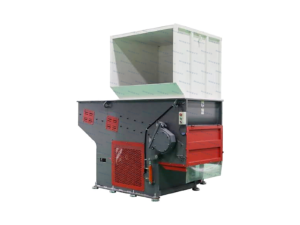
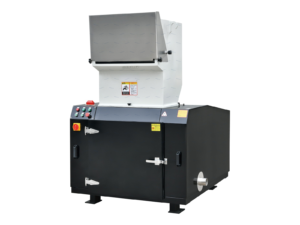
Single-Shaft Shredding, Granulation & Magnetic Separation
Raw Material Preparation
Shreds thick drums and bottle bales into uniform 30–50 mm chunks, granulates to 10–12 mm flakes, and extracts magnetic metal.
-
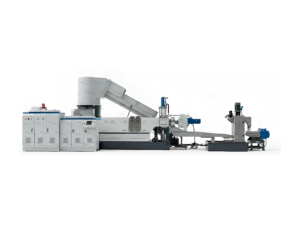
Extrusion Plastification, Vacuum Degassing & Melt Filtration
Extrusion and Melt Processing
Plastifies high-viscosity flakes, extracts moisture and volatiles under high vacuum (-0.095 MPa), and filters contaminants continuously.
-
Die-Face Water-Ring Pelletizing
Pelletizing
Cuts polymer melt directly at the die head with rotating knives while enclosed in circular cooling water.
-
Centrifugal Dewatering & Vibratory Classification
Post-Pellet Treatment
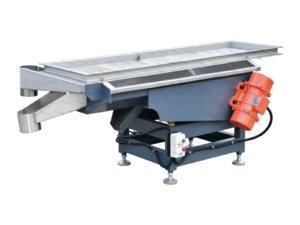
High-g centrifugal spinning expels water to ≤ 0.05%; dual-deck vibrating screen scalps off oversize doublets and dedusts micro-fines.
Requirements
What the process demands, and what quality is judged on
Requisitos críticos del proceso
1. Low-Speed, High-Torque Primary Shredding: Single-shaft shredder operating at 60–85 RPM shears thick-walled hollow drums and bottle bales into uniform 30–50 mm chunks without plastic melting or flying fragments, followed by suspended magnetic tramp metal extraction.
2. High-Torque Plastification & Dual-Vent Degassing: Large L/D (36:1 to 38:1) extruder with grooved feed bush processes high-molecular-weight melt; dual vacuum vents at -0.095 MPa boil off residual wash water, label adhesive volatiles, and organic odors.
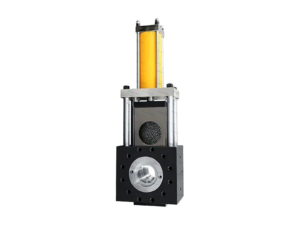
3. Continuous Dual-Piston Hydraulic Screen Changing: Dual breaker plates provide large filtration surface area; screens can be replaced under full line pressure (< 15 bar fluctuation) without line stoppages or melt leakage.
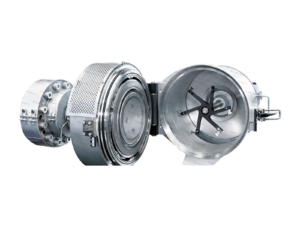
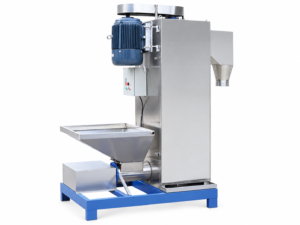
4. Die-Face Water-Ring Hot Cutting & Centrifugal Dewatering: Molten r-HDPE is sheared directly at the die head by pneumatic-loaded rotating blades; high-g vertical centrifugal dryer strips water to ≤ 0.05% before dedusting classification.
Requisitos de calidad
Bulk Density: Finished r-HDPE pellets must achieve solid bulk density ≥ 0.54 kg/L with zero porous foam cavities.
Melt Purity: Melt filtered through 80 to 120 mesh screens ensuring zero unmolten specks, metal particles, or foreign fibers in blown bottle walls.
Residual Moisture: Surface moisture strictly ≤ 0.05% (500 ppm) upon discharge from the centrifugal dryer.
Selection
What decides the equipment in this scenario
These are the questions a quotation is built from — answering them up front shortens the first round.
- Single-shaft shredder with hydraulic ram
- Solid alloy rotor with four-way indexable DC53/D2 blades and curved classifying screen (30–50 mm holes).
- Bimetallic recycling extruder with dual vacuum ports
- Deep-flighted screw with tungsten carbide flight cladding and dual high-vacuum degassing chambers.
- Continuous dual-piston hydraulic screen changer
- Dual cylindrical breaker plates with integral heating and electric hydraulic power pack for 24/7 non-stop filtration.
- Die-face water-ring pelletizer & centrifugal dryer
- Direct-coupled cutting hood with stainless steel water ring vortex chamber and vertical centrifugal dryer.
Fit
Where this scenario fits — and where it does not
The boundaries are part of the scenario: they keep equipment from being quoted into a case it cannot serve.
Mejor opción cuando
Best fit for commercial plastic recycling operations and PCR compounding reprocessors converting post-consumer rigid HDPE scrap (washed milk jugs, bleach bottles, cosmetic bottles, chemical containers, 200L drums, and gas pipe offcuts) into premium blow-molding and pipe-extrusion grade r-HDPE pellets with capacities ranging from 500 kg/h to 2,000 kg/h.
Requiere evaluación cuando
Requires assessment when processing ultra-low MFI blow-molding drums (MFI < 0.05 g/10 min) or multi-layer co-extruded barrier bottles (HDPE/EVOH/PA), where specialized high-torque barrier screws, high-vacuum oil-mist condensers, and continuous backflush screen changers are mandatory to prevent unmolten specks.
No adecuada cuando
Not suitable for unwashed, dirt-encrusted municipal waste containing over 10% stones, sand, or PVC bottle contamination without an upstream sink-float separation wash line.
Variants
How the scenario splits
A variant is written down only where the process and the decision actually differ.
Natural Bottle-Grade PCR r-HDPE (Milk Jugs)
- En qué se diferencia
Washed post-consumer translucent natural HDPE milk jugs (fractional MFI 0.5–0.8 g/10 min) with low color and minimal printing.
- Diferencia de proceso
Utilizes single-screw extruder with grooved feed bush and ceramic band heaters to prevent shear degradation, paired with fine 100-mesh filtration.
- Diferencia de producción
High-purity natural r-HDPE pellets with light transmission > 75%, suitable for blending up to 50%–100% into non-food blow-molded bottles.
Pipe & Drum Grade High-Toughness r-HDPE
- En qué se diferencia
Post-industrial and post-consumer thick-walled 200L chemical drums and pipe regrind (MFI 0.08–0.3 g/10 min) requiring extreme environmental stress crack resistance (ESCR).
- Diferencia de proceso
Requires heavy single-shaft shredder with hydraulic pusher ram, bimetallic screw/barrel, and continuous dual-piston screen changer.
- Diferencia de producción
High-viscosity, high-toughness black or dark grey r-HDPE pellets achieving ESCR (ASTM D1693 Condition B) > 500 hours.
Photos
The scenario in practice
Photos go here once real views of this scenario are cleared to publish.
-

Placeholder · 1200 × 900 px (4:3)(占位图) Replace with an approved application photo, real workshop or installation views at this size.(按此尺寸替换为正式图片。) -

Placeholder · 1200 × 900 px (4:3)(占位图) Replace with an approved application photo, real workshop or installation views at this size.(按此尺寸替换为正式图片。)
Before an inquiry
What we need to know to quote this scenario
- 01 r-HDPE feedstock source and sorting status Feedstock type (baled milk bottles, detergent containers, 200L drums, pre-crushed flakes), color purity, and label residue (%).
- 02 Moisture and contamination levels Residual surface moisture (typically 1.0% to 3.0%) and estimated non-polyolefin contamination (paper, foil, dirt).
- 03 Target downstream application and MFI Melt Flow Index (MFI at 190°C/2.16kg and 21.6kg) and downstream process (blow molding, double-wall corrugated pipe, sheet).
- 04 Plant utilities and floor footprint 3-phase 380V/415V electrical power (min 250 kW), cooling water (15–30 m³/h), and workshop space.
Request a Quote Send these points with your inquiry; the scenario can then be quoted against your line, not against an assumption.
Where to go next
The solutions and the equipment this scenario names
Solutions for this scenario
Solución
Closed-Loop Pellet Dewatering, Spiral Cooling, and Dedusting System
Integrated post-pelletiz…
Equipment for this scenario