_画板-1的副本-300x300.png)
Solución
Closed-Loop Underwater Pelletizing and Chilled-Water System for Thermoplastic Elastomers
Closed-loop underwater p…
Application
Industrial application profile for soft TPE, TPU, and TPV compound manufacturers, detailing twin-screw compounding, underwater pelletizing, and closed-loop chilled-water crystallization.

This industrial application profile examines the compounding, melt cutting, and closed-loop chilled water pelletizing setup engineered specifically for thermoplastic elastomer manufacturers producing soft TPE, TPU, TPV, and high-VA EVA compounds (hardness range Shore 30A to 85A) used across athletic footwear midsoles, automotive window sealing profiles, medical tubing, soft-touch electronics, and halogen-free cable jacketing.
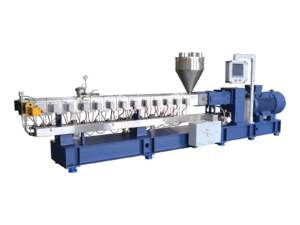
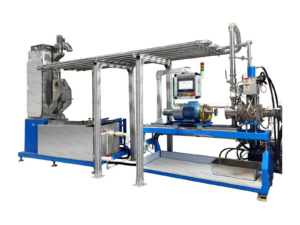
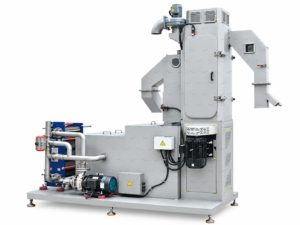
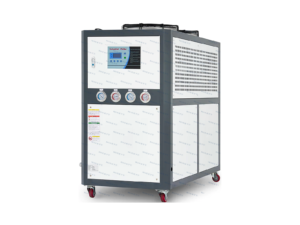
Manufacturing thermoplastic elastomers presents extreme processing challenges during the transition from melt to solid pellets. Low-modulus elastomers exhibit high melt tackiness and prolonged crystallization times. Attempting to process these materials via conventional water bath strand cutting causes strands to sag, stretch, fuse together in the water trough, and wrap around feed rollers. Similarly, conventional water-ring cutters suffer from severe blade smearing, thermal agglomeration, and die-face wrap-around ("ice hockey puck" build-ups). This specialized application integrates a high-torque co-rotating twin-screw extruder with pressurized melt delivery, a fully submerged underwater pelletizer with pneumatic blade advance, an industrial chiller delivering ±0.5°C process water control, and a dedicated centrifugal underwater dewatering machine, producing perfectly uniform, non-sticking spherical micro-pellets.
The scenario
Specialty thermoplastic elastomer compounders, synthetic shoe sole material manufacturers, and cable compound producers supplying automotive overmolding, footwear, consumer electronics, and medical device markets.
Free-flowing, non-sticking spherical elastomer pellets (Ø2.0–3.0 mm) packaged in 25 kg foil-lined moisture-barrier bags or lined cardboard octabins, ready for direct injection overmolding, extrusion blow molding, or calender sheet manufacturing.
Achieve continuous, uninterrupted extrusion and pelletizing of tacky, low-hardness elastomers with zero die-face agglomerations, zero water carryover, and uniform spherical pellet morphology.
Material
The properties named here are the ones the equipment questions turn on — they are confirmed per project, from samples where it matters.
Thermoplastic elastomer raw materials: SEBS / SBS block copolymers (crumb or powder form), polypropylene copolymer pellets, dynamic vulcanized EPDM/PP, TPU granules, accompanied by technical white mineral oils (viscosity 15# to 68#), processing aids, antioxidants, and silane coupling agents.

Process
The flow is the usual shape of the scenario; the machines for each step are chosen per project — see the solutions below.

Feeding and Material Transfer
Transfers SEBS crumb, PP pellets, and solid additives into multi-component gravimetric loss-in-weight feeders.
Compounding
Plastifies polymer components; high-pressure liquid pumps inject paraffinic oil into melt zones for continuous internal plasticization and devolatilization.
Pelletizing
Extrudes molten elastomer through an insulated circular die plate into an enclosed water cutting chamber, sheared instantly into droplets by rotating carbide knives.
Cooling
High-velocity turbulent water stream instantly chills molten droplets into solid spherical beads and flushes them to the dewatering section.
Post-Pellet Treatment
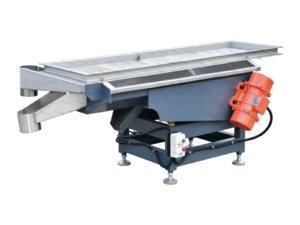
High-speed centrifugal rotor expels water through a fine slotted screen basket; dried pellets pass over a dedusting vibrating screen directly to packaging.
Requirements
1. Controlled Liquid Injection & Plasticization: Multi-stage liquid injection skids deliver pressurized white oil into the twin-screw mixing zones without pooling, ensuring total absorption into the SEBS elastomeric block network.
2. Stable Melt Pressure & Gear Pump Delivery: A high-precision melt gear pump between extruder and die head decouples extrusion surging, providing laminar melt pressure to the underwater die face.
3. Dynamic Blade Pressure & Anti-Freezing Die Plate: Die inserts feature vacuum thermal insulation layers and electric heat cartridges to prevent cold process water from freezing polymer inside die orifices, while pneumatic blade auto-advance maintains uniform micro-gap cutting contact.
4. Closed-Loop Chilled Water Recirculation: Industrial chiller circulates 8°C to 15°C water at high flow velocity to instantly solidify tacky molten droplets into solid spheres within milliseconds.
Pellet Morphology: Spherical or ellipsoidal micro-pellets with smooth surfaces; 100% free of agglomerated twins, triplets, or hollow shapes.
Residual Moisture: Surface moisture ≤ 0.05% (500 ppm) upon discharge from the centrifugal dewatering machine.
Free Flowability: Zero cold-caking or clumping during 48-hour palletized warehouse storage under ambient tropical conditions (35°C).
Selection
These are the questions a quotation is built from — answering them up front shortens the first round.
Fit
The boundaries are part of the scenario: they keep equipment from being quoted into a case it cannot serve.
Best fit for thermoplastic elastomer compounders manufacturing soft compounds with Shore hardness from 30A to 85A (SEBS/SBS oil-extended TPE, polyester/polyether TPU, dynamic vulcanized TPV, and high-VA EVA > 18%) where traditional strand lines fail due to low melt modulus and extreme tackiness.
Requires assessment when processing ultra-soft “gel-like” TPEs (Shore 00 to 20A) with oil extensions exceeding 60%, where specialized anti-tack liquid additives, chilled anti-stick water bath treatments, and modified pelletizer cutter speeds are necessary to prevent post-dehydration re-agglomeration.
Not suitable for crosslinked vulcanized rubbers (EPDM, NBR, silicone) requiring curing autoclaves, or rigid glassy engineering polymers with melt temperatures exceeding 330°C (PEEK, PEI).
Variants
A variant is written down only where the process and the decision actually differ.
SEBS/PP formulations with 30% to 55% paraffinic white mineral oil extension for consumer soft-grip overmolding and automotive interior trim.
Requires multi-stage liquid oil injection pumps along extruder barrel sections and precise chilled water temperature (10°C–15°C) to lock oil into SEBS rubber domains.
Ultra-soft spherical pellets with dry, non-oily surface and zero block caking during bulk carton storage.
Polyester and polyether TPU formulations for athletic shoe foaming beads (E-TPU), pneumatic tubing, and medical catheters.
Requires micro-hole die inserts, high-RPM underwater cutter rotor (up to 4,500 RPM), and stainless steel contact surfaces throughout.
Translucent, perfectly spherical micro-pellets (Ø1.2–2.0 mm) with tight particle size distribution and zero moisture bubbles.
Photos
Photos go here once real views of this scenario are cleared to publish.


Before an inquiry
Request a Quote Send these points with your inquiry; the scenario can then be quoted against your line, not against an assumption.
Where to go next
Solución
Closed-loop underwater p…
Solución
Integrated post-pelletiz…
Indíquenos el material, el proceso y el resultado que necesita lograr. Los detalles técnicos se pueden completar más adelante junto con nuestro equipo de ventas.