_画板-1的副本-300x300.png)
Solución
Dust-Free High-Speed PVC Compounding and Central Vacuum Feeding System
Enclosed, dust-free PVC …
Application
PVC extrusion pelletizing plant profile covering high-speed hot/cold compounding mixing, central vacuum transfer, and low-shear single-screw die-face pelletizing.

This industrial application profile outlines the dry blending, automated vacuum conveying, and single-screw pelletizing line architecture engineered specifically for PVC pelletizing plants producing flexible and semi-rigid polyvinyl chloride (PVC) pellets. Common applications include medical grade tubing, wire and cable jacketing, footwear soles, soft gasket extrusions, and automotive floor mats.
Processing plasticized PVC compounds requires precise thermal management and gentle shear control: high-shear compounding extruders overheat and degrade sensitive PVC polymers, triggering hazardous hydrochloric acid (HCl) gas liberation and burnt black discoloration. Conversely, insufficient pre-blending results in "sweating" pellets with unabsorbed liquid plasticizer puddles and inconsistent Shore hardness. This specialized application integrates a high-speed heating and cooling compounding mixer unit (SRL-Z series) for thorough plasticizer absorption (115°C–120°C hot mix to open PVC resin pores, followed by rapid cooling to 40°C), closed-loop vacuum conveying via a centralized feeding system, and a temperature-regulated low-shear single-screw extruder with die-face air/water-ring pelletizing, delivering bubble-free, perfectly plasticized, and crystal-clear PVC pellets.
The scenario
PVC compounders, cable manufacturing plants, footwear compound suppliers, and extrusion pelletizing facilities producing soft and semi-rigid PVC granules.
Clean, non-sticky flexible PVC pellets packaged in 25 kg multi-layer paper-plastic bags, ready for injection molding or extrusion of footwear, wire cables, medical tubes, and automotive trim.
Produce dust-free, non-blooming, completely plasticized flexible PVC pellets with stable Shore hardness, zero black specks, and pristine surface clarity.
Material
The properties named here are the ones the equipment questions turn on — they are confirmed per project, from samples where it matters.
Suspension PVC resin powder (K-value 65–70, bulk density 0.45–0.55 kg/L), liquid plasticizers (DOP, DOTP, DINP, DOA), Ca-Zn or organotin thermal stabilizers, stearic acid / PE wax lubricants, calcium carbonate fillers, and color pigments.

Process
The flow is the usual shape of the scenario; the machines for each step are chosen per project — see the solutions below.

Feeding and Material Transfer
Discharges PVC resin, mineral fillers, and additives into high-speed mixer charging port with dust collection.
Mixing
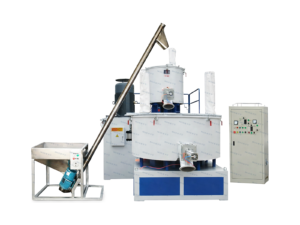
High-speed aerodynamic impellers generate frictional heat up to 120°C, soaking liquid plasticizers deep into PVC grains.
Cooling
Discharges hot dry-blend into lower cooling mixer, rapidly quenching material to 40°C via chilled water jackets to stop thermal history.
Feeding and Material Transfer
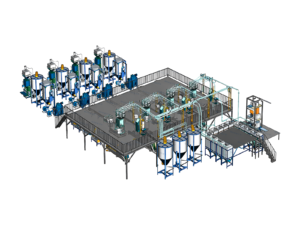
Transfers cooled dry-blend pneumatically through stainless vacuum pipes to the extruder feed hopper without powder segregation.
Extrusion and Melt Processing
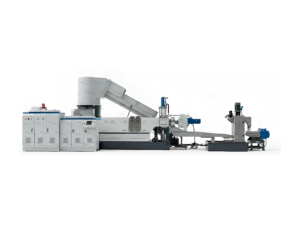
Plastifies PVC dry-blend under low shear and stable temperature, discharging molten polymer through a multi-hole circular die.
Pelletizing
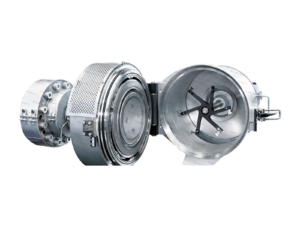
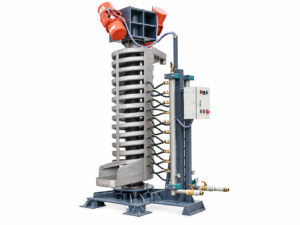
Cuts polymer melt at the die plate, conveying pellets into a spiral cooling elevator for gentle final cooling and dedusting.
Requirements
1. Controlled Frictional Heating & Plasticizer Soaking: High-speed mixer impellers convert kinetic energy into frictional heat, raising batch temperature to 115°C–120°C in 6–9 minutes to open porous PVC suspension resin grains, allowing complete plasticizer absorption.
2. Rapid Cold-Mix Quenching: Hot dry-blend drops automatically into the lower cooling mixer, cooling rapidly to ≤ 40°C in 4–6 minutes via chilled water jackets to stop thermal degradation and restore dry flowability.
3. Gentle Low-Shear Plastification: Single-screw extruder with deep-flighted feed zone and oil-cooled screw core gently plastifies PVC without localized shear overheating or thermal decomposition.
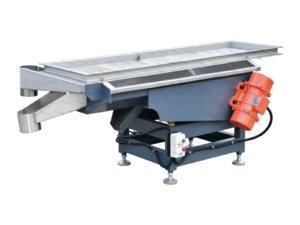
4. Die-Face Hot Cutting & Spiral Elevator Cooling: Molten PVC is sheared directly at the die head; pellets are pneumatically conveyed through a vibrating spiral cooling elevator to cool below glass transition before packaging.
Plasticizer Absorption: Dry-blend powder must be 100% dry and free-flowing with zero liquid oil sweating on touch.
Thermal Stability: Congo Red test at 200°C ≥ 60 minutes, ensuring zero polymer degradation during extrusion.
Pellet Consistency: Uniform lenticular or spherical shape (Ø3.0 mm), Shore hardness variation within ±1 Shore A across full batch.
Selection
These are the questions a quotation is built from — answering them up front shortens the first round.
Fit
The boundaries are part of the scenario: they keep equipment from being quoted into a case it cannot serve.
Best fit for PVC pelletizing plants manufacturing flexible PVC compounds (Shore 45A to 95A), PVC wire and cable insulation compounds, medical PVC pellets, and transparent footwear sole materials where complete liquid plasticizer absorption and gentle melt processing are mandatory.
Requires assessment when processing high-transparency crystal-clear medical PVC or food-contact grades, where liquid tin stabilizers, electropolished SUS316 contact surfaces, and dust-filtered cleanroom packaging enclosures are necessary.
Not suitable for direct powder-to-pipe rigid PVC processing (where dry-blend powder is fed directly into conical counter-rotating twin-screw extruders without intermediate pelletizing).
Variants
A variant is written down only where the process and the decision actually differ.
Flexible PVC formulations with 40 to 80 phr DOP/DOTP plasticizer for transparent medical drip chambers and soft tubing.
Requires liquid tin/non-toxic Ca-Zn stabilization, mirror-polished screw chrome-plating, and air-cooling die-face pelletizing to prevent water absorption.
Crystal-clear, non-blooming pellets with light transmission > 90% and zero yellowing.
Cable insulation and jacketing PVC formulations with 30 to 50 phr plasticizer, heavy CaCO3 filler (30–60 phr), and flame-retardant antimony trioxide.
Requires heavy-duty hot/cold mixer with dual-tier high-shear impellers to fully disperse heavy mineral fillers and antimony synergists.
Flame-retardant, high-dielectric-strength PVC pellets complying with UL94 V-0 and RoHS/REACH standards.
Photos
Photos go here once real views of this scenario are cleared to publish.


Before an inquiry
Request a Quote Send these points with your inquiry; the scenario can then be quoted against your line, not against an assumption.
Where to go next
Solución
Enclosed, dust-free PVC …
Solución
Integrated post-pelletiz…
Indíquenos el material, el proceso y el resultado que necesita lograr. Los detalles técnicos se pueden completar más adelante junto con nuestro equipo de ventas.