_画板-1的副本-300x300.png)

Heavy-Duty Dual-Column Gantry Framework
Robust dual-column gantry architecture eliminates cantilever shaft deflection under high strand tension, guaranteeing uniform blade clearance across widths up to 800 mm.
Equipment
Heavy-duty gantry portal strand pelletizer engineered for high-throughput continuous pelletizing of engineering plastics and reinforced compounds.
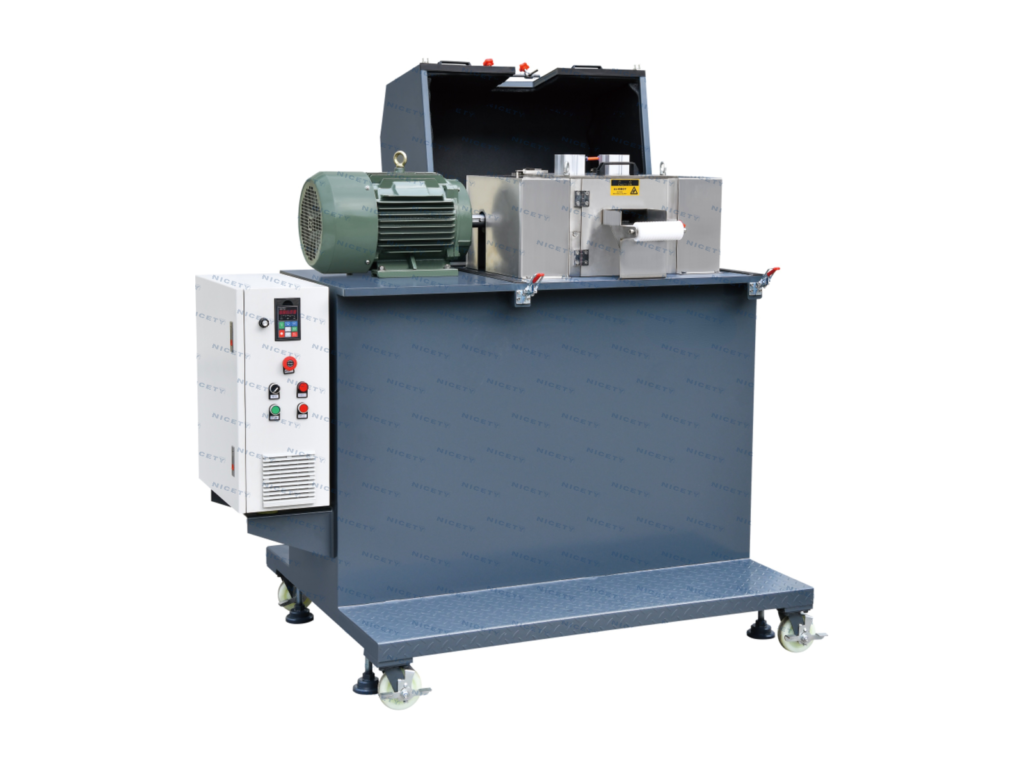
Overview
Continuously draws, feeds, and precision scissor-cuts wide arrays of cooled polymer strands into uniform cylindrical plastic pellets across high-output production lines.
The Gantry Pelletizer (heavy-duty portal / cantilever strand cutting system) is the industrial high-capacity benchmark for continuous polymer strand pelletizing in petrochemical polymer plants, large-scale engineering plastics compounding, and high-volume masterbatch production lines. Built on a rigid dual-column gantry or bridge-type cantilever structure, it accommodates wide strand working widths (typically 300 mm to 800 mm or more) and handles scores of simultaneous polymer strands drawn continuously from high-throughput extruder water baths.
Unlike light cantilever strand cutters that suffer from spindle deflection under heavy pulling loads, the gantry pelletizer’s portal framework delivers maximum mechanical rigidity, uniform blade-to-bed-knife clearance across the entire working width, and high vibration damping during non-stop 24/7 industrial campaigns. Driven by independent heavy-duty variable frequency or servo drive systems for the feed traction rollers and multi-blade helical cutting rotor, it delivers razor-sharp scissor cutting of solidified strands, producing uniform cylindrical pellets with clean cut faces, strict length consistency, and minimal fines—even when processing tough, highly filled, or high-viscosity polymers such as glass fiber reinforced engineering thermoplastics (PA66, PBT, PC) and high-load masterbatches.
Key features
Each picture names one part of the machine and what it does for the material and the batch.
Robust dual-column gantry architecture eliminates cantilever shaft deflection under high strand tension, guaranteeing uniform blade clearance across widths up to 800 mm.

Multi-tooth helical cutter cylinder dynamically balanced to ISO G1.0, delivering a continuous scissor shearing action that minimizes cutting impact, vibration, and dust generation.

Solid tungsten carbide stationary counter-blade with multiple precision-ground reversible cutting edges, maximizing service life in abrasive glass fiber processing.

Pneumatic cylinder loaded upper polyurethane/rubber traction roller coupled with a precision-ground alloy steel lower roller, delivering constant, non-slip pulling tension across dozens of strands.

Upper cutting chamber tilts or swings open via hydraulic/pneumatic assist, offering unobstructed access for blade inspection, gap adjustment, and thorough cleaning during color or grade changeovers.

Digital line speed synchronization with upstream extruder, stepless pellet length regulation, emergency strand-break stop interlocks, and safety cover interlock switches.
Material and process
Read the conditions together: a machine is selected for the material and the output, not from its name alone.
The standard industrial solution for high-throughput continuous strand pelletizing in engineering plastics compounding, reinforced composites, petrochemical virgin polymer plants, and masterbatch manufacturing.
Universally suitable for Polyamides (PA6, PA66), Polycarbonate (PC), Polybutylene Terephthalate (PBT), Polyethylene Terephthalate (PET), ABS, SAN, Polystyrene (PS), Polypropylene (PP), High-Density Polyethylene (HDPE), and POM. Highly recommended for abrasive glass-fiber reinforced formulations (15%–50%+ GF), carbon-fiber compounds, flame-retardant alloys, and high-concentration masterbatches requiring continuous heavy-duty operation.
The gantry pelletizer is a high-rigidity cold strand scissor cutting machine; key process and operational boundaries include:
Accepts cooled, solidified, and dewatered continuous polymer strands emerging from the upstream strand water bath and high-velocity air wipe drying blowers.
Strands must be cooled below their crystallization/solidification temperature to ensure adequate mechanical stiffness without molten cores. Surface water must be thoroughly removed to prevent wet pellet clumping. Nominal strand diameter typically ranges from 2.0 mm to 4.0 mm with consistent strand spacing.
Delivers uniform cylindrical plastic pellets with clean, perpendicular cut faces, tight length-to-diameter aspect ratio, and minimal dust or agglomerates.
Pellets discharge smoothly via gravity from the bottom funnel directly into vibratory grading sieves, fluid-bed cooling classifiers, or pneumatic dense-phase conveying lines.
Throughput
Read a figure together with the basis below it: the same machine reaches different numbers on different materials.
Throughput typically ranges from 800 kg/h to 3,500+ kg/h depending on working cutter width (e.g. 300 mm, 500 mm, 600 mm, 800 mm), number of active strands (up to 40–120 strands), and line hauling speed.
Actual output is governed by upstream polymer cooling efficiency in the strand water bath and strand cross-sectional stiffness. Rigid engineering plastics (e.g. PA66, PBT, PET) cut cleanly at high linear speeds, whereas high-elasticity or ductile polymers require optimized cooling water residence time before reaching the infeed nip.
Scope of supply
The quotation states the scope for the confirmed configuration; the groups below describe how a supply is normally split.
Installation planning
These are the connections the machine and the line around it have to agree on before the layout is fixed.
Mechanical: Rigid floor mounting on vibration-damping pads; feed table flange aligns with the upstream strand guide trough; bottom discharge hopper flange designed to mate directly with vibratory classifying screens or pneumatic conveying suction boots.
Electrical & Automation: Three-phase industrial power supply to the main control panel; dry contact interlock signals for upstream extruder emergency stop coordination and line speed synchronization.
The buyer provides a reinforced level concrete floor foundation, electrical power drops terminated at the local control panel isolator switch, upstream strand cooling water troughs, air-wipe water suction blowers, pneumatic air lines, and safe operator access platforms around the feed table.
Spare parts
The parts that wear in normal service, and the spares worth keeping on site. How often a part is replaced depends on the material and the duty the machine runs, so the basis is confirmed for each machine.

Inspect cutting edges monthly; resharpen or replace when blade edges show micro-chipping, rounding, or when pellet cut faces exhibit burrs.
The primary multi-blade cutting cylinder. Rotating at high speed against the bed knife. It is strongly recommended to keep one precision-balanced spare rotor in stock to prevent prolonged production stoppage during resharpening cycles.

Rotate to a fresh cutting edge upon wear; resharpen or replace when all reversible edges have been utilized.
Stationary bottom counter-blade mounted on the rigid gantry base with fine micrometer gap adjustment screws.

Inspect every 3 to 6 months for surface grooving, abrasion, or hardening; recover or replace sleeve when traction grip degrades.
Resilient elastomer sleeve on the upper feed roller providing non-slip pulling tension on plastic strands without crushing.

Lubricate per maintenance schedule; replace every 10,000–15,000 operating hours or upon bearing temperature rise / vibration.
High-precision spherical or cylindrical roller bearings supporting the dynamic gantry cutting shaft.
Blades, screens and other normal consumables are outside the standard warranty. How a spare part is identified and ordered is set out under Warranty & Spare Parts.
Selection
Work through what you already know. The rest is settled in the conversation, not before the first message.
Select the optimal gantry pelletizer configuration based on production output, strand width, and resin abrasiveness:
Request a Quote A model name, a material or a drawing is enough to start.
Indíquenos el material, el proceso y el resultado que necesita lograr. Los detalles técnicos se pueden completar más adelante junto con nuestro equipo de ventas.