
Application
High-Loading Calcium Carbonate (75%–85% CaCO3) Filler Masterbatch Compounding Line
Industrial application profile for high-loading calcium carbonate (75%–85% CaCO3) filler masterbatch compounding, surface coating, and water-ring pelletizing.
Calcium carbonate (CaCO3) and talc-filled masterbatches represent the highest volume additive compounds produced in the global plastics conversion industry. Widely utilized in PE t-shirt bags, agricultural mulch films, PP woven sacks, thermoformed food packaging containers, and automotive injection-molded components, these functional filler masterbatches incorporate 70% to 85% by weight of micro-fine mineral powder into a low-viscosity polyolefin carrier resin (typically LLDPE, LDPE, or homo-PP).
Producing high-concentration filler masterbatch at competitive throughput rates presents severe rheological, mechanical, and material handling challenges. Ultrafine calcium carbonate (typically 800 to 2500 mesh, average particle size $d_{50} = 1.5\text{--}5.0\ \mu\text{m}$) possesses a massive specific surface area and a naturally hydrophilic surface, making it completely incompatible with hydrophobic polyolefin melts. If fed without high-intensity surface modification, individual mineral particles agglomerate into tight microscopic clusters, causing severe melt filter clogging, high Filter Pressure Values (FPV > 5 bar/g), and visible white pinhole specks or tearing in thin blown films.
Moreover, micronized mineral powders entrain enormous volumes of trapped air. When fed into co-rotating twin-screw extruders at loadings above 75%, entrained air fluidizes the powder, resulting in severe feed throat bridging, vacuum vent eruptive boiling, and screw conveying slip. Furthermore, highly filled polyolefin melts exhibit virtually zero melt tensile strength at the extruder die face; conventional water-flume strand pelletizing fails completely because strands snap and tear under the slightest tension.
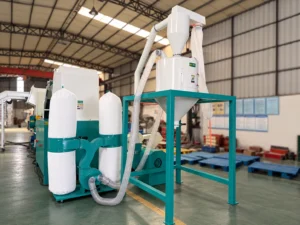
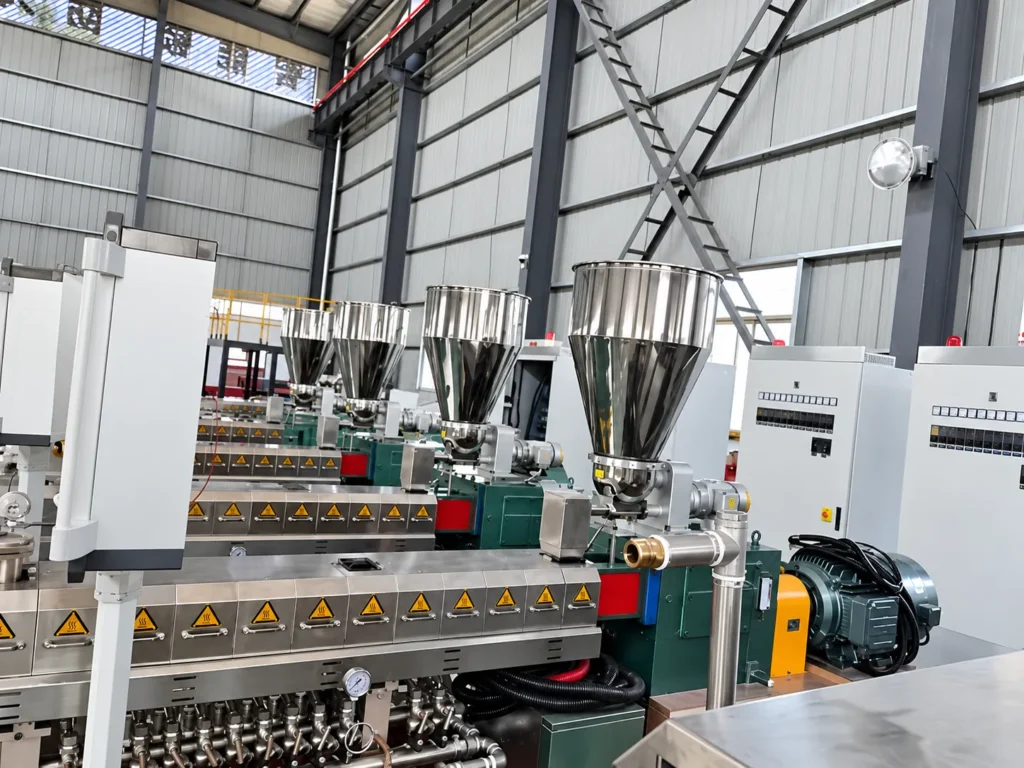
This specialized application scenario details the complete engineering process flow for 75%–85% CaCO3/talc filler masterbatch production: high-speed aerodynamic surface coating with stearic acid and coupling agents at 105°C–115°C, gravimetric multi-component feeding with high-torque side-feed de-aeration, co-rotating intermeshing twin-screw compounding with specialized kneading blocks, and enclosed die-face water ring pelletizing with centrifugal spin drying and inline multi-deck classifying.
Photos
The scenario in practice
Photos of the scenario type, cleared to publish; the shots of a specific project live in its project record.
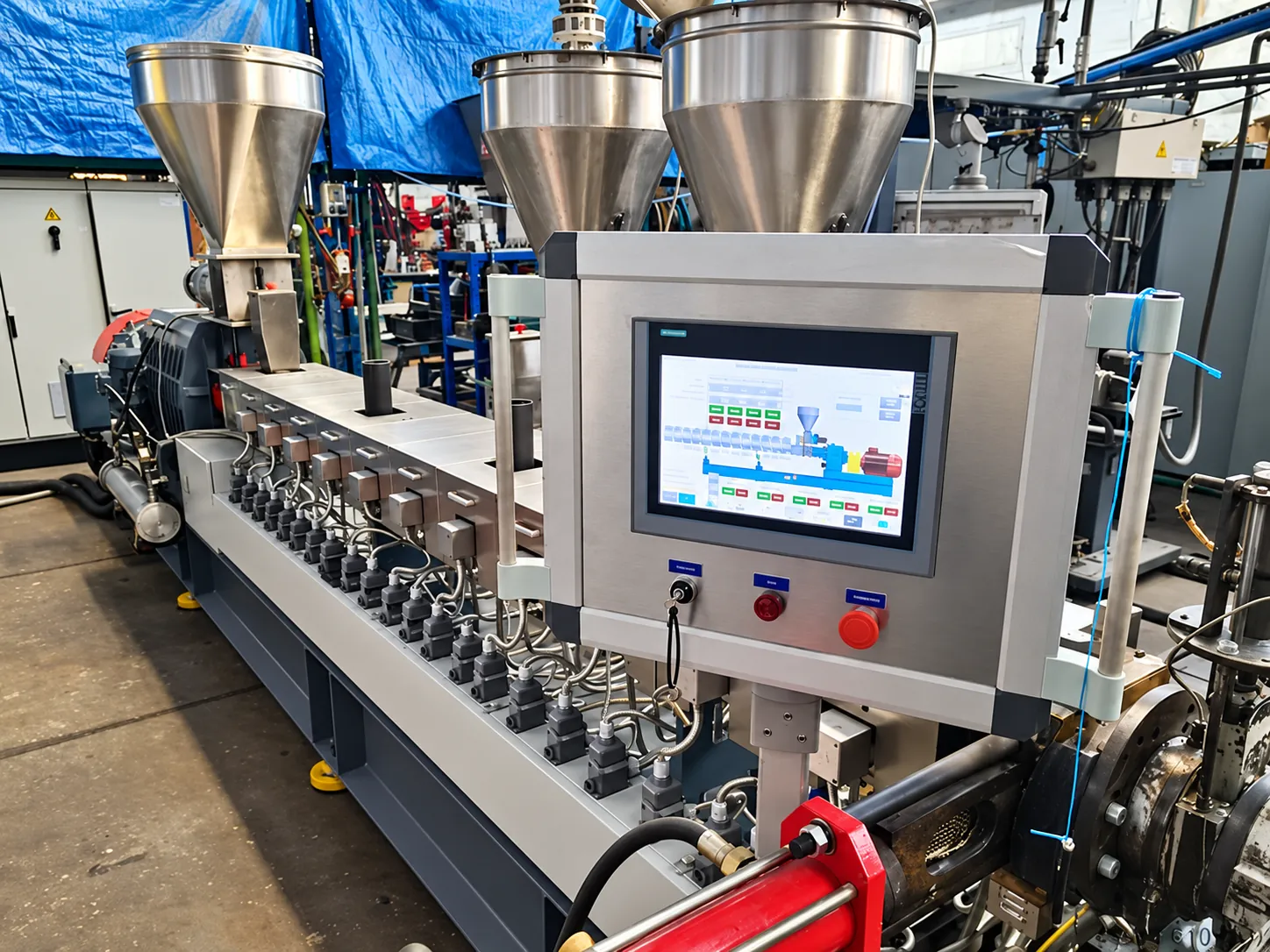
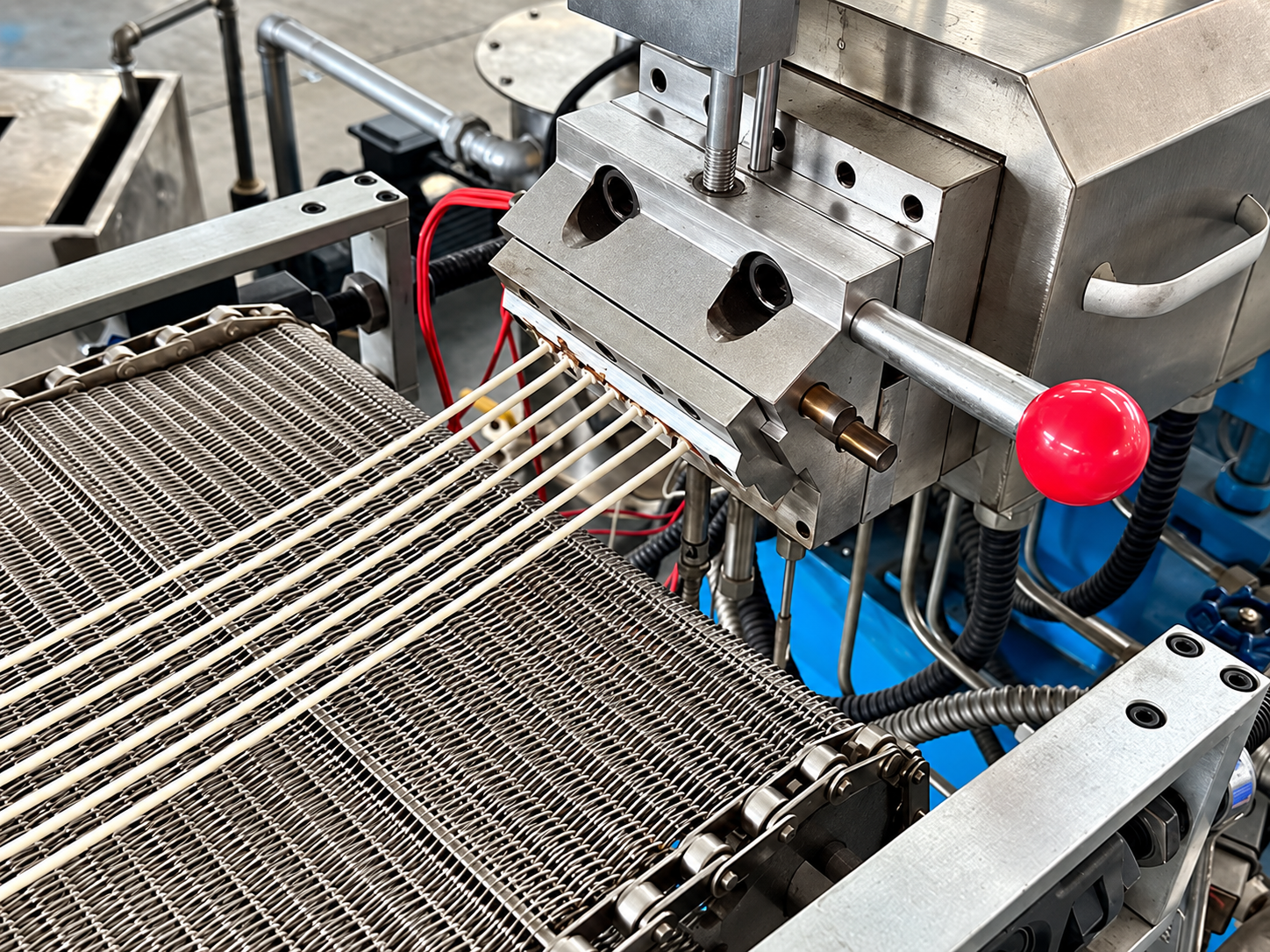
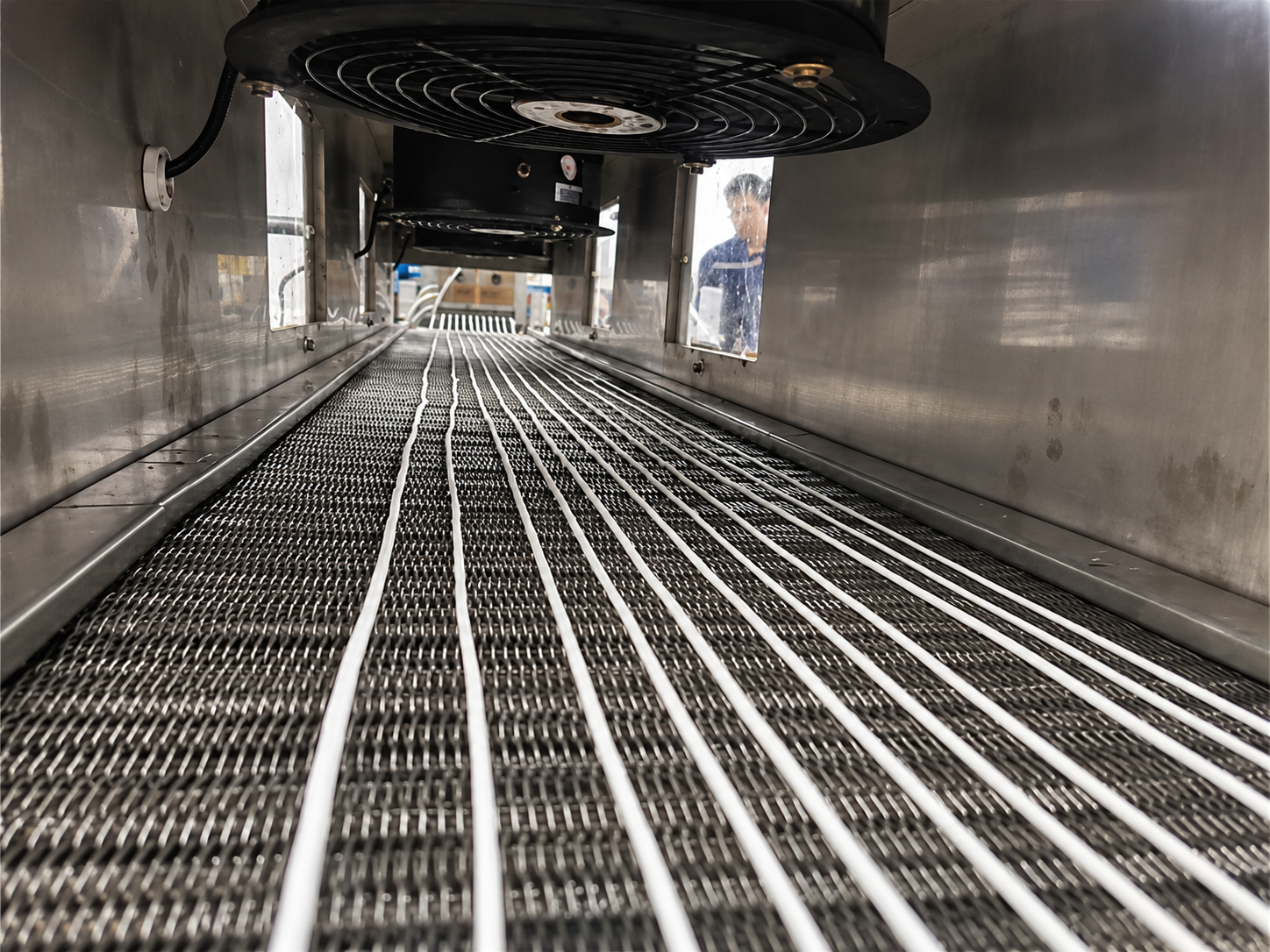
The scenario
Who runs it, what it makes, and what it must hold
Who it is for
Filler masterbatch producers and toll compounders supplying PP woven-sack and raffia converters, PE film and shopping-bag plants, pipe extruders and injection moulders; raffia tape and woven-bag factories that run their own captive masterbatch to hold their raw-material cost; and resin traders adding a filler masterbatch line to widen what they can offer.
Typical output
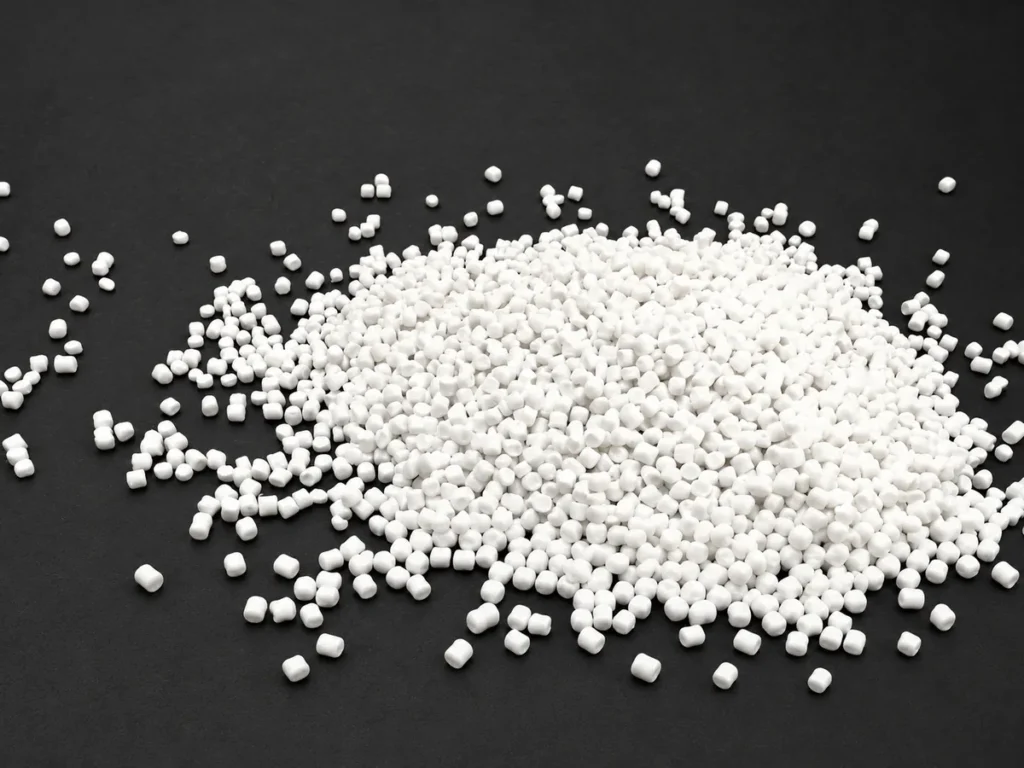
Mineral-filled masterbatch pellets on a polyolefin carrier, with the mineral share inside the 75–85% band the line was sized for, packed in 25 kg bags or FIBC bulk bags. Pellets are judged on loading consistency (ash against the recipe), grit-free dispersion and free-flowing behaviour at the customer’s dosing point — not on how they look in a sample bag.
Production goal
Hold the declared mineral loading batch after batch, keep the powder side of the plant clean and accurately weighed, and pelletize a stiff, highly filled melt without breaks, blockage or dust — so the masterbatch lets down smoothly in the customer’s film, tape or moulding process and its cost saving survives contact with the customer’s own dosing equipment.
Material
What the line is fed
The properties named here are the ones the equipment questions turn on — they are confirmed per project, from samples where it matters.
Heavy calcium carbonate, normally in coated (stearate-treated) form; where powder is bought untreated, the coating step is carried out in-house with stearic acid or a coupling agent. Talc replaces or accompanies the carbonate on grades that need stiffness or a matte surface. The carrier is a polyolefin matched to the customer’s own process — LLDPE or LDPE for film let-down, homo-PP for raffia and injection grades — with small additions of processing aids and antioxidants as the recipe requires. Powder fineness, coating type and moisture are confirmed on the actual purchased grade before anything is sized, because conveying behaviour, abrasion and dosing all follow the powder rather than the product name.
Process
The typical flow, step by step
The flow is the usual shape of the scenario; the machines for each step are chosen per project — see the solutions below.
-
Powder intake and dust-tight storage
Coated calcium carbonate — and talc where the grade calls for it — is received in bags or silos and moved in enclosed equipment with extraction at the transfer points. Powder handled in the open is the usual root cause of dirty weighing and dirty premixes.
-
Surface coating and premix in the high-speed mixer
Where powder is coated in-house, the hot stage disperses the stearic acid or coupling agent over the mineral surface and the cold stage cools the batch to a free-flowing discharge. On lines buying pre-coated powder this stage shrinks to a short blending step. Some lines omit the hot-coating stage entirely and buy fully coated powder.
-
Multi-component gravimetric dosing
Carrier pellets and coated premix are metered at the set ratio into the extruder. At loadings this high the recipe’s economics are decided at the weigh scale, so a dosing error is treated as a yield loss, not as fine-tuning.
-
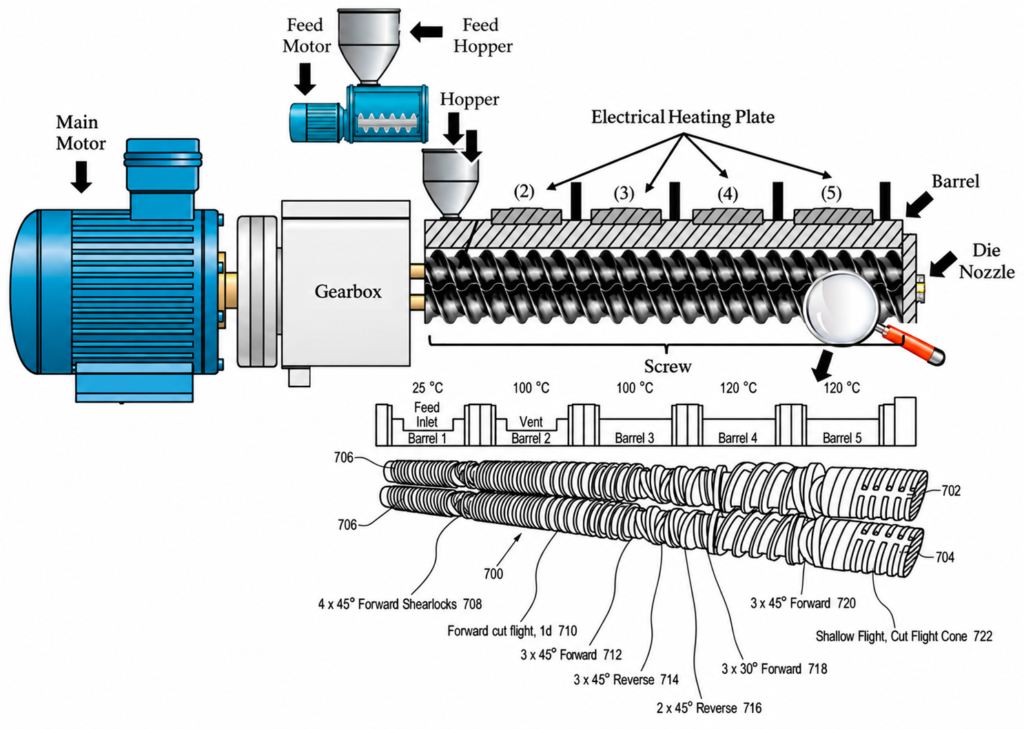
Twin-screw compounding
The carrier melts and the coated mineral is distributed through it; the screw layout is kept as gentle as the dispersion target allows, because the melt path is already working against an abrasive, highly filled recipe.
-
Vacuum venting of air and moisture
The vent strip removes the air and surface moisture that powder-rich recipes inevitably carry into the melt. Skipping it or running it under-sized shows up as unstable output and porous pellets rather than as an alarm.
-
Melt filtration before the die
A screen changer between extruder and die catches grit, coating residues and accidental contamination before the melt reaches the die face — the step that keeps specks out of film and tape grades and keeps a loaded pack from stopping the line.
-
Water-ring die-face pelletizing and drying
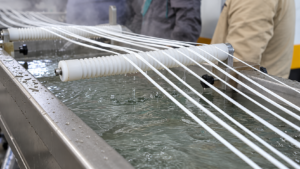
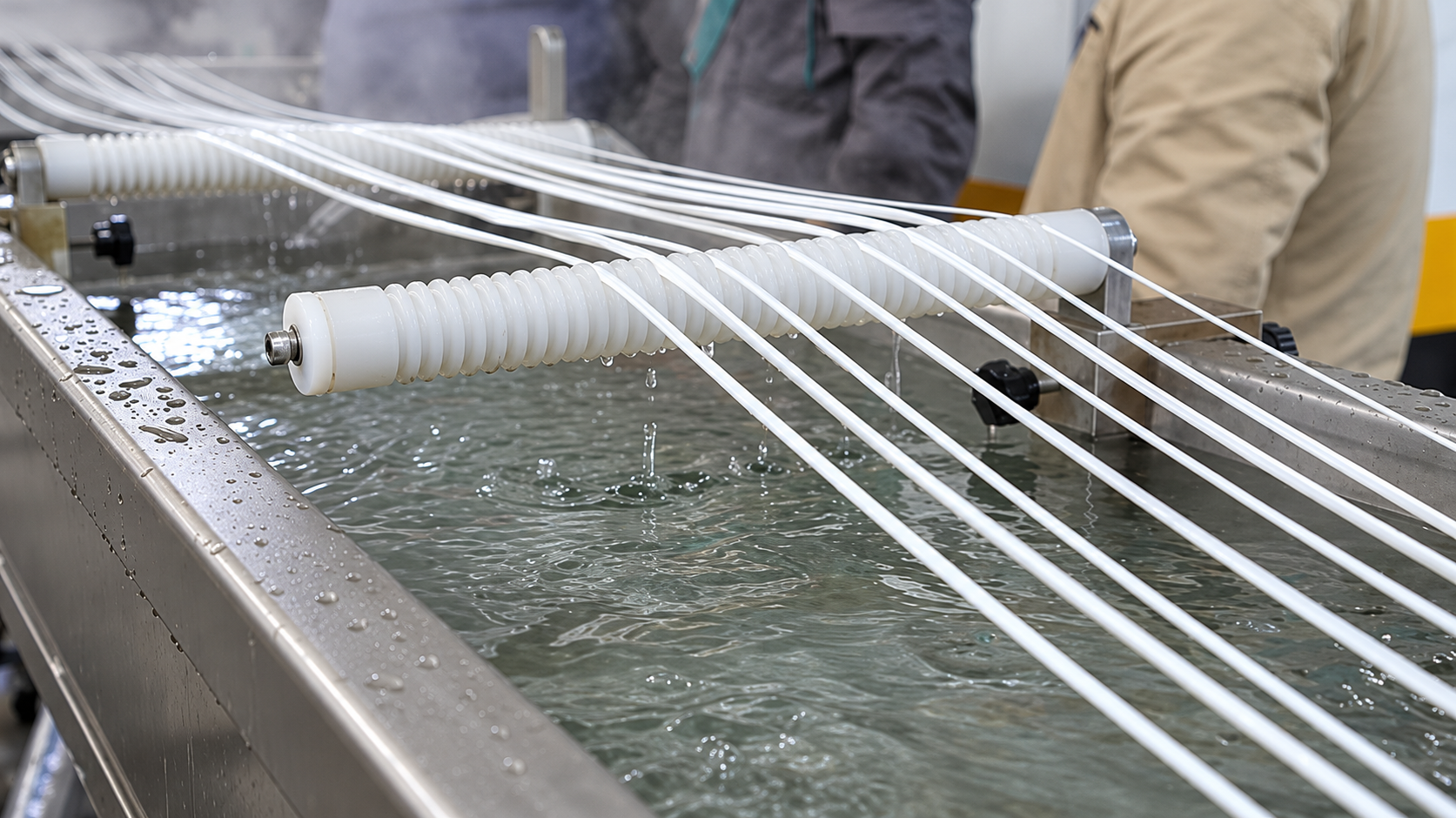
The highly filled melt is cut at the die face against a rotating water ring and the pellets are spun dry immediately. With melt strength this low, strand running is not a realistic alternative on most grades.
-
Classification and packing
Fines and doubles are screened out before the pellets reach silo or bag. Lines without silo storage pack straight from classification; either way, dusty masterbatch is exactly what the customer’s own dosing equipment then suffers from.
Requirements
What the process demands, and what quality is judged on
Critical process requirements
1. Enclosed powder handling from intake to dosing: coated calcium carbonate is received in bags or silos and moved in sealed equipment with dust extraction at the transfer points. Every kilogram lost to the workshop air is both a yield loss and a housekeeping problem, and open powder handling is the usual root cause of inconsistent premixes.
2. Coating quality before compounding: the wetting layer on the mineral surface decides how the powder behaves in the melt. Where powder is coated in-house, dispersion of the coating agent in the hot mixing stage is controlled by temperature and residence time; an under-coated powder reappears downstream as filter loading and surface specks.
3. Air and moisture management at the vent: powder-rich recipes carry a great deal of air and surface moisture into the extruder. The vent strip has to remove both continuously, because a melt carrying dispersed air loses output stability and pellet quality long before anyone sees a visible defect.
4. Wear management on the melt path: at this mineral loading the melt is abrasive, so metallurgy, barrel sections and the spare-parts plan are set with wear in mind from the first day, not after the first refurbishment.
5. Filtration discipline before the die: screens are changed at a set differential pressure rather than when trouble appears, so the die face and the customer’s downstream process are protected without the filtration step dictating the shift plan.
6. Pelletizing matched to a stiff, low-strength melt: die-face cutting with immediate pellet cooling and thorough drying replaces strand running, and the classifier takes out fines and doubles before pellets reach silo or bag.
Quality requirements
Verification concentrates on what filler customers actually pay for: mineral loading confirmed by ash content against the declared recipe, coarse grit controlled by sieve residue, moisture at packing low enough for the customer’s storage and dosing, a melt-flow value inside the grade’s window, and free-flowing pellets without doubles or fines. The pass/fail numbers and the test methods are fixed with the customer for each grade — this profile deliberately quotes no generic thresholds, because tolerances follow the downstream application.
Selection
What decides the equipment in this scenario
These are the questions a quotation is built from — answering them up front shortens the first round.
- Enclosed powder intake and storage
- Bag-dumping stations with dust extraction or silo delivery; the powder side is designed before the extruder side, because every downstream number follows the powder.
- High-speed hot/cold premixing combination
- Hot stage for coating dispersion where powder is coated in-house; cold stage to discharge a free-flowing premix cool enough not to cake in transfer.
- Gravimetric dosing group
- Separate weighing for carrier pellets and premix so the recipe ratio survives a full shift, with records the operator can reconcile at end of shift.
- Twin-screw extruder sized for abrasive duty
- Wear-oriented metallurgy and barrel sections, a vent for air and moisture, and a filtration flange in the melt line before the die.
- Hydraulic screen changer
- Plate change at a set differential pressure with the melt flowing, so filtration protects the die without pacing production.
- Water-ring die-face pelletizer with centrifugal dryer
- Cutting at the die face against a rotating water ring, with pellets dried immediately and thoroughly enough to flow into silo or bag without lumping.
- Classification and packing
- Vibratory screening for fines and doubles ahead of bagging or FIBC filling matched to the dispatch pattern.
Fit
Where this scenario fits — and where it does not
The boundaries are part of the scenario: they keep equipment from being quoted into a case it cannot serve.
Best fit when
Producers and toll compounders supplying filler masterbatch into PP woven sacks and raffia tape, PE film and shopping bags, pipes and injection moulding — especially where the masterbatch is bought to cut cost per tonne of finished product rather than to add function, and where the buyer judges it on loading consistency and free-flowing pellets.
Needs assessment when
Talc-dominant or ultrafine grades, carriers beyond standard polyolefins (including degradable or bio-based carriers), food-contact positions, or recipes that must deliver colour, UV or other functional performance on top of filling — those push the line past a standard filler masterbatch layout and deserve their own assessment.
Not suitable when
Producers whose real product is a colour or additive masterbatch — different dispersion logic, different changeover discipline. PVC dry-blend operations, which run a powder route with no pelletizing stage at all. And buyers who want high loading without budgeting enclosed powder handling or wear parts — the mineral share that makes the product cheap is the same share that punishes an open, under-equipped plant.
Variants
How the scenario splits
A variant is written down only where the process and the decision actually differ.
PE-carrier film grades
- How it differs
Carrier LLDPE or LDPE, with the masterbatch let down into blown or cast film at the converter.
- Process difference
PE carriers hold more melt strength than PP, so some producers still run strand pelletizing on PE grades; the die-face water-ring route is chosen when loading is pushed towards the top of the range and strand stability becomes unreliable.
- Output difference
Film-grade pellets judged above all on dispersion and specks, since the converter’s film is thin enough to show everything the masterbatch let through.
PP-carrier raffia and injection grades
- How it differs
Carrier homo-PP, with the masterbatch let down into woven tape and moulded articles.
- Process difference
Die-face cutting is the normal choice, because PP grades at this loading lose strand strength quickly; drying and classification are watched closely, since tape lines punish dusty or lumpy masterbatch immediately at the tape line.
- Output difference
Pellets tuned for tape lines and moulding shops: consistent loading for tape tenacity, free flow for volumetric dosing on the customer’s side.
Before an inquiry
What we need to know to quote this scenario
- 01 Powder specification Fineness (mesh), coating status — coated as purchased or to be coated in-house, and with which agent — plus moisture and bulk density of the actual powder.
- 02 Recipe and carrier split Carrier polymer and share, the additive package, and the declared mineral loading the masterbatch must carry.
- 03 Quality acceptance method How loading (ash), grit and moisture will be verified, and the tolerances the customer's own customers hold them to.
- 04 Packing and dispatch pattern Bag or FIBC, batch sizes, and whether pellets are held in silos before dispatch.
Request a Quote Send these points with your inquiry; the scenario can then be quoted against your line, not against an assumption.